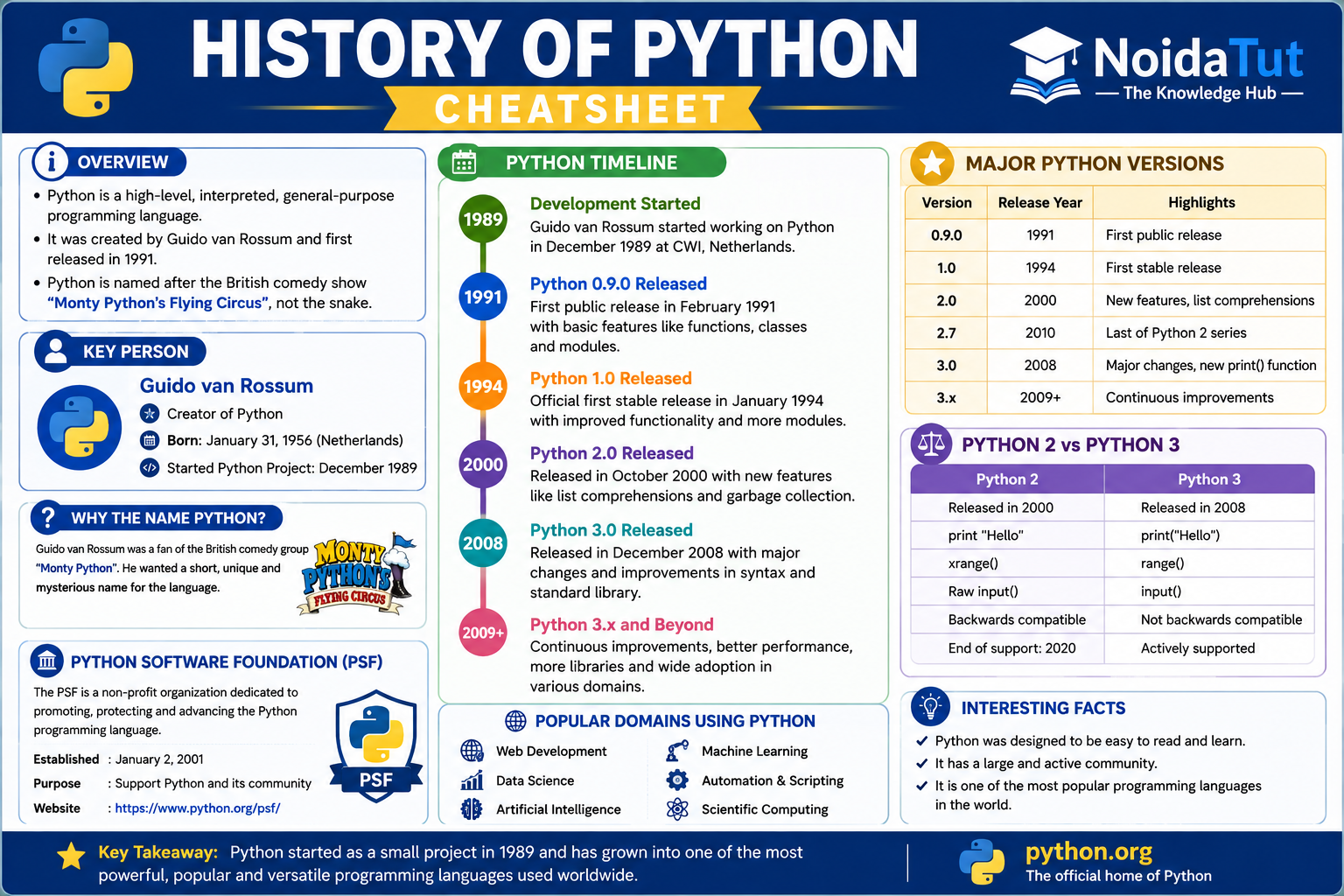
History and Evolution of Python Programming Language
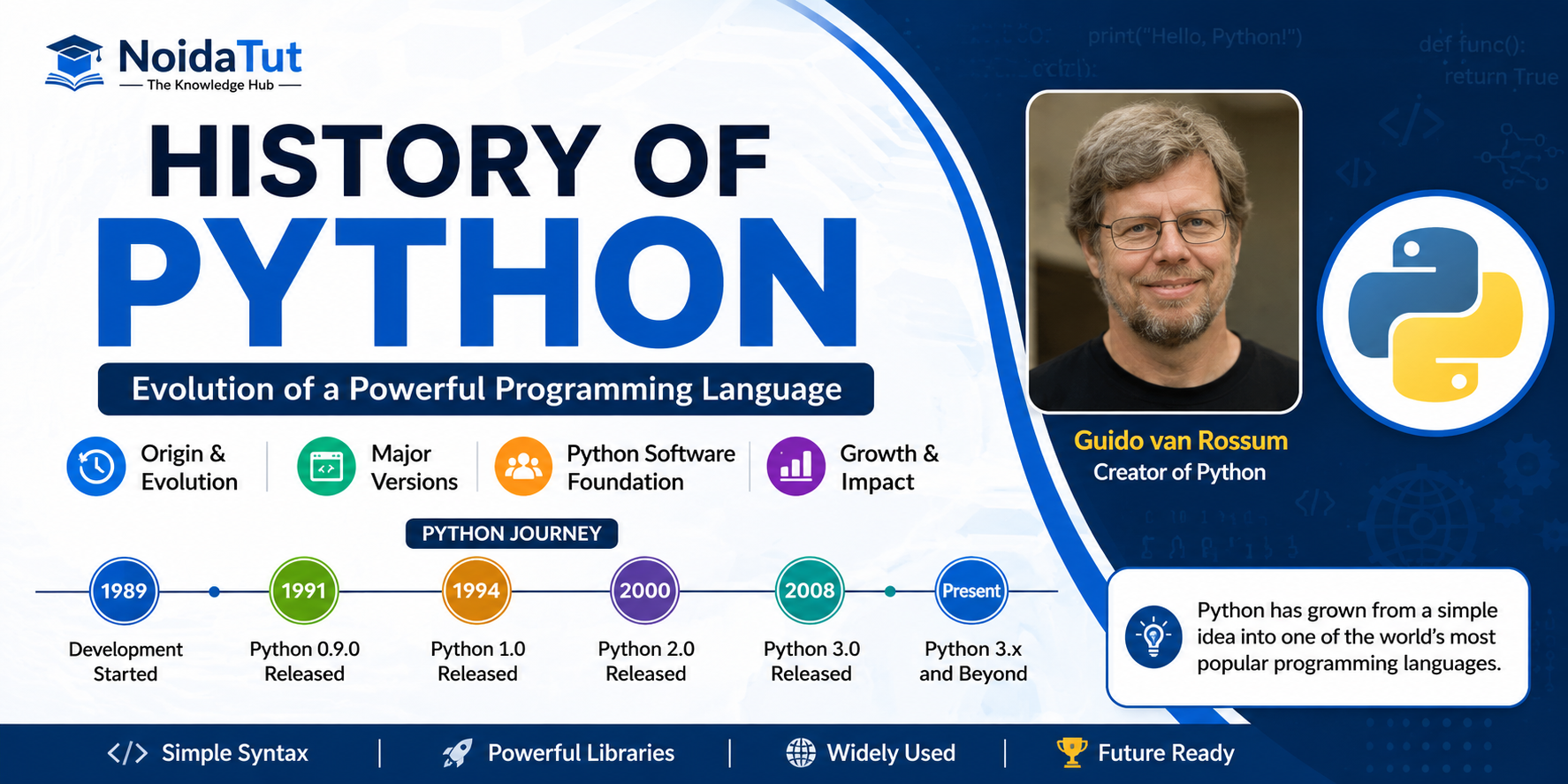
Introduction
Python is one of the world's most popular programming languages today. Millions of students, software engineers, data scientists and researchers use Python for developing different kinds of software applications.
However, Python was not created overnight. It is the result of years of planning and development by a talented computer programmer who wanted to make programming simple, readable and enjoyable.
In this tutorial, we shall learn the complete history of Python, including its origin, creator, development, important versions and major milestones.
Learning Objectives
After completing this tutorial, students will be able to:
- Know who developed Python.
- Understand why Python was created.
- Know when Python was introduced.
- Understand the evolution of Python.
- Learn important Python versions.
- Prepare AKTU examination questions.
Who Developed Python?
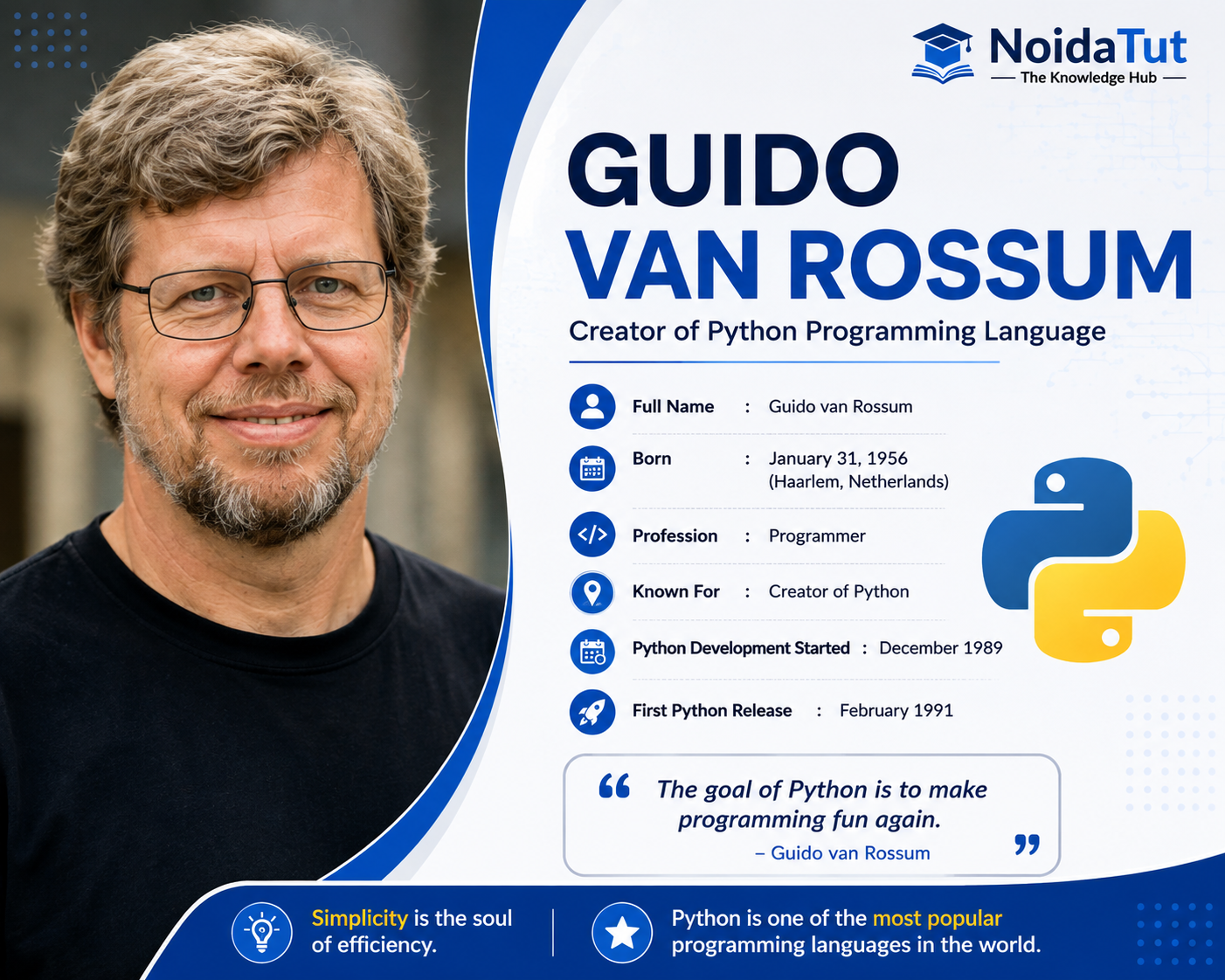
Python was developed by Guido van Rossum, a famous Dutch computer programmer. He started working on Python during the Christmas holidays in December 1989 while working at the Centrum Wiskunde & Informatica (CWI) located in the Netherlands.
His aim was to develop a programming language that was easier to read, easy to write and more productive than many existing programming languages.
Why Was Python Developed?
During the late 1980s, many programming languages were difficult to learn because they required lengthy and complex syntax. Guido van Rossum wanted to solve this problem by creating a language that would be:
- Easy to Learn
- Easy to Read
- Easy to Write
- Highly Productive
- Suitable for Beginners
- Powerful for Professional Developers
The result of this vision was Python—a programming language that combines simplicity with powerful programming capabilities.
Why is Python Called "Python"?
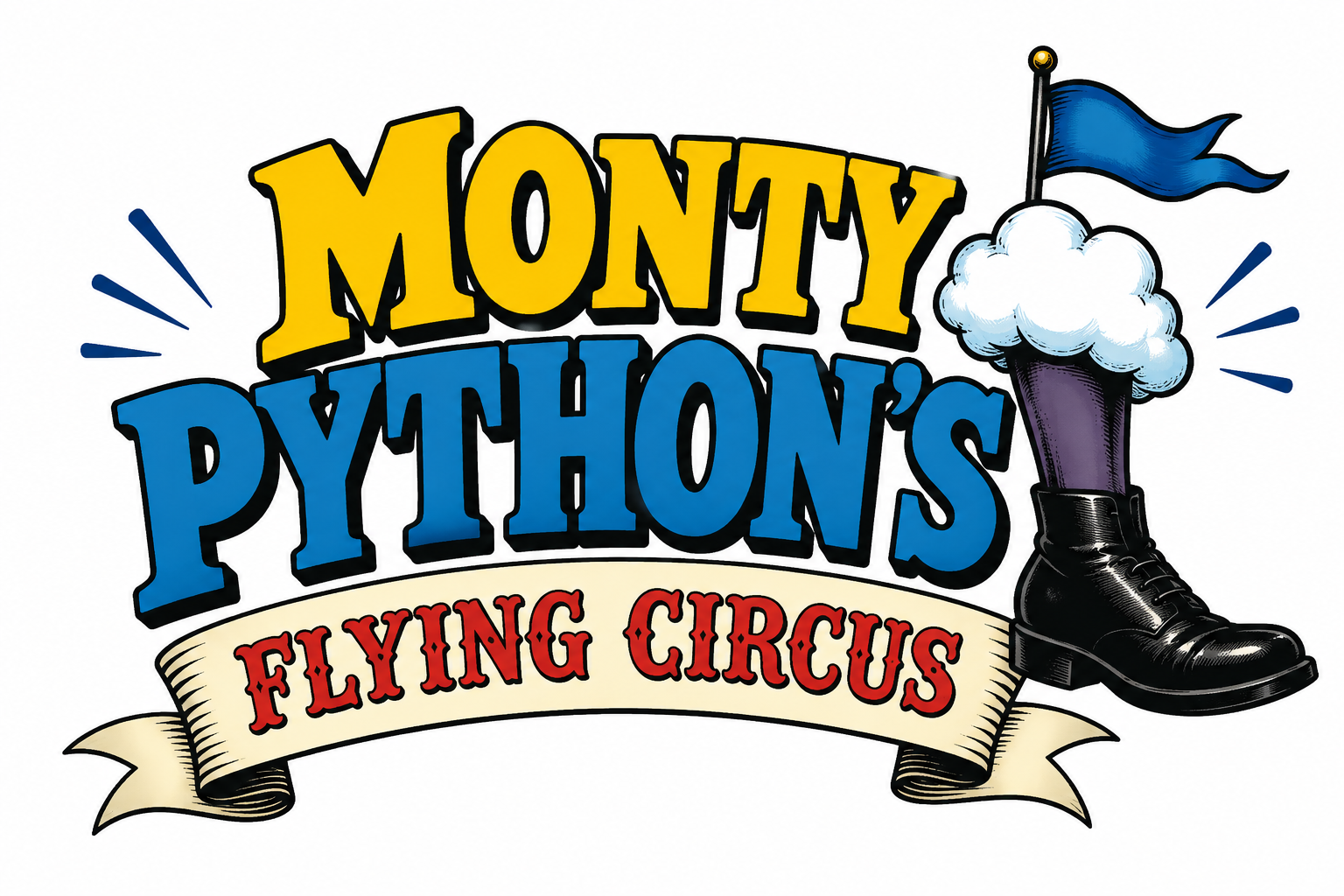
Many beginners believe that Python is named after the Python snake. This is not true.
Guido van Rossum was a fan of the famous British comedy television series "Monty Python's Flying Circus." While searching for a short, unique and memorable name for his new programming language, he chose the word "Python" from this television show.
Python Development Timeline
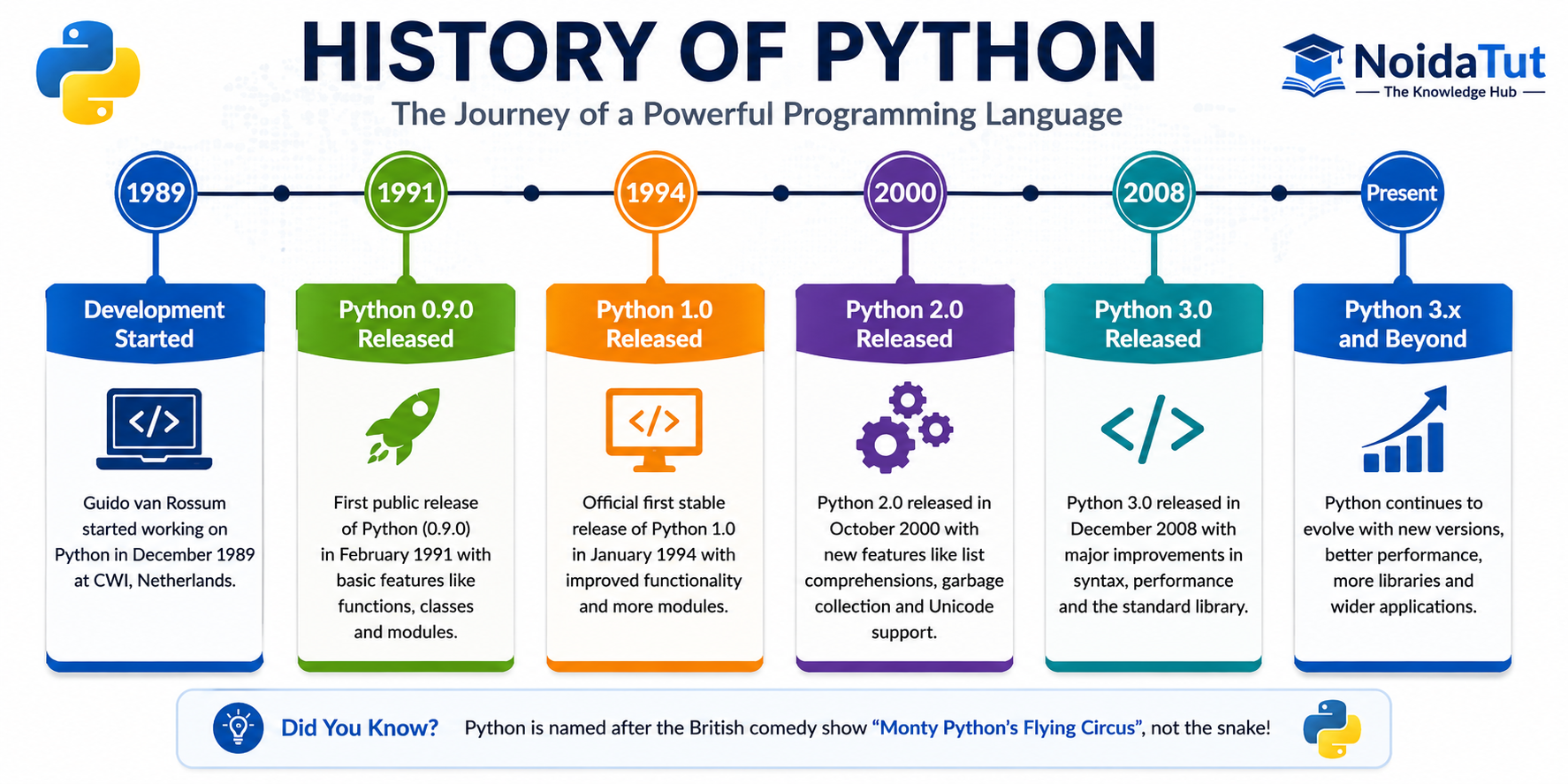
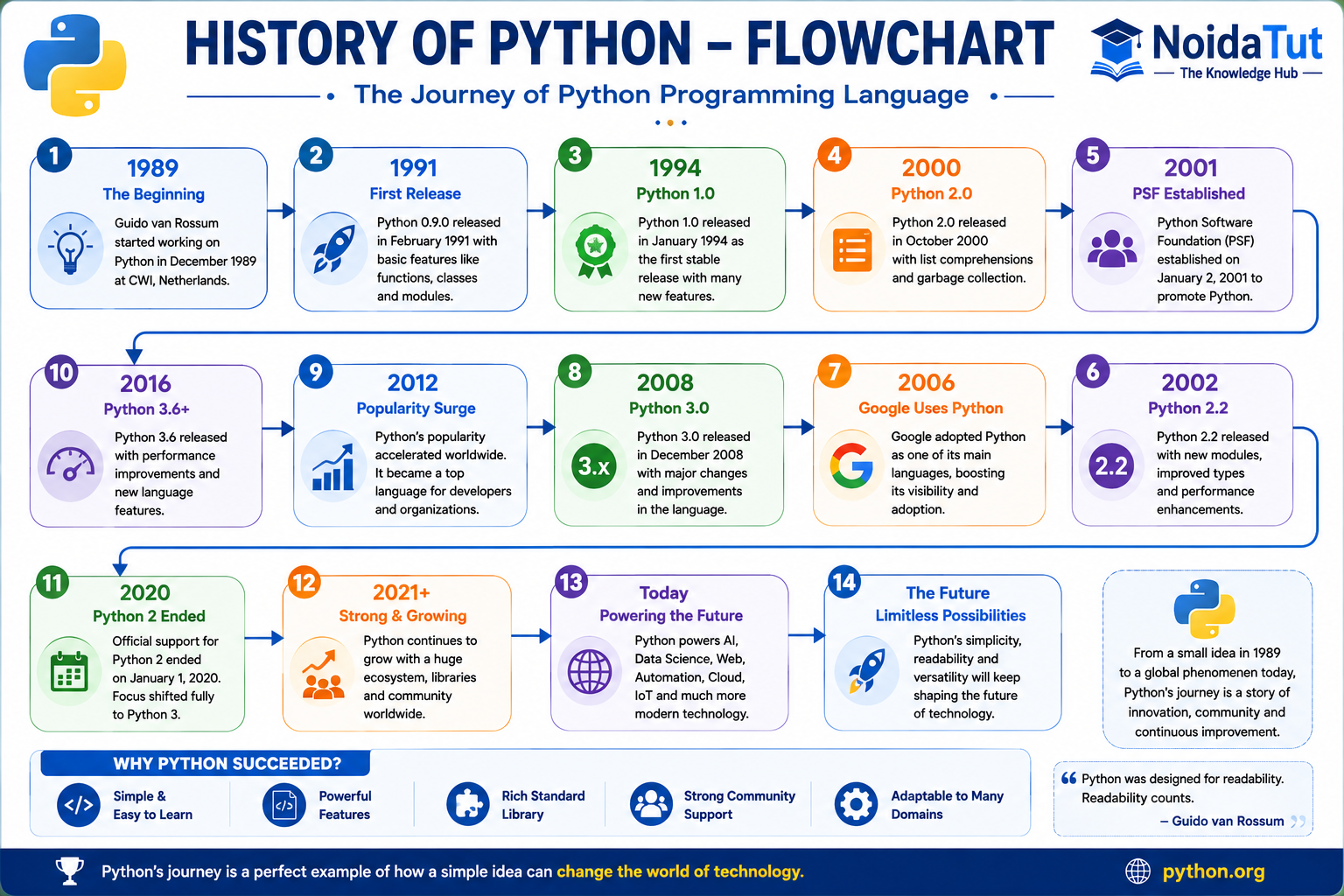
The following table shows the important milestones in the history of Python.
| Year | Major Event |
|---|---|
| 1989 | Guido van Rossum started developing Python. |
| 1991 | Python Version 0.9.0 was released to the public. |
| 1994 | Python 1.0 officially released. |
| 2000 | Python 2.0 introduced many powerful features. |
| 2008 | Python 3.0 released with major improvements. |
| Present | Python is among the most popular programming languages in the world. |
Evolution of Python
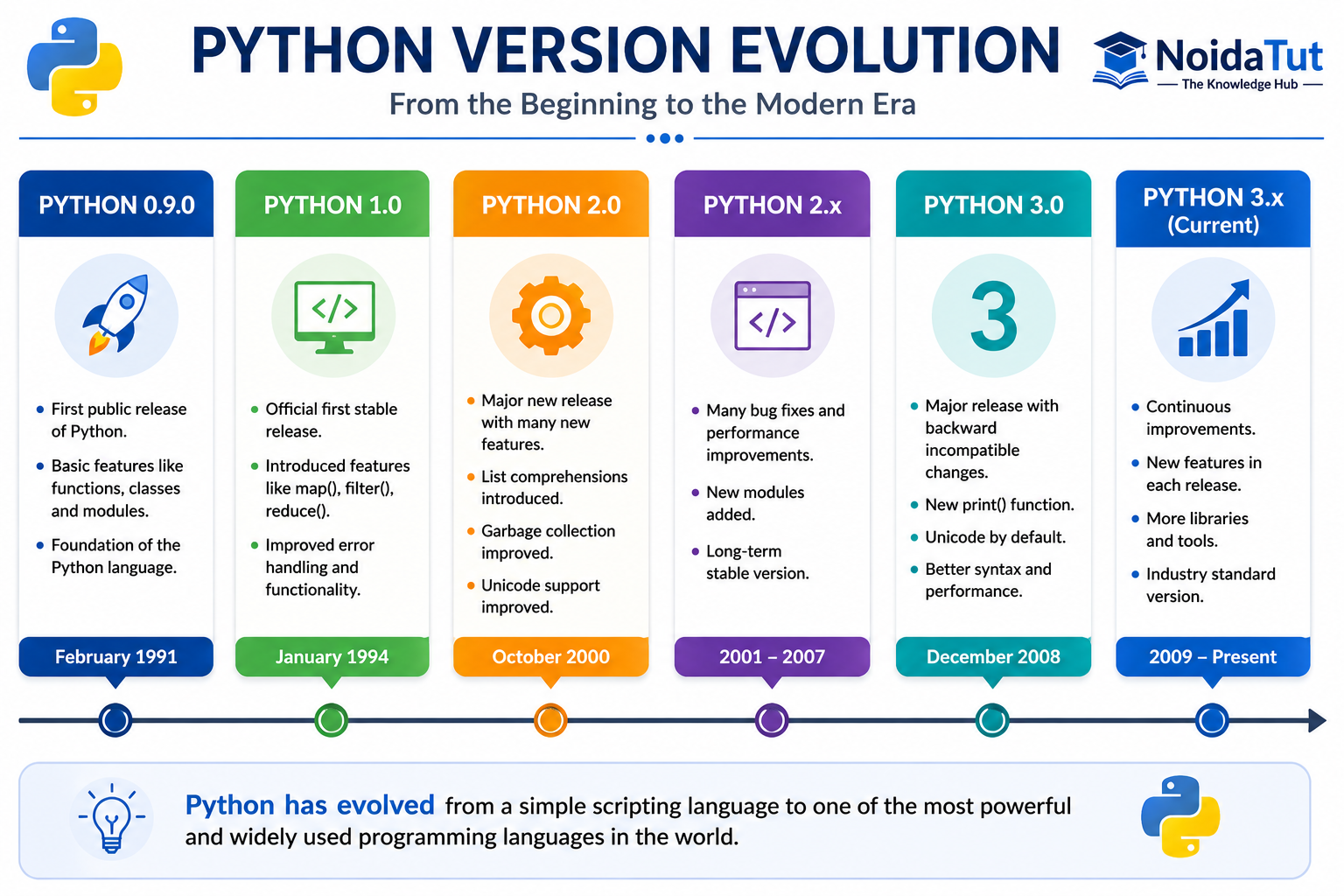
Python has continuously evolved since its first release. Every major version introduced new features, improved performance and made the language more powerful while maintaining its simplicity.
Today, Python is used in Artificial Intelligence, Data Science, Machine Learning, Robotics, Cloud Computing, Web Development, Cyber Security and many other emerging technologies.
Major Versions of Python
| Version | Important Features |
|---|---|
| Python 0.9.0 (1991) |
First public release containing:
|
| Python 1.0 (1994) |
Official first stable release with improved functionality and greater community support. |
| Python 2.0 (2000) |
Introduced:
|
| Python 3.0 (2008) |
Major redesign of Python with:
|
| Python 3.x | Current versions continue to improve speed, security, libraries and developer productivity. |
Python Software Foundation (PSF)
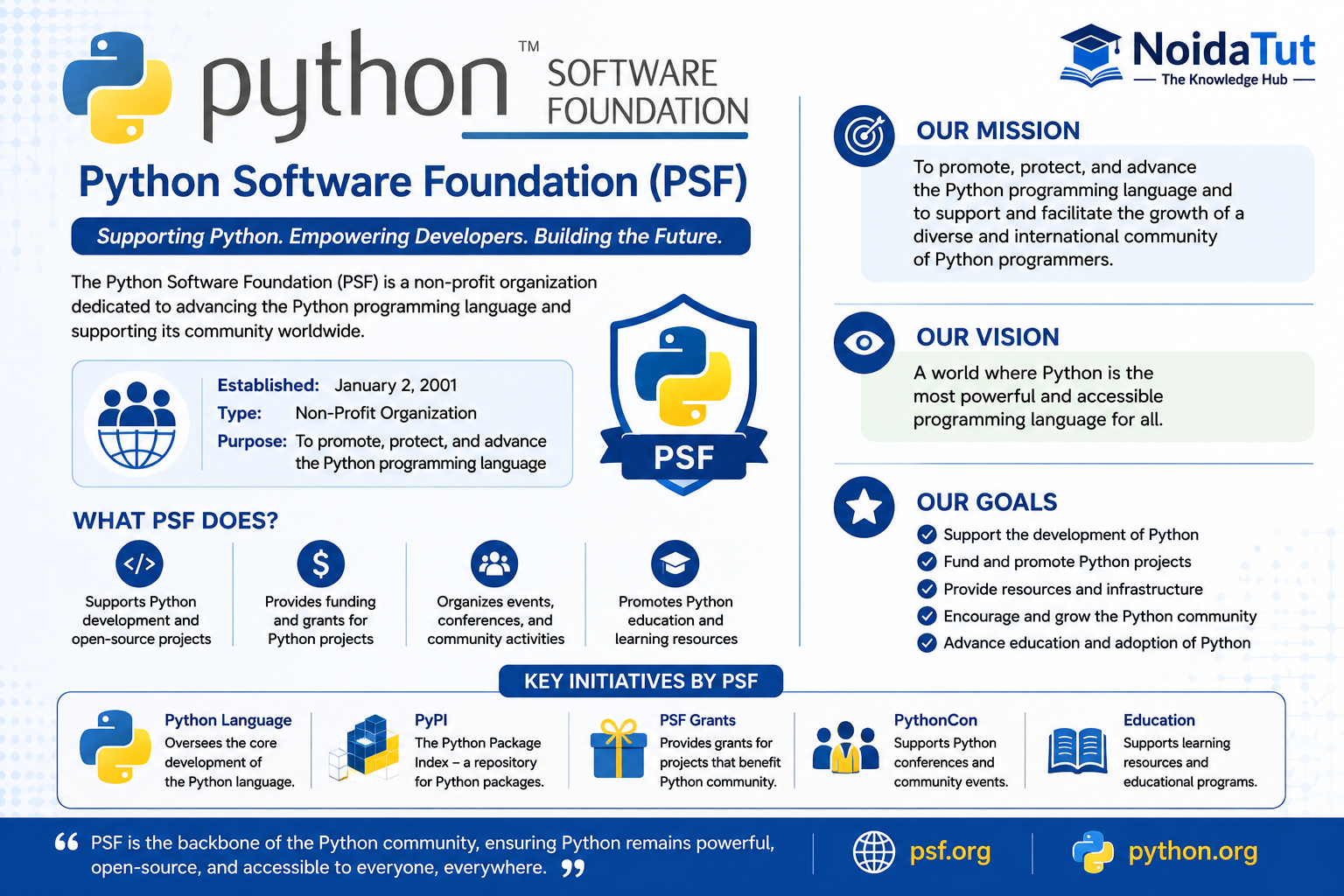
The Python Software Foundation (PSF) is a non-profit organization responsible for supporting and promoting Python throughout the world.
The PSF manages the development of Python, protects the Python trademark, organizes conferences, supports developers and encourages the growth of the Python community.
Why Did Python Become So Popular?
Python became popular because it solved many problems faced by programmers.
| S.No. | Reason | Explanation |
|---|---|---|
| 1 | Simple Syntax | Easy to learn and understand. |
| 2 | Less Coding | Programs require fewer lines compared to C and Java. |
| 3 | Open Source | Free for everyone to use. |
| 4 | Huge Libraries | Thousands of built-in and third-party libraries. |
| 5 | Cross Platform | Runs on Windows, Linux and macOS. |
| 6 | Industry Demand | Used by leading technology companies worldwide. |
| 7 | AI & Data Science | One of the preferred languages for Artificial Intelligence and Machine Learning. |
Companies Using Python
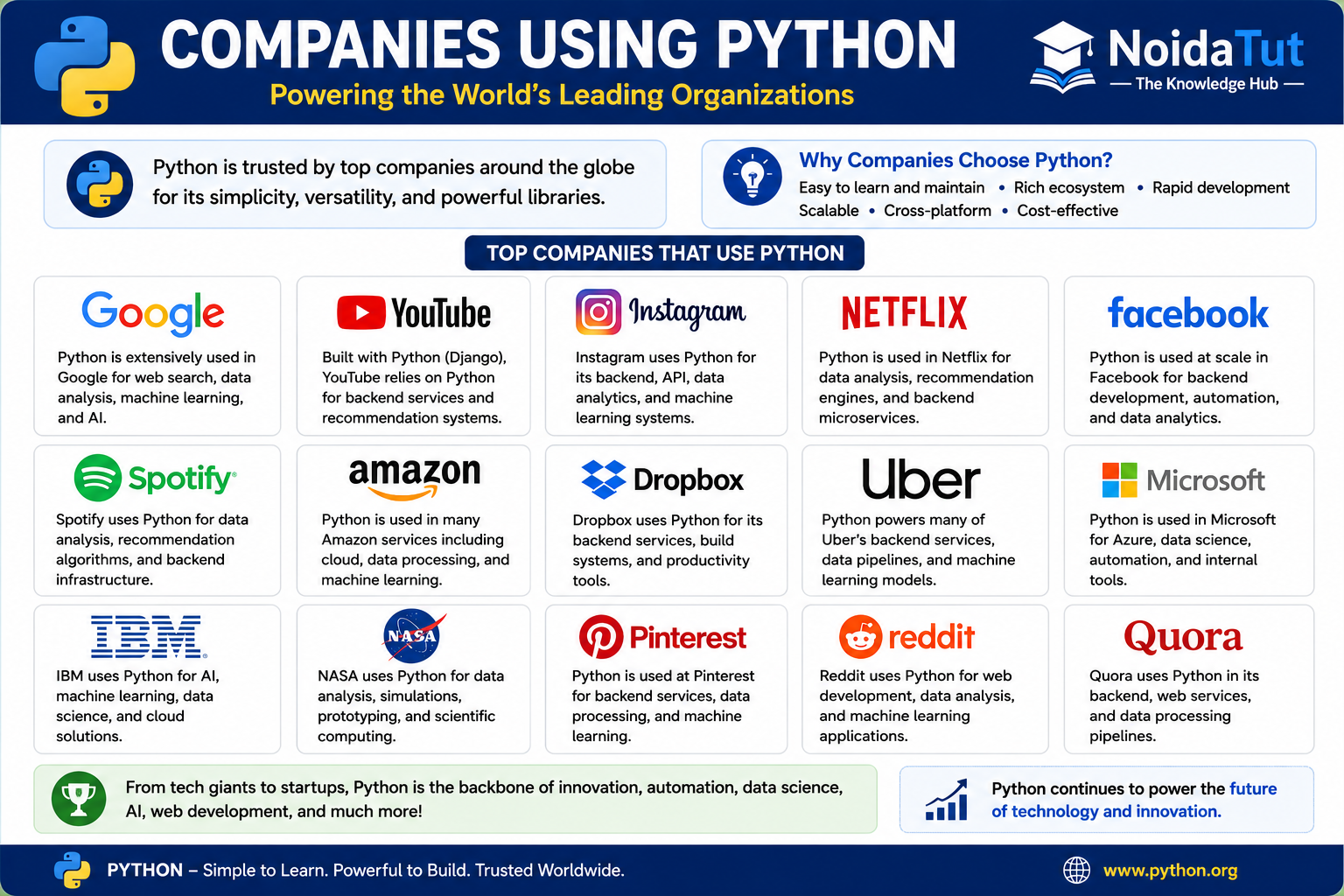
Many world-famous companies use Python for developing their software and online services.
Netflix
Spotify
Dropbox
NASA
Amazon
Interesting Facts About Python
Python 2 vs Python 3
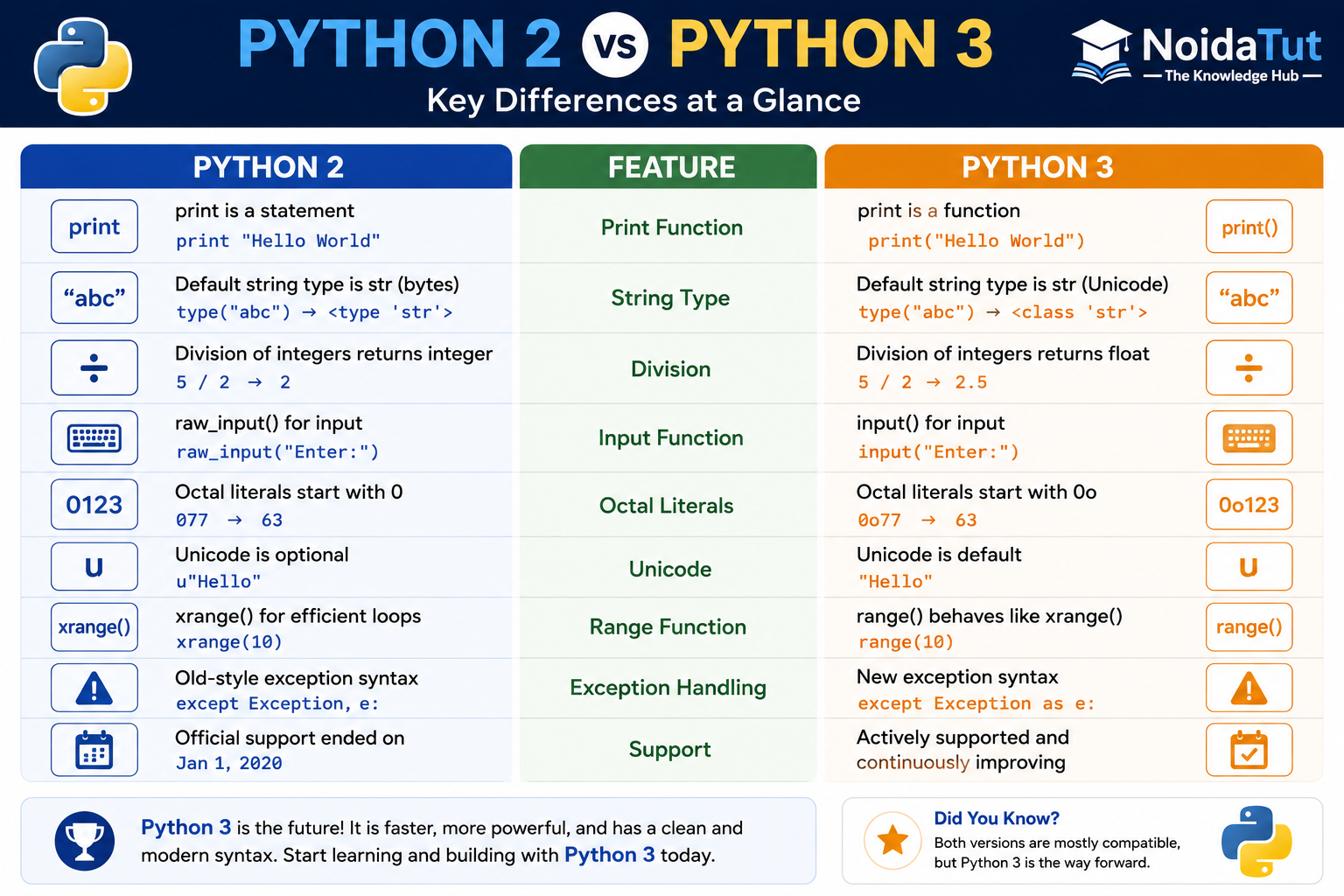
Python 2 and Python 3 are two major versions of the Python programming language. Python 3 was developed to overcome several limitations of Python 2 and to provide a cleaner, more efficient programming language. Today, Python 3 is the recommended version for all new projects.
| Feature | Python 2 | Python 3 |
|---|---|---|
| Release Year | 2000 | 2008 |
| Current Status | Discontinued | Actively Supported |
| print Statement | print "Hello" | print("Hello") |
| Unicode Support | Limited | Improved |
| Performance | Good | Better |
| Recommended | No | Yes |
Growth of Python

Over the last three decades, Python has experienced remarkable growth. Initially developed as a simple scripting language, it has evolved into one of the most widely used programming languages across academia, industry and research.
Its popularity increased because of its simplicity, rich ecosystem of libraries and its adoption in rapidly growing fields such as Artificial Intelligence, Machine Learning and Data Science.
Python in Modern Technologies

Today Python is used in almost every modern technology.
Artificial Intelligence
Develop intelligent systems capable of learning and decision making.
Machine Learning
Develop predictive models and recommendation systems.
Data Science
Analyse large datasets and generate useful insights.
Cyber Security
Develop penetration testing and security automation tools.
Cloud Computing
Develop cloud-based applications and automation scripts.
Automation
Automate repetitive tasks using simple Python scripts.
History of Python - Flowchart
Common Mistakes Made by Beginners
- Thinking Python is named after the snake.
- Confusing Python 2 with Python 3.
- Writing Python 2 syntax in Python 3 programs.
- Assuming Python was developed recently.
- Believing Python is only used for web development.
Key Points to Remember
AKTU Important Questions with Answers
The following questions are frequently asked in AKTU semester examinations. Students should prepare these questions carefully.
Interview Questions
- Who developed Python?
- When was Python first released?
- Why was Python developed?
- Why is Python named "Python"?
- What is the Python Software Foundation?
- Which version of Python should be used today?
- Why is Python popular worldwide?
- Name some companies that use Python.
Viva Questions
- Who is Guido van Rossum?
- When did Python development begin?
- Where was Python developed?
- Which country does Guido van Rossum belong to?
- What was the first public version of Python?
- What is PSF?
- Why is Python called Python?
- Is Python named after a snake?
- Which version is recommended today?
- Name any three applications of Python.
Multiple Choice Questions (MCQs)
-
Python was developed by
- (A) Dennis Ritchie
- (B) James Gosling
- (C) Guido van Rossum ✔
- (D) Bjarne Stroustrup
-
Python development started in
- (A) 1985
- (B) 1989 ✔
- (C) 1995
- (D) 2000
-
The first public release of Python was in
- (A) 1989
- (B) 1991 ✔
- (C) 1995
- (D) 2000
-
Python is named after
- (A) A Snake
- (B) Monty Python's Flying Circus ✔
- (C) A Mountain
- (D) A Computer
-
Python is maintained by
- (A) Google
- (B) Microsoft
- (C) Python Software Foundation ✔
- (D) Oracle
Practice Questions
- Write a short note on the history of Python.
- Explain the evolution of Python.
- Differentiate Python 2 and Python 3.
- Write the major milestones in Python's development.
- Explain the role of the Python Software Foundation.
- Why is Python one of the most popular programming languages?
- Write five interesting facts about Python.
- Explain why Python is named "Python".
Summary