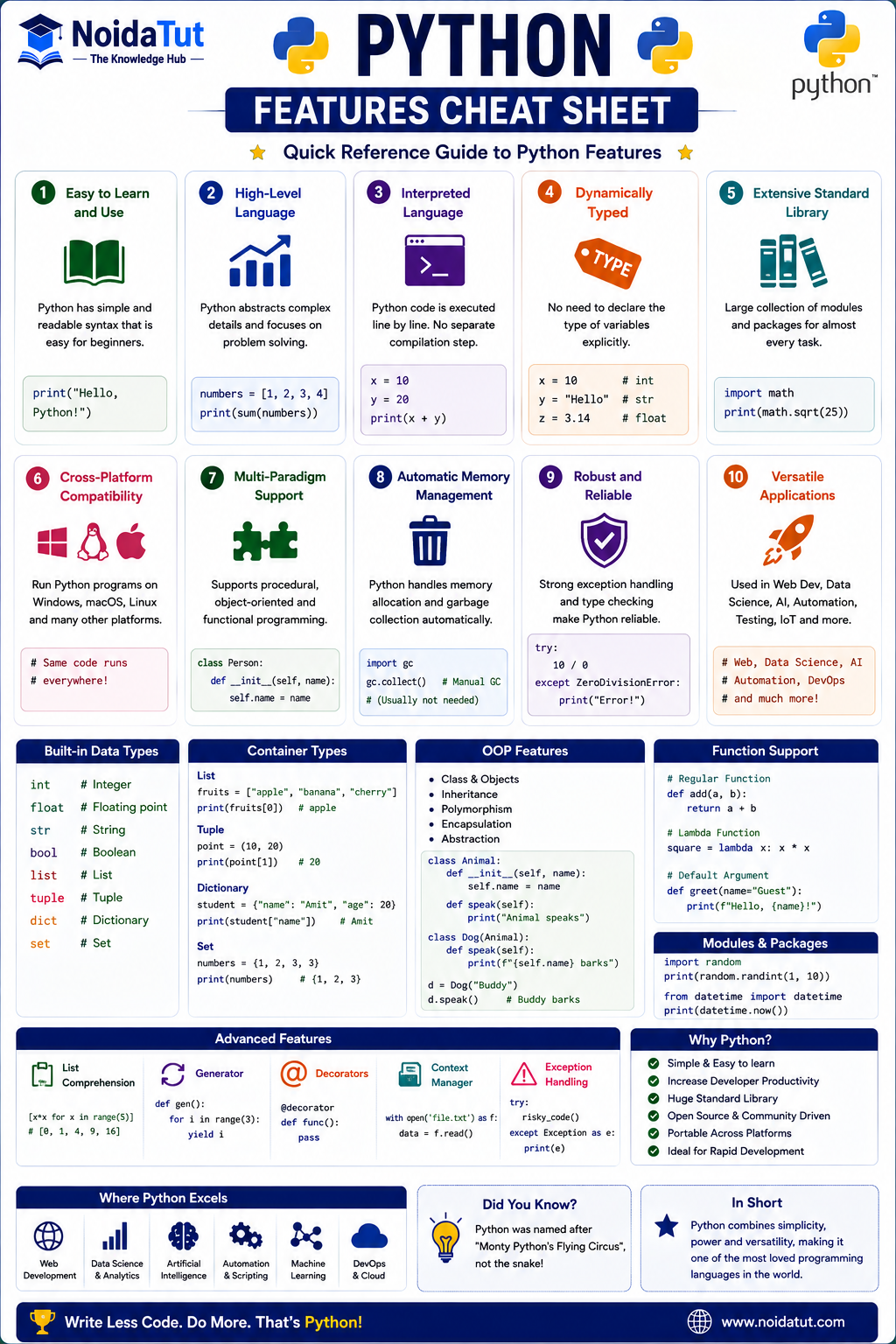
Features of Python
Important Features and Characteristics of Python Programming Language
Introduction
Python has become one of the most popular programming languages in the world because of its powerful features. These features make Python easy to learn, easy to write and easy to maintain.
Unlike many traditional programming languages, Python allows programmers to develop applications using fewer lines of code while maintaining high readability and performance. It supports multiple programming paradigms and provides a rich collection of built-in libraries.
In this tutorial, we shall study the important features of Python in simple language with suitable examples and illustrations.
Learning Objectives
After completing this tutorial, students will be able to:
- Understand the major features of Python.
- Explain why Python is easy to learn.
- Differentiate Python from other programming languages.
- Understand Python's advantages for software development.
- Prepare AKTU examination questions.
What are the Features of Python?

The term Features of Python refers to the special characteristics that make Python different from other programming languages.
These features help programmers develop software quickly, write clean programs and solve complex problems with minimum effort.
Main Features of Python
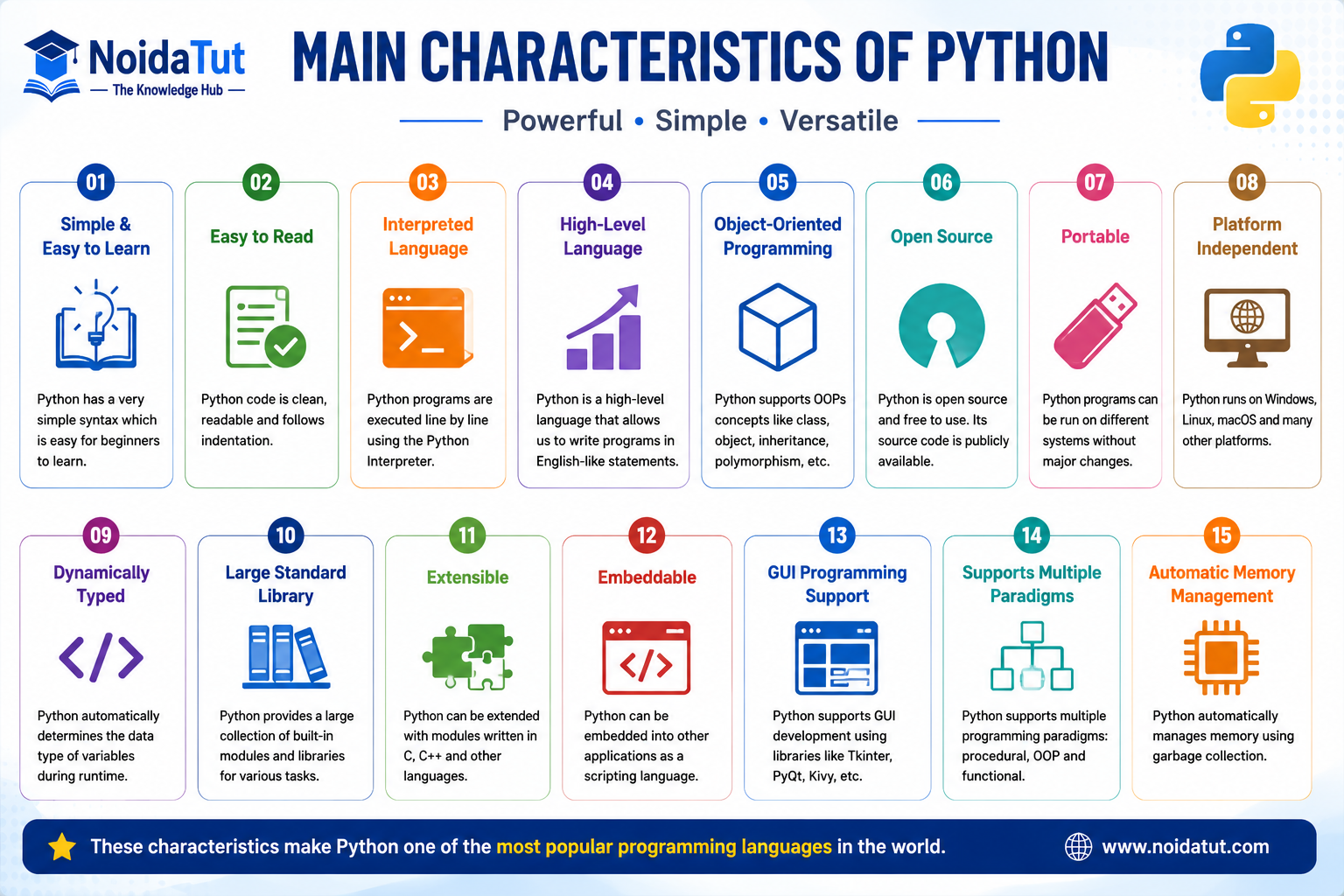
The major features of Python are:
- Simple and Easy to Learn
- Easy to Read
- Interpreted Language
- High-Level Language
- Object-Oriented
- Open Source
- Portable
- Platform Independent
- Dynamically Typed
- Large Standard Library
- Extensible
- Embeddable
- Free to Use
- Supports GUI Programming
- Supports Multiple Programming Paradigms
Overview of Python Features
| Feature | Description |
|---|---|
| Simple Syntax | Python programs are easy to read and write. |
| Easy to Learn | Suitable for beginners as well as professionals. |
| Interpreted | Programs are executed line by line by the Python Interpreter. |
| Object-Oriented | Supports classes, objects, inheritance and polymorphism. |
| Portable | Programs can run on different operating systems. |
| Open Source | Python is freely available to everyone. |
| Large Library | Thousands of built-in and third-party libraries are available. |
| Cross Platform | Runs on Windows, Linux and macOS without major changes. |
1. Simple and Easy to Learn
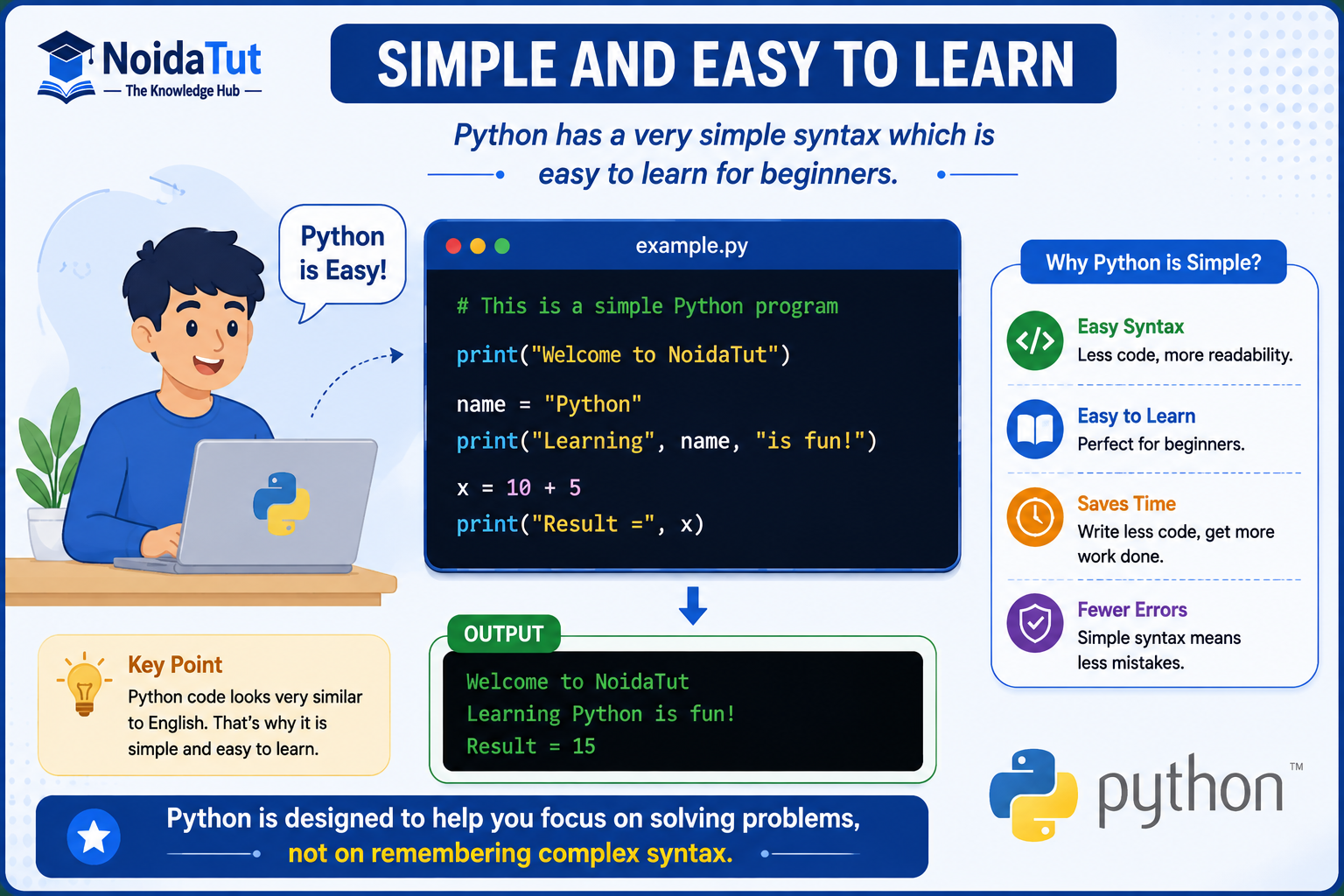
One of the biggest reasons behind Python's popularity is its simple and easy-to-understand syntax. Python programs look very similar to the English language, making them easy for beginners to read and write.
Unlike C or Java, Python does not require complex syntax, semicolons or curly braces. Therefore, students can concentrate on solving problems instead of remembering complicated language rules.
Example
print("Welcome to NoidaTut")
The above program contains only one line of code, yet it displays the message on the screen.
2. Easy to Read
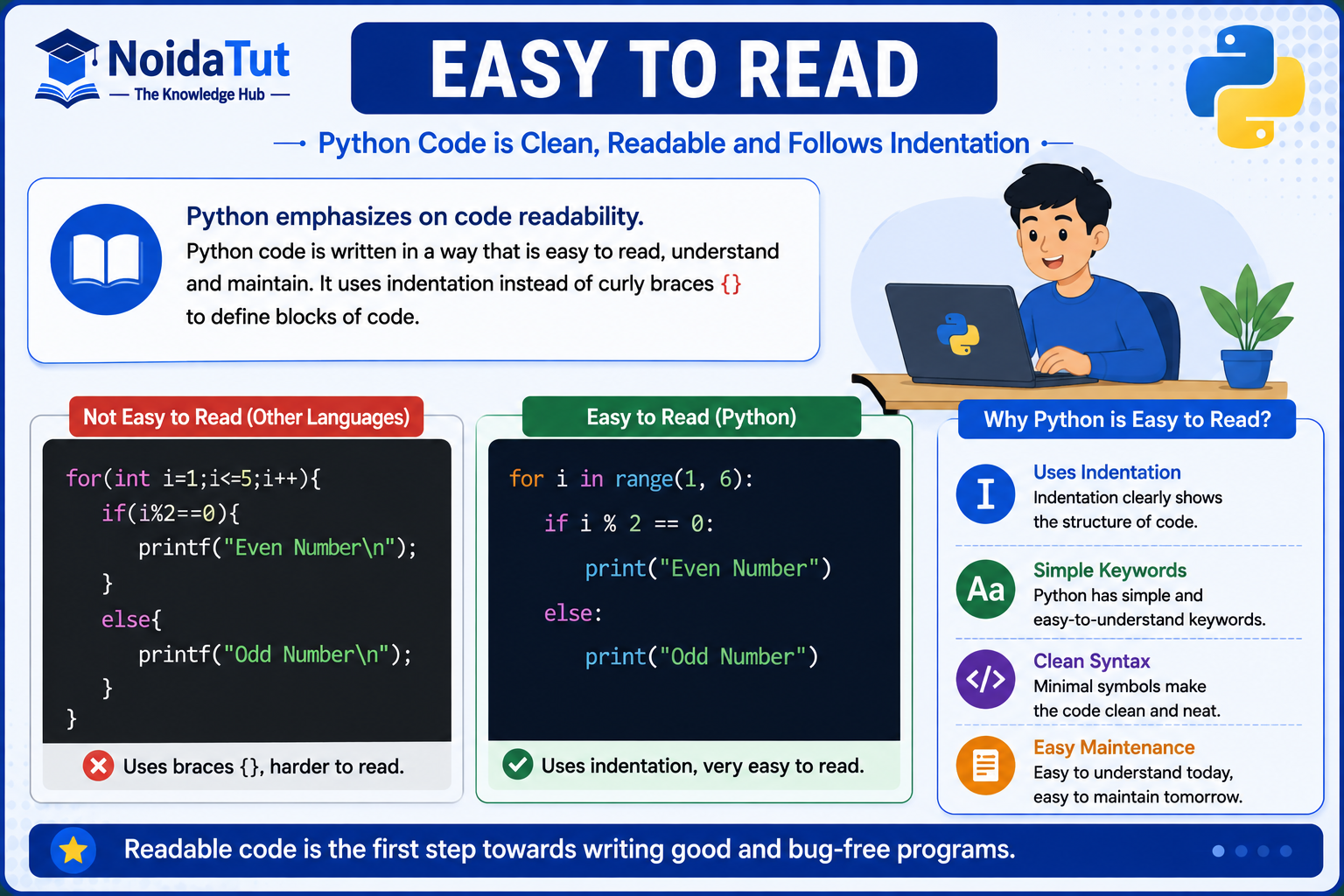
Python emphasizes code readability. Programs are written using proper indentation and meaningful keywords, making them easy to understand even after several years.
Because of its readability, Python is widely used in schools, universities and software companies.
3. Interpreted Language
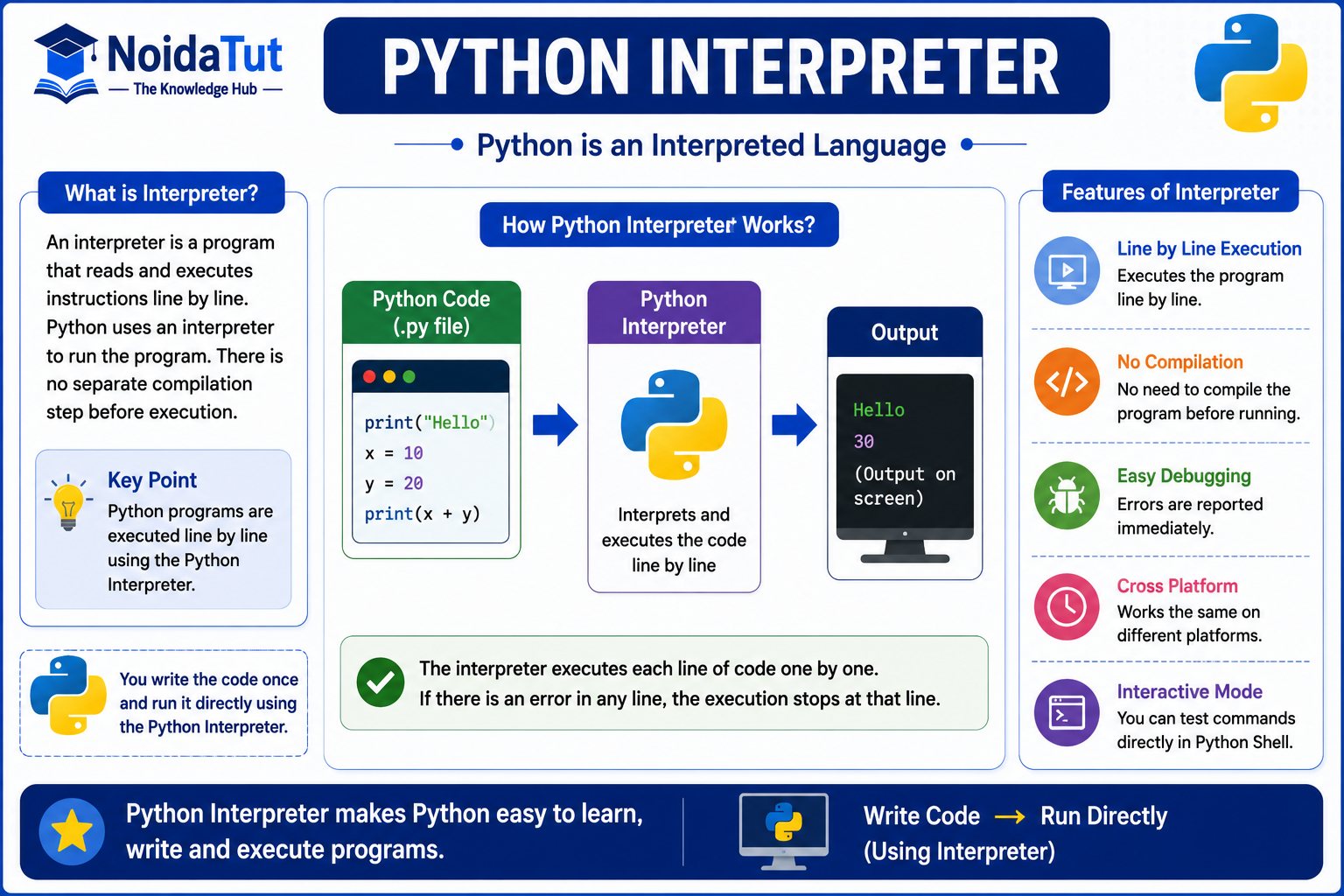
Python is an interpreted programming language. This means Python code is executed line by line using the Python Interpreter.
Unlike compiled languages, there is no need to compile the complete program before execution.
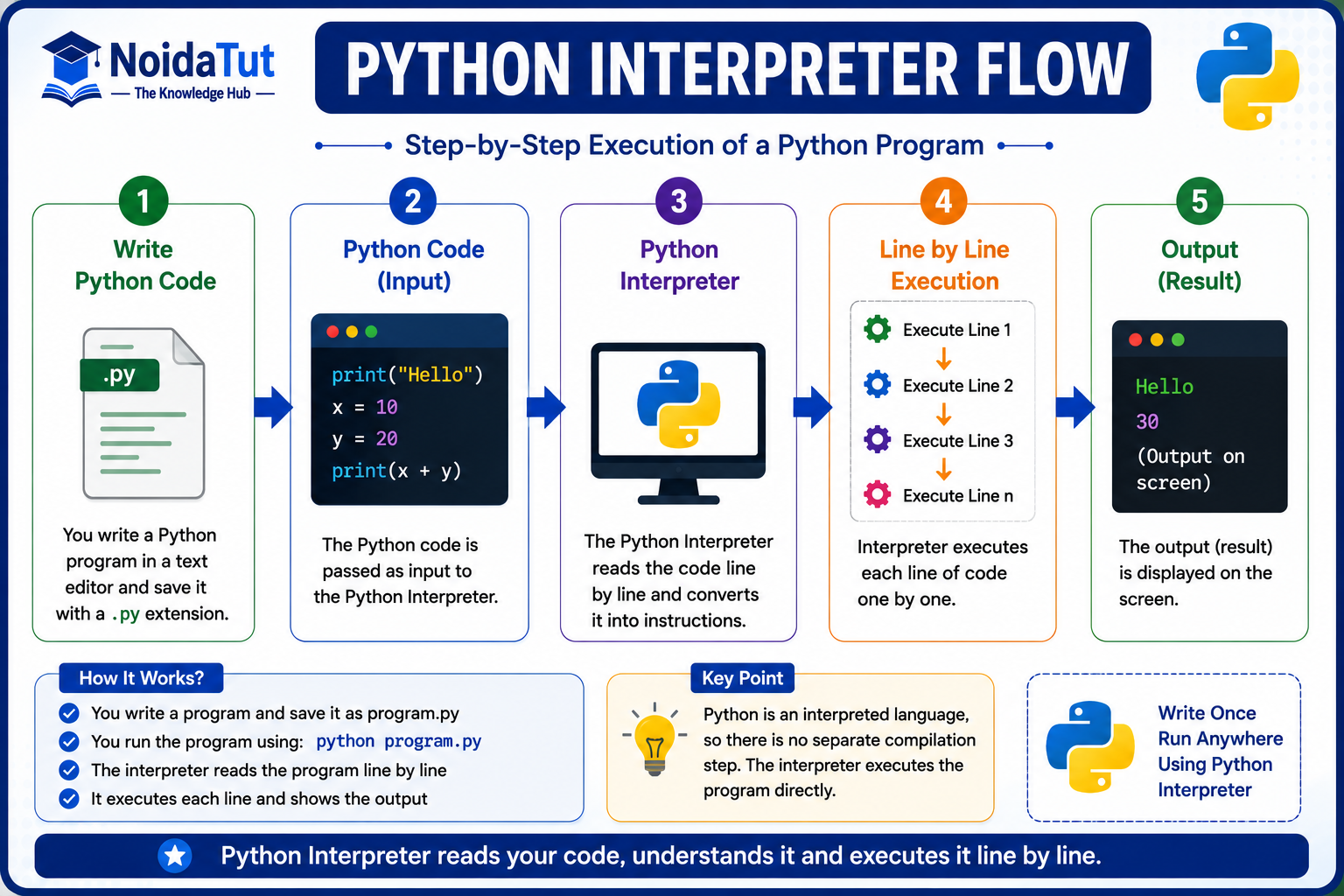
Execution Process
- Write Python Program
- Save Program
- Python Interpreter Reads Code
- Program Executes
- Output is Displayed
4. High-Level Programming Language

Python is a high-level programming language. It allows programmers to write programs using simple English-like statements instead of machine language or assembly language.
The Python Interpreter automatically converts high-level instructions into machine-understandable code.
5. Object-Oriented Programming Language
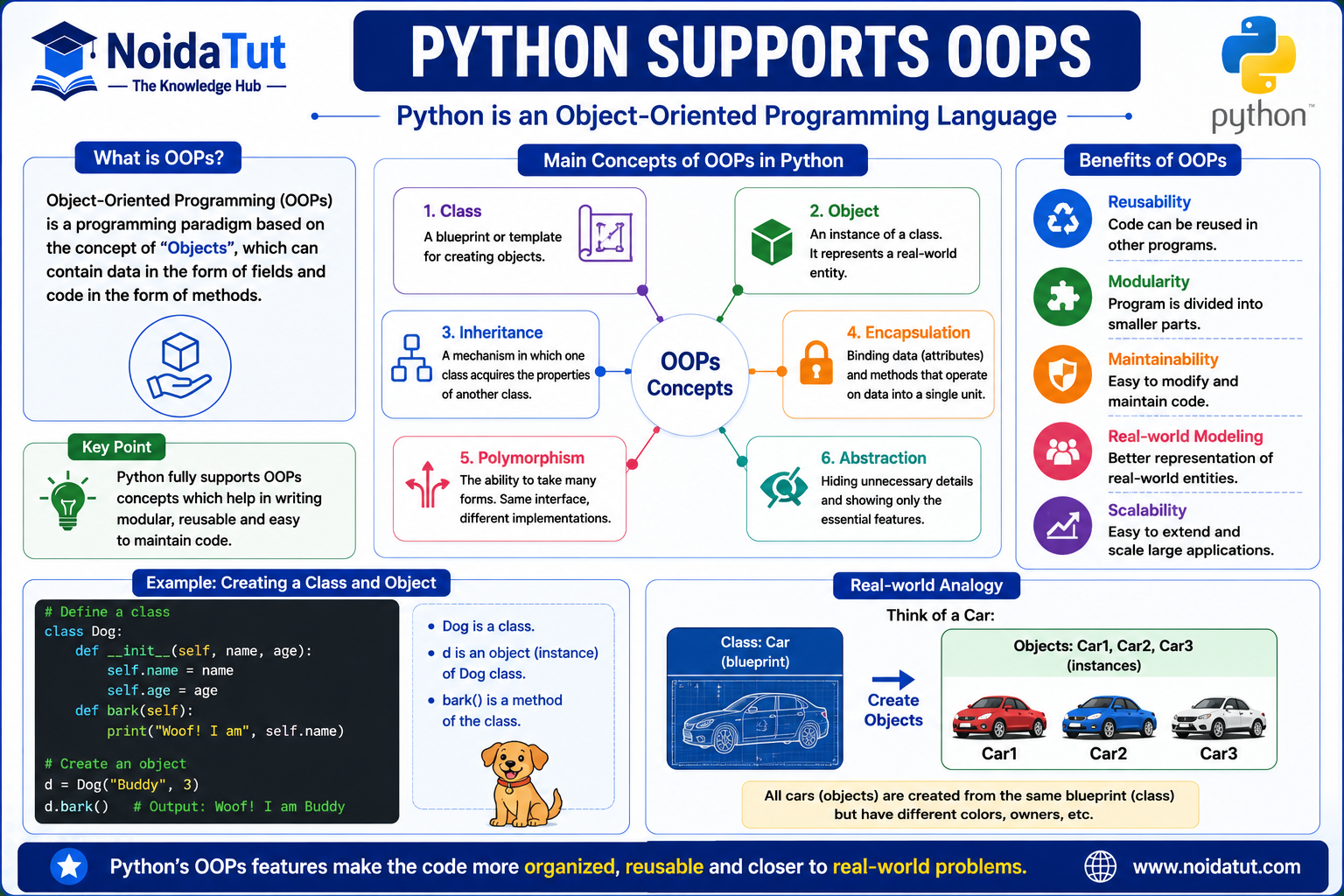
Python supports Object-Oriented Programming (OOP). It allows programs to be developed using classes and objects.
Python supports:
- Class
- Object
- Inheritance
- Polymorphism
- Encapsulation
- Abstraction
6. Open Source
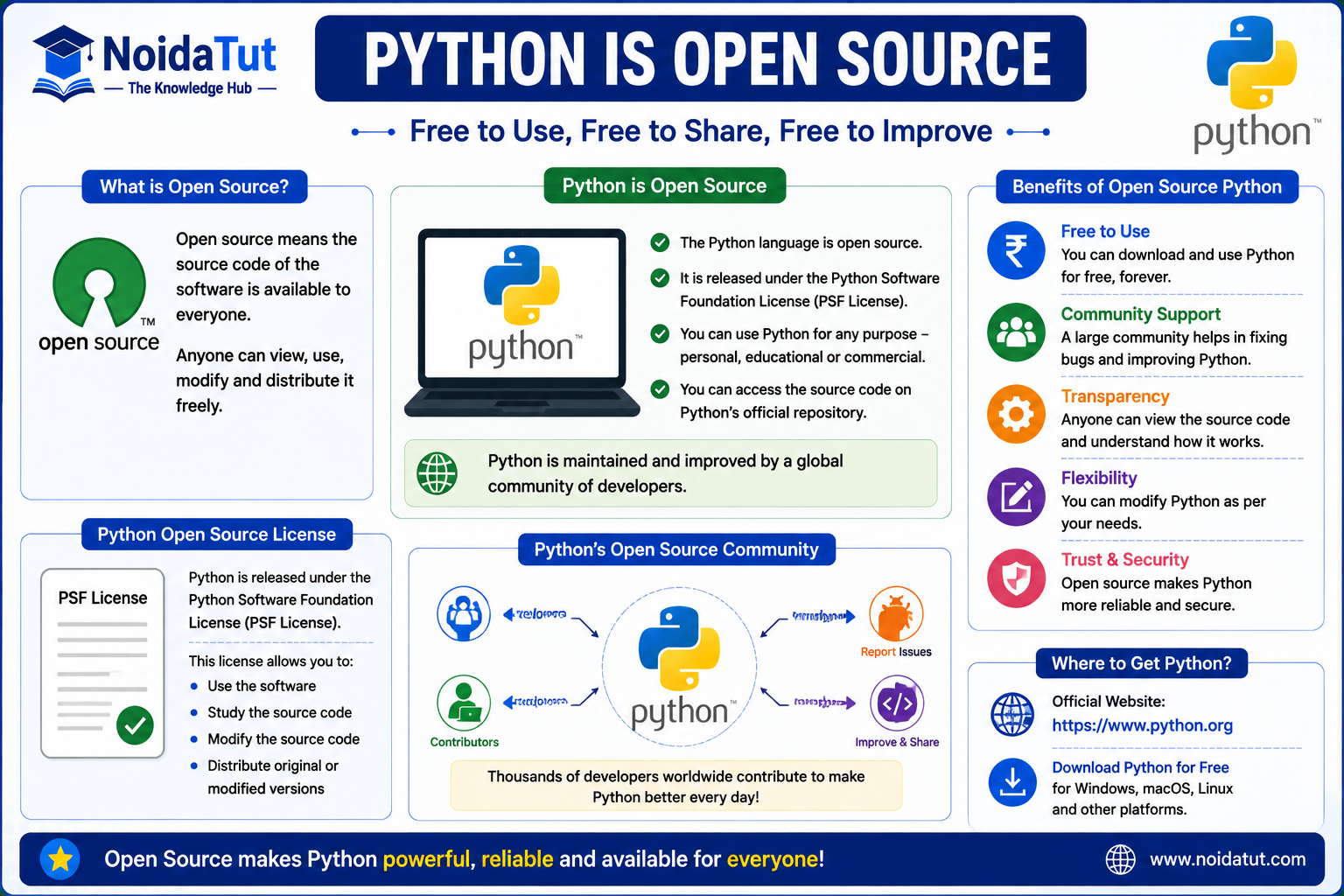
Python is an open-source programming language. Anyone can download, install and use Python free of cost.
The source code of Python is publicly available, allowing developers to study, modify and improve the language.
7. Portable Language
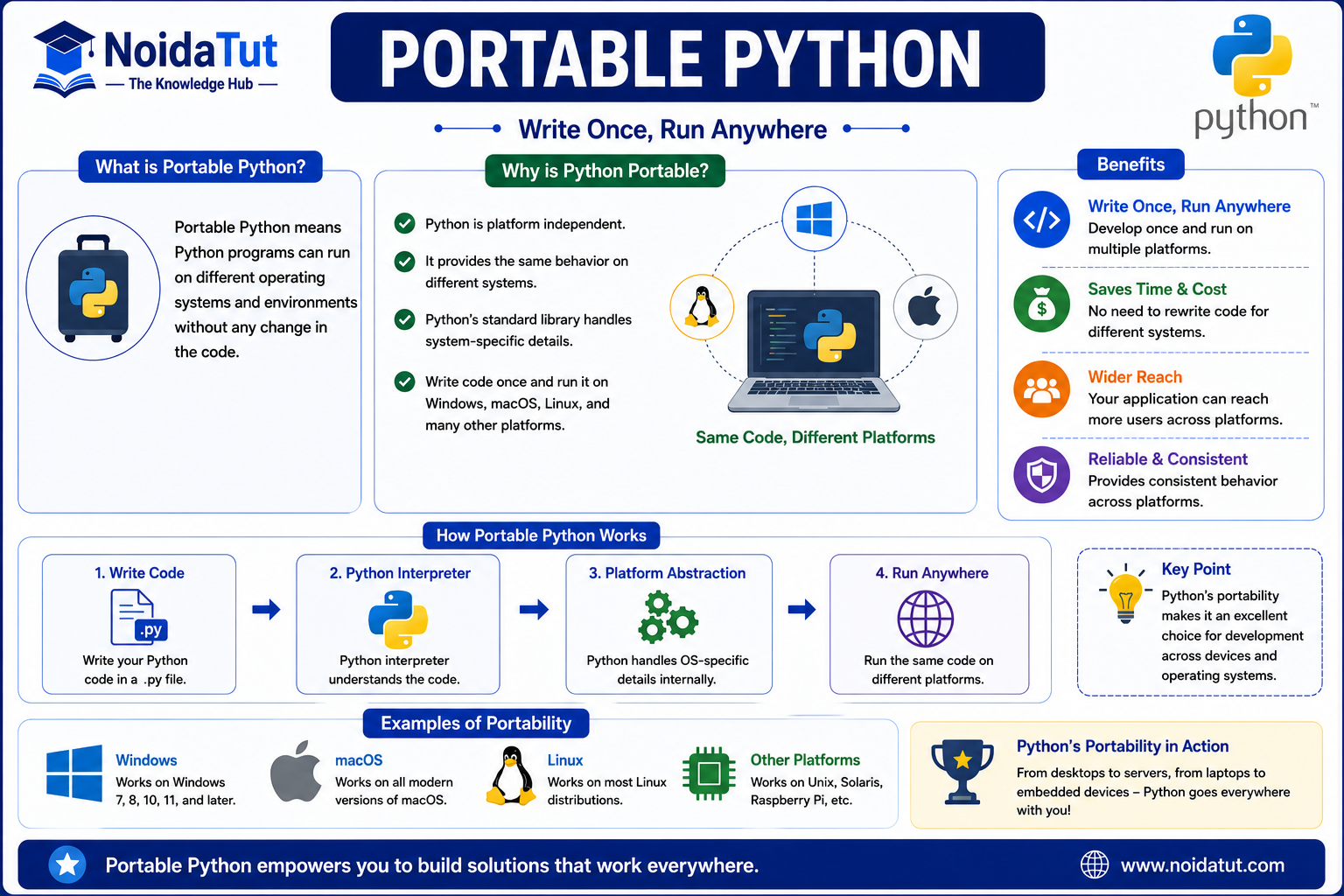
Python is a portable programming language. A Python program written on one operating system can generally run on another operating system without making major changes.
For example, a Python program developed on Windows can also run on Linux or macOS if Python is installed on those systems.
8. Platform Independent
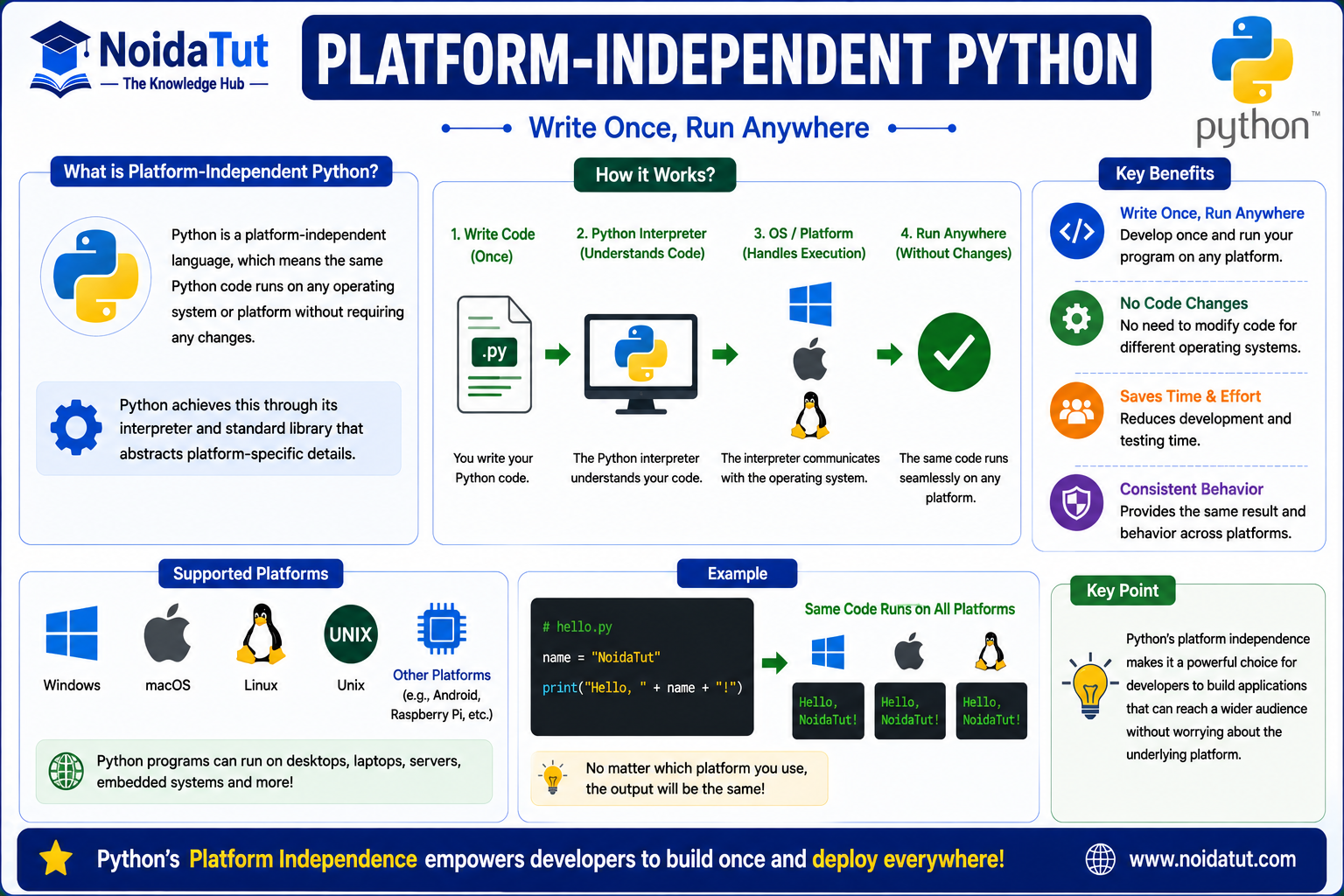
Python is platform independent because the same Python code can execute on different operating systems such as Windows, Linux and macOS.

| Operating System | Python Support |
|---|---|
| Windows | ✔ Supported |
| Linux | ✔ Supported |
| macOS | ✔ Supported |
| Raspberry Pi OS | ✔ Supported |
9. Dynamically Typed Language
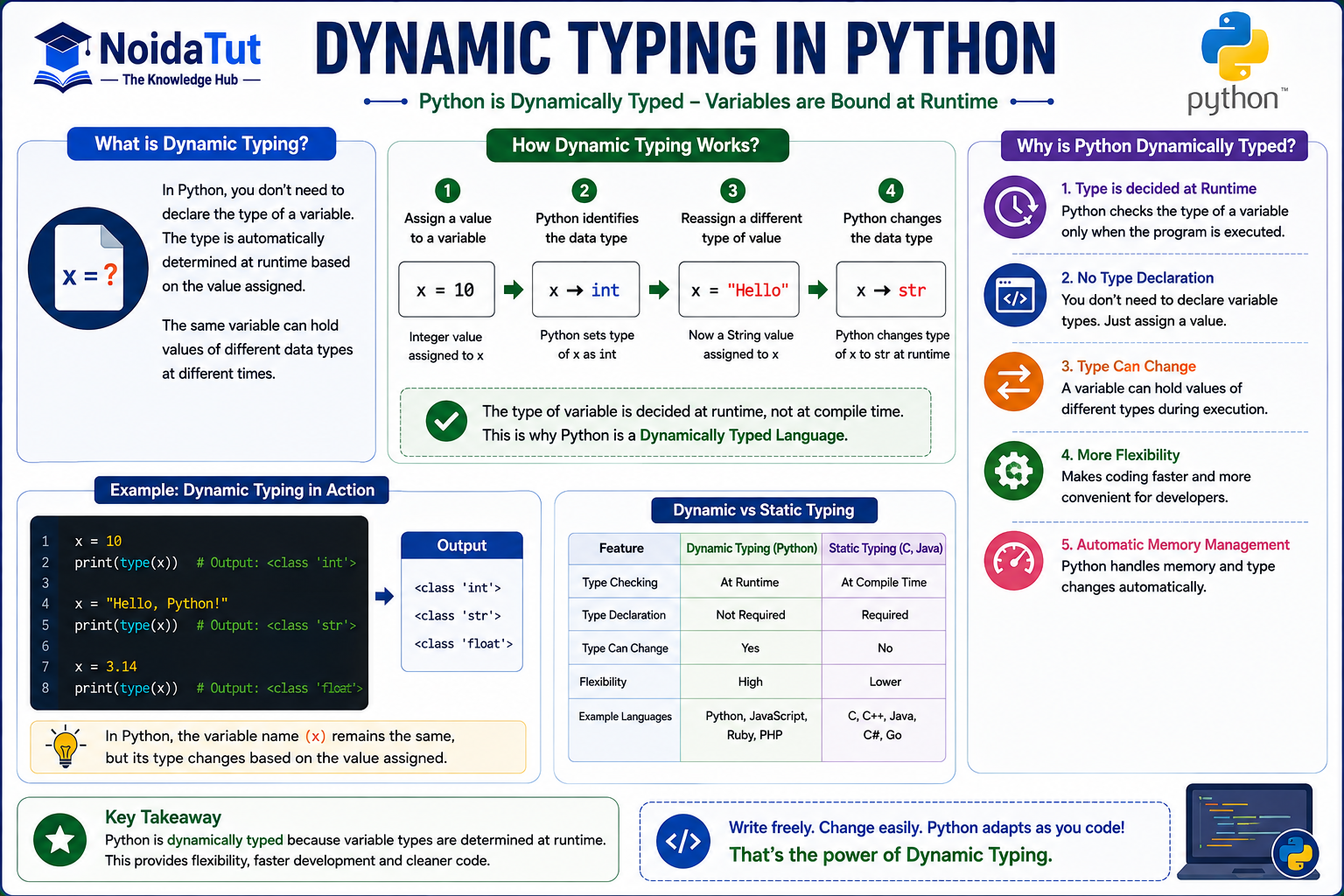
Python is a dynamically typed language. This means the programmer does not need to declare the data type of a variable explicitly.
Python automatically determines the type of data stored in a variable.
Example
x = 100

name = "NoidaTut"

price = 99.95
Python automatically identifies:
- x → Integer
- name → String
- price → Float
10. Large Standard Library
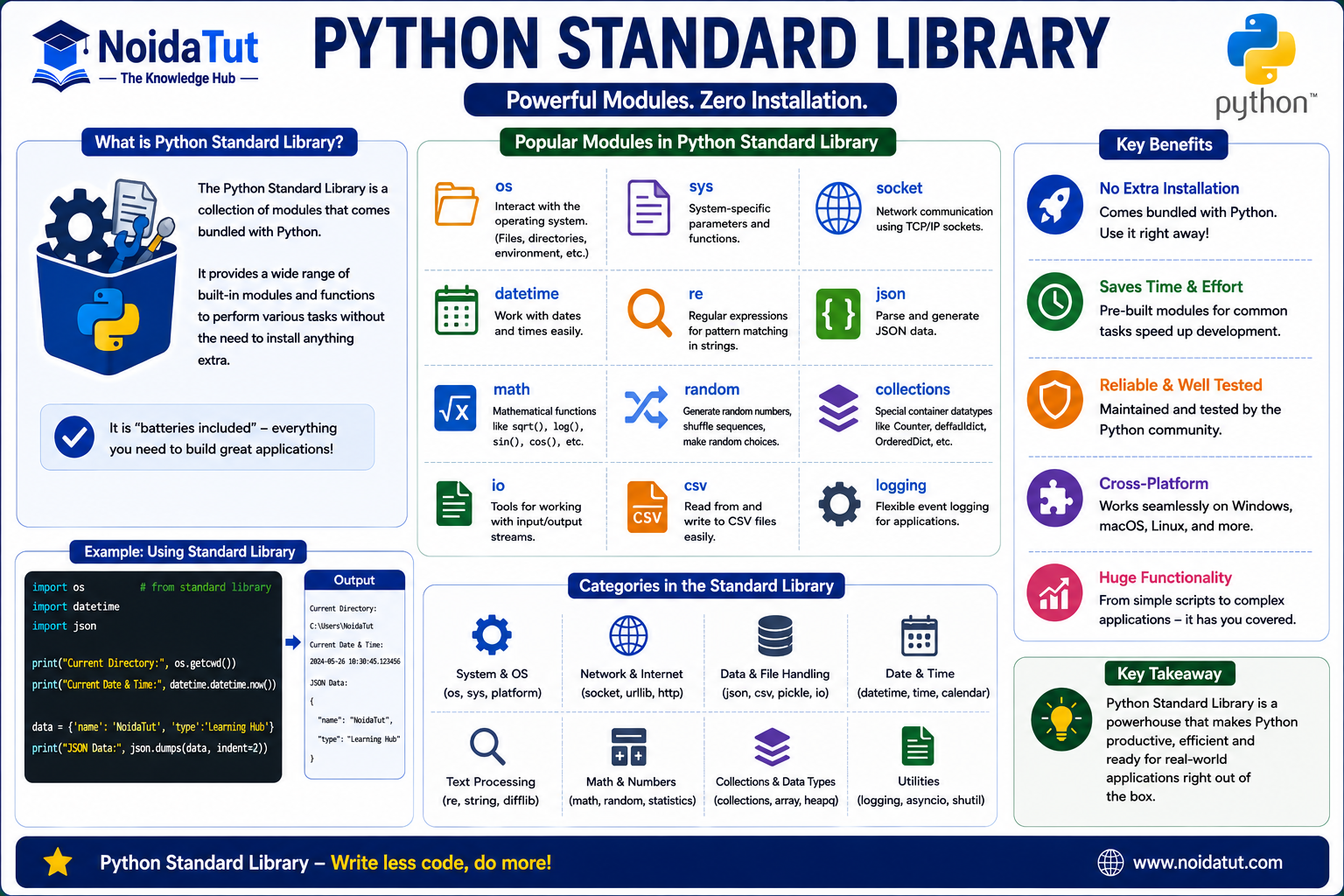
Python provides a huge collection of built-in modules and libraries. These libraries help programmers perform different tasks without writing everything from scratch.
| Library | Purpose |
|---|---|
| math | Mathematical calculations |
| random | Random number generation |
| datetime | Date and Time |
| os | Operating system operations |
| statistics | Statistical calculations |
11. Extensible Language
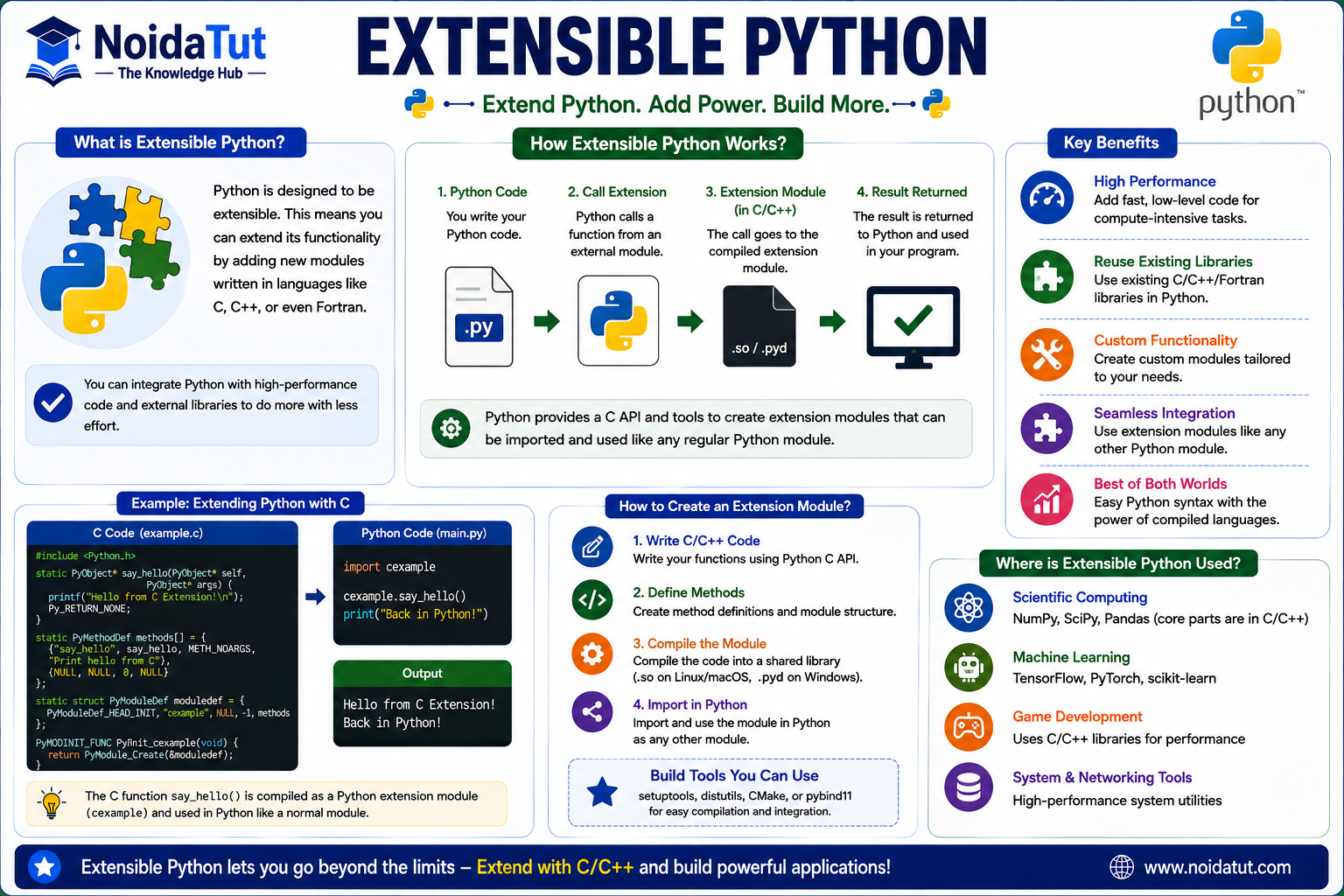
Python is extensible because Python programs can be extended using languages such as C and C++.
Developers can write performance-critical modules in C or C++ and use them inside Python applications.
12. Embeddable Language
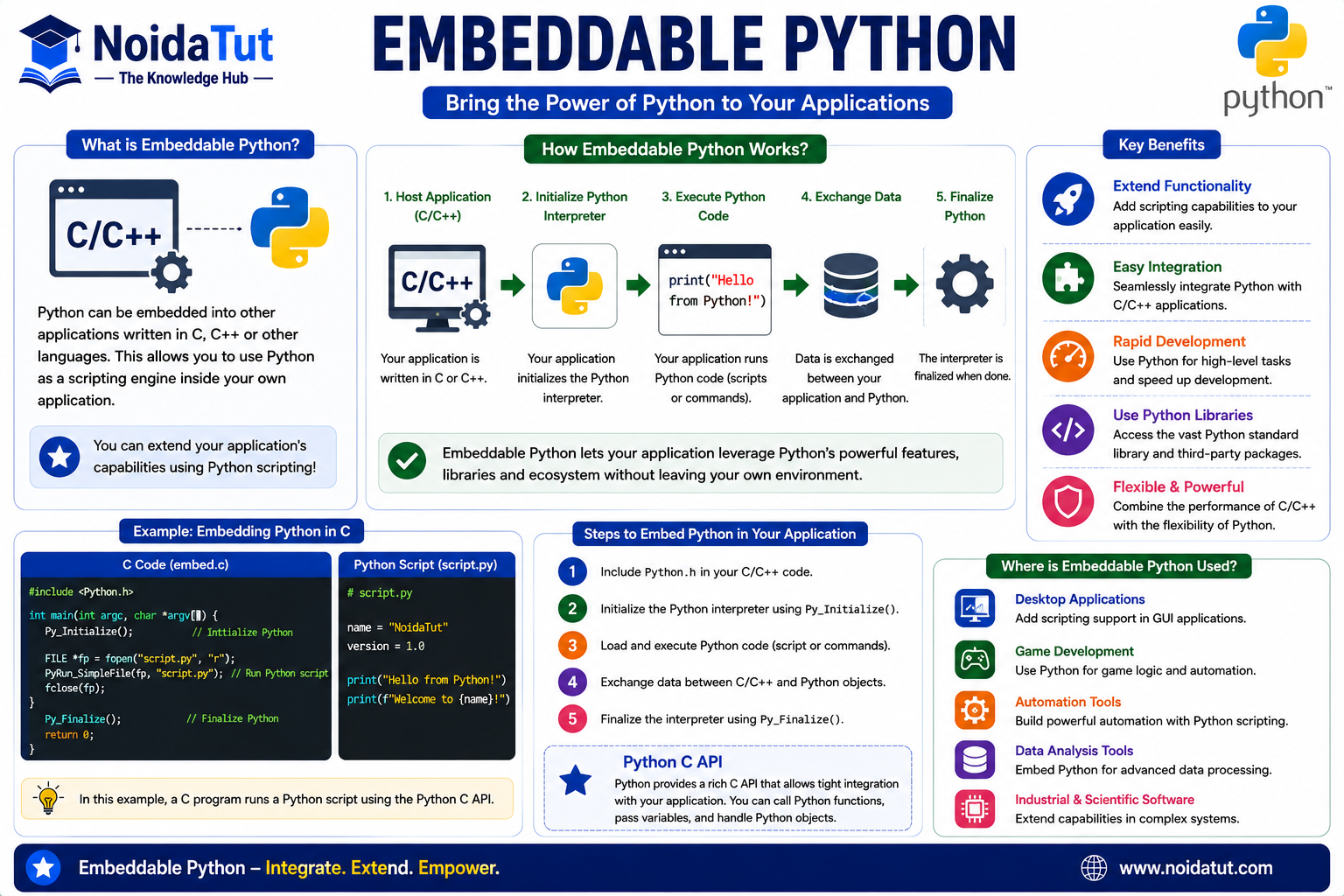
Python is an embeddable programming language. It can be embedded inside other programming languages and software applications.
Many software products use Python as their scripting language.
13. GUI Programming Support
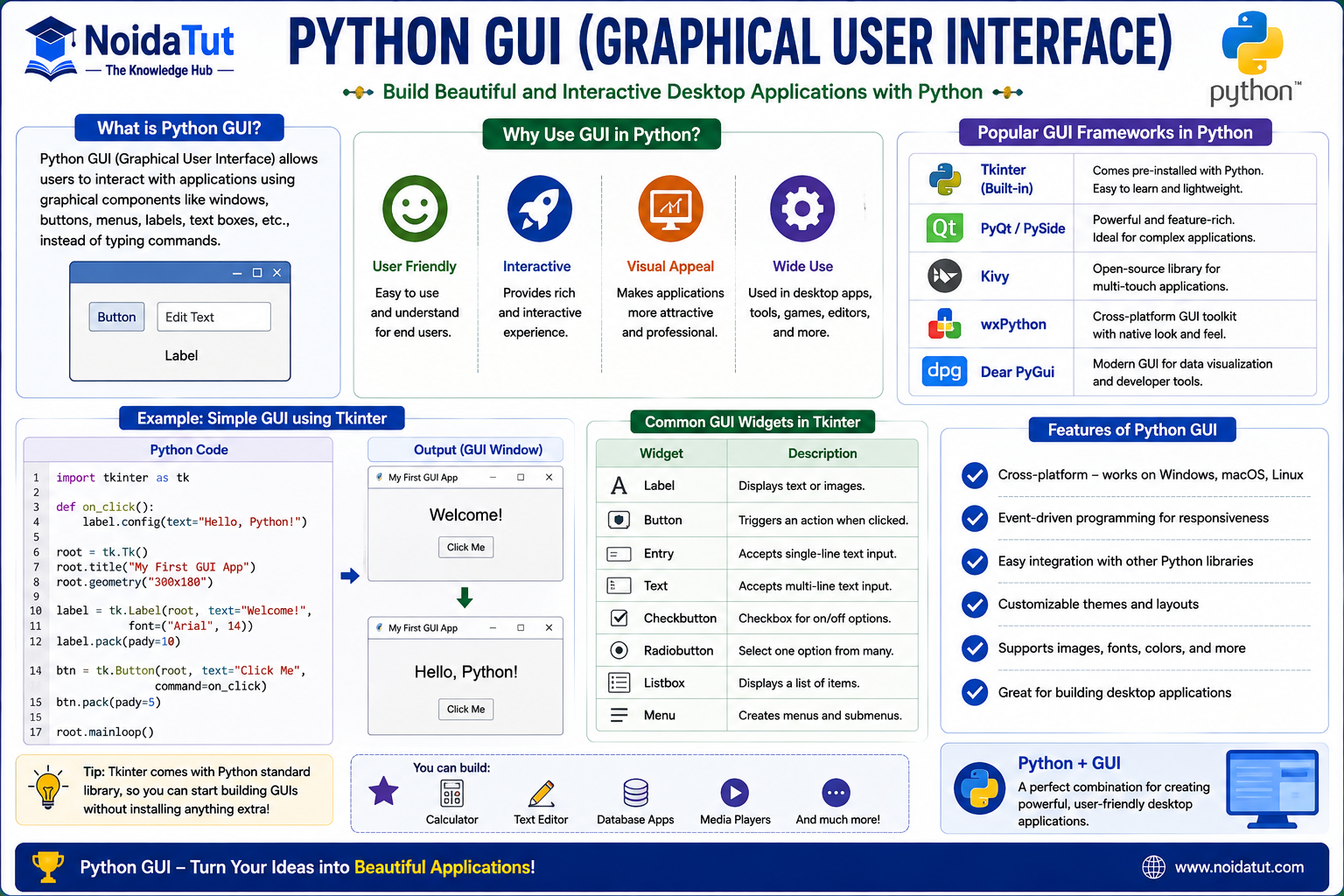
Python supports Graphical User Interface (GUI) development using libraries such as Tkinter.
GUI applications contain windows, buttons, labels, menus and text boxes.
Popular GUI Libraries
- Tkinter
- PyQt
- Kivy
- wxPython
14. Supports Multiple Programming Paradigms
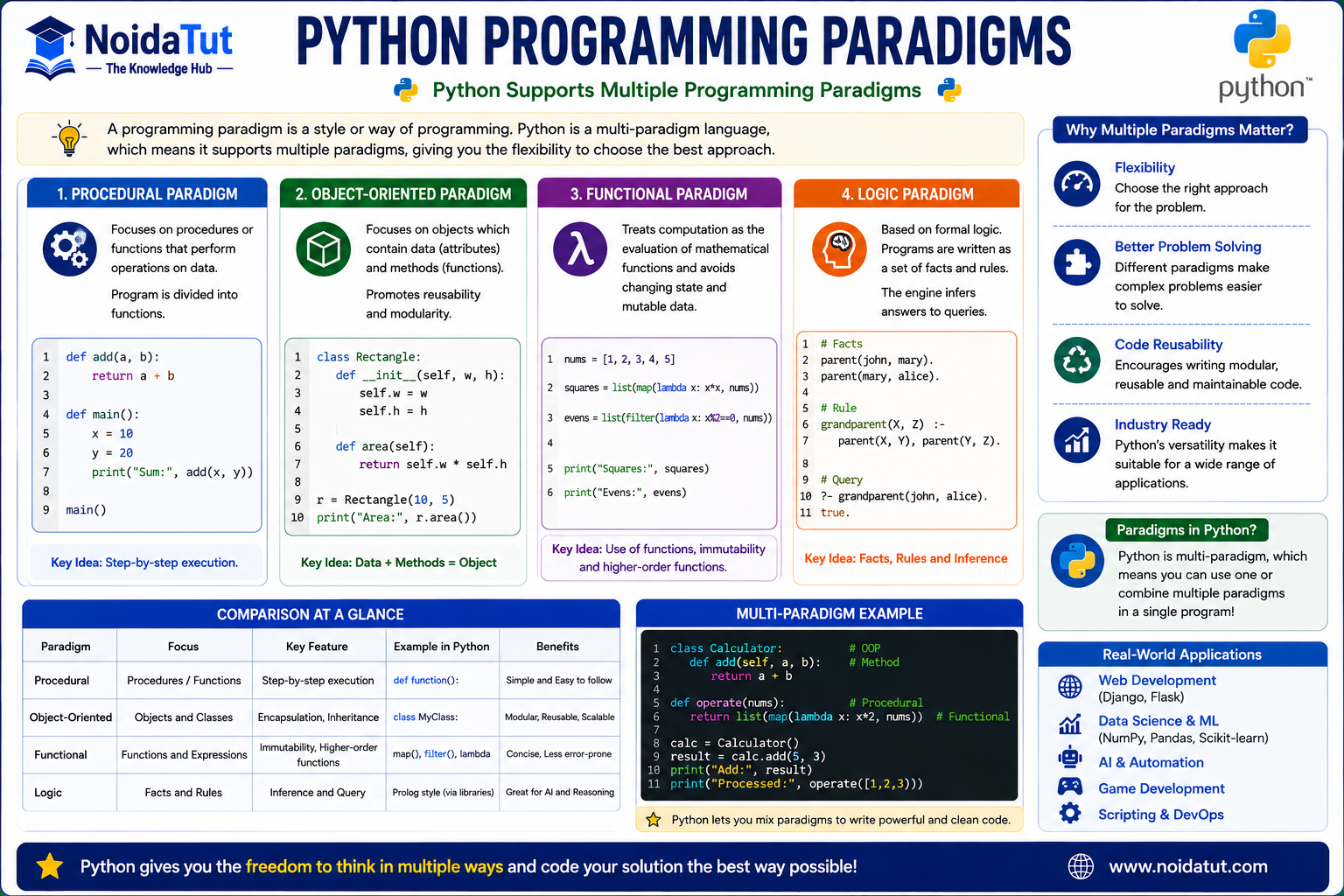
Python supports multiple programming styles. Therefore, programmers can choose the most suitable approach for solving a problem.
| Paradigm | Description |
|---|---|
| Procedural | Program written using functions and statements. |
| Object-Oriented | Program written using classes and objects. |
| Functional | Program written using functions such as lambda(). |
15. Automatic Memory Management
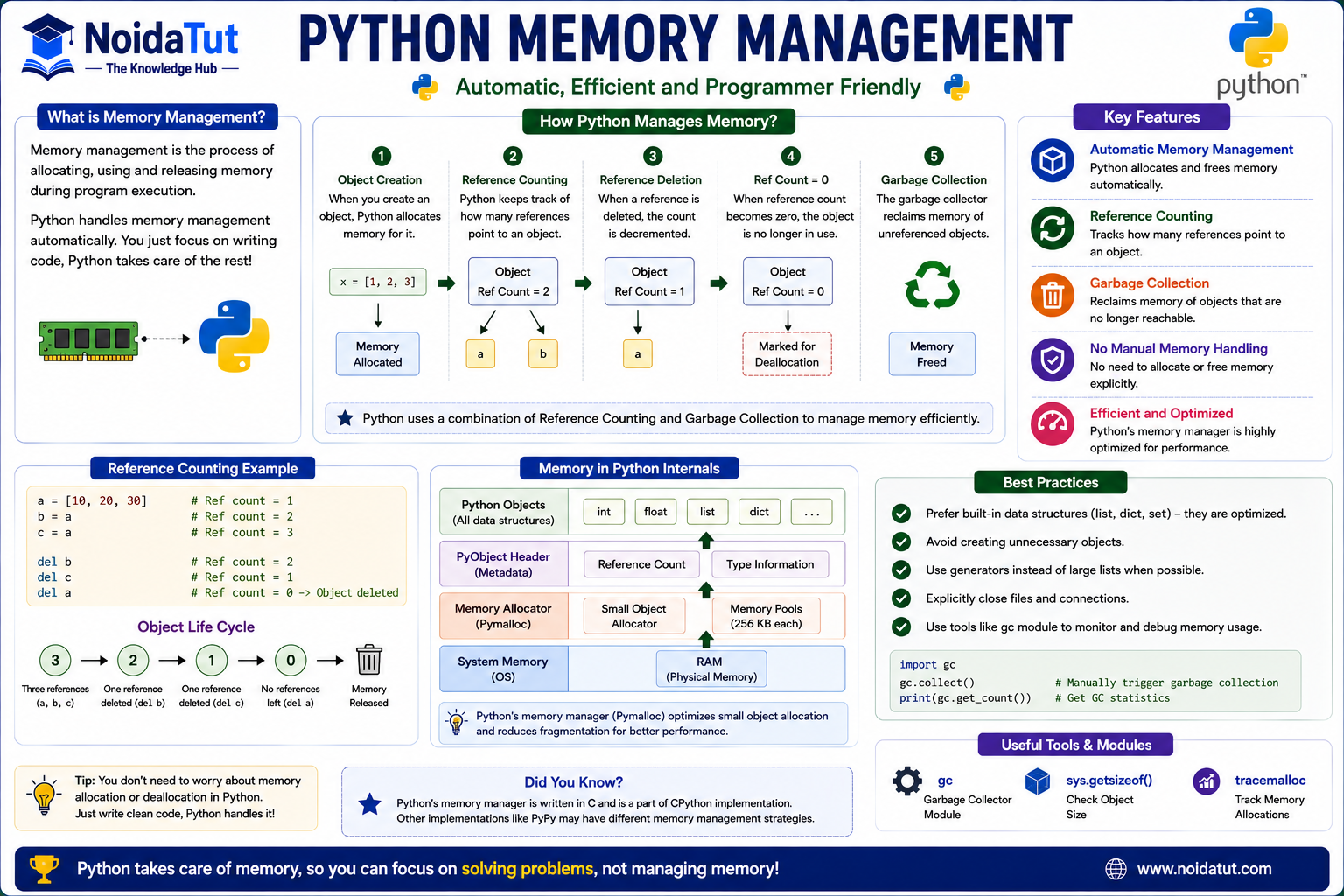
Python automatically manages memory using Garbage Collection. The programmer does not need to manually allocate or release memory.
Summary of Python Features
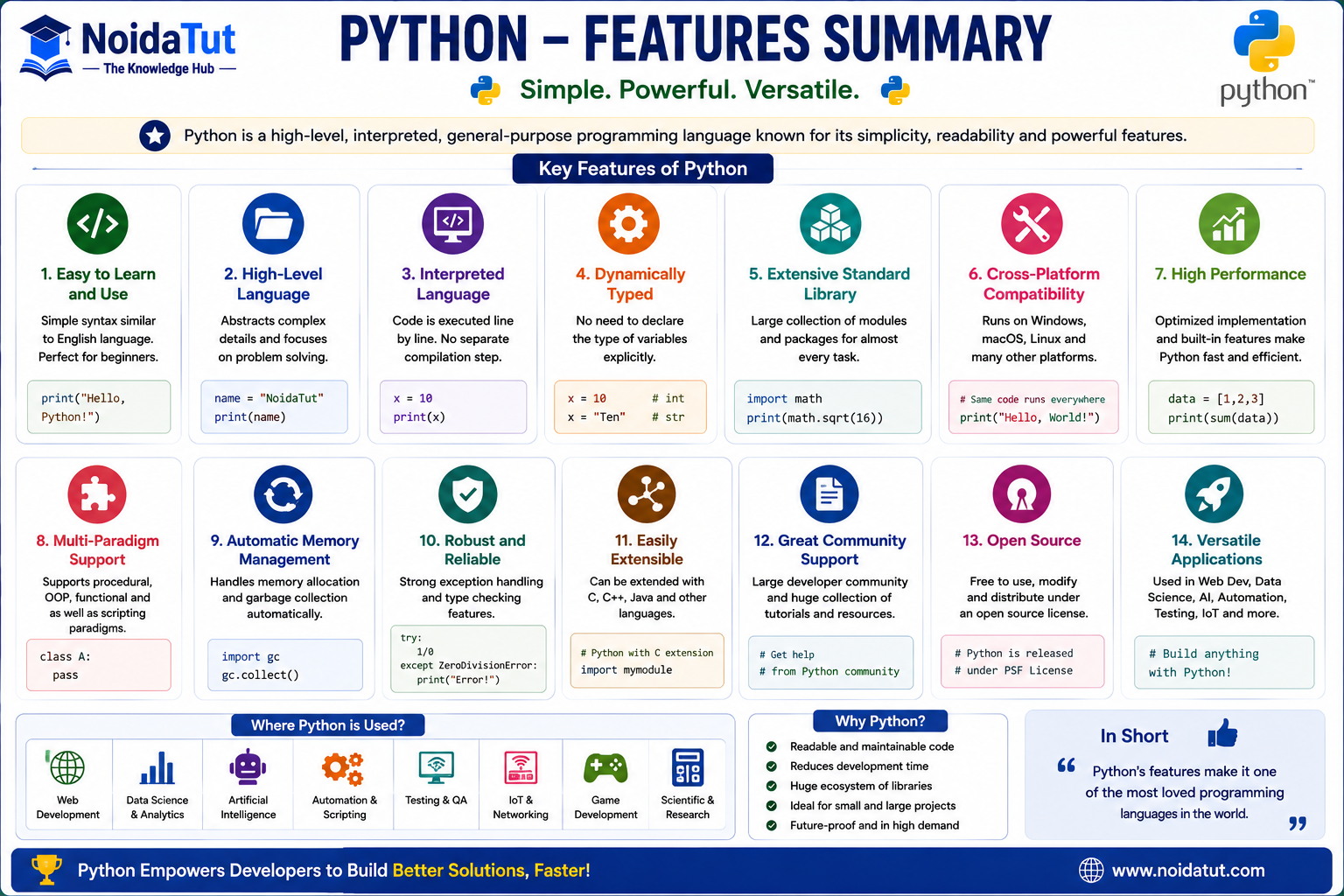
| Feature | Main Benefit |
|---|---|
| Simple | Easy to Learn |
| Readable | Easy Maintenance |
| Interpreted | No Compilation |
| Portable | Runs Everywhere |
| Platform Independent | Cross Platform |
| Dynamic Typing | No Type Declaration |
| Open Source | Free to Use |
| Large Library | Faster Development |
| GUI Support | Desktop Applications |
| OOP Support | Reusable Software |
Advantages of Python
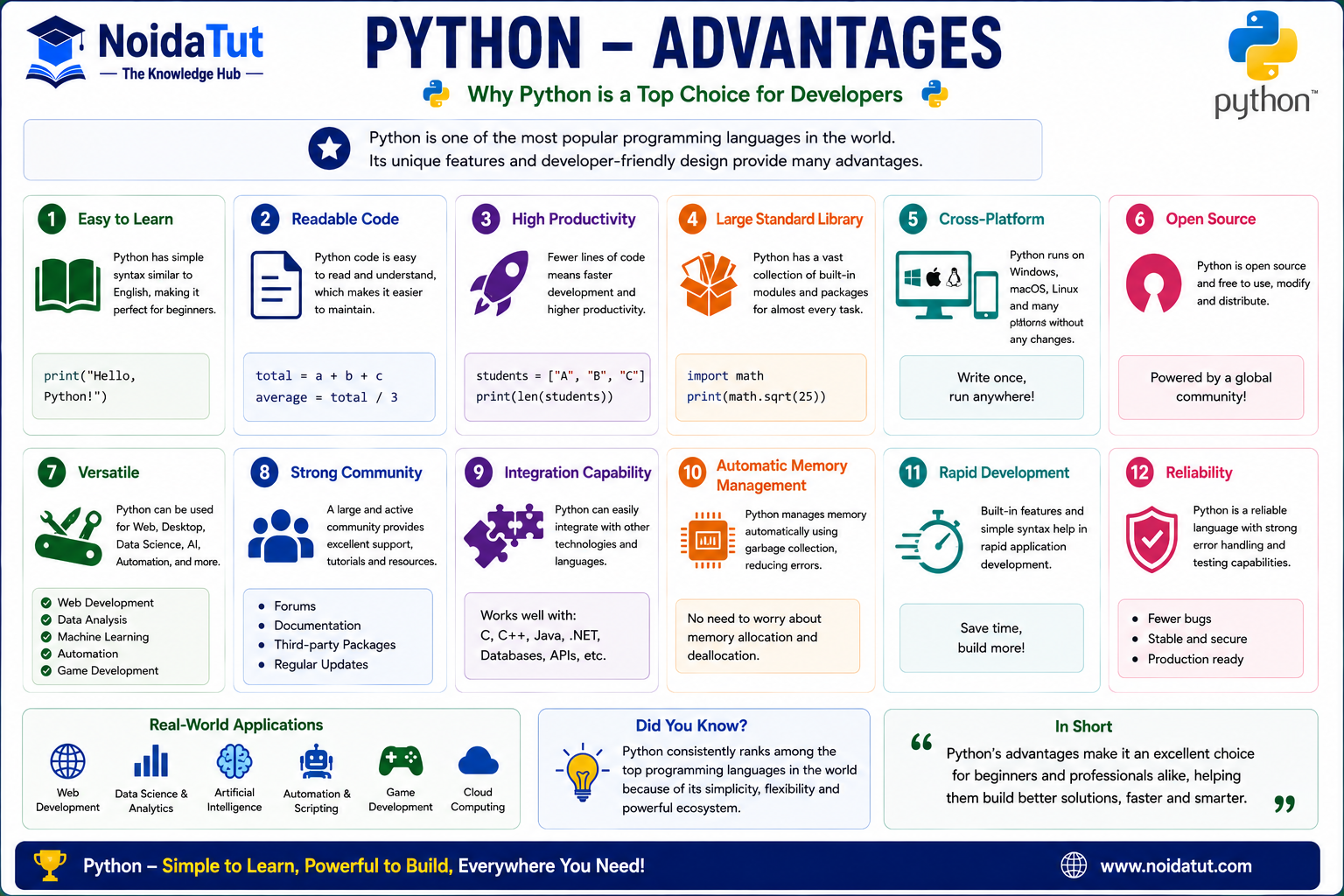
Python offers numerous advantages over many traditional programming languages.
- Simple and easy to learn.
- Easy to read and maintain.
- Free and Open Source.
- Large Standard Library.
- Supports Object-Oriented Programming.
- Platform Independent.
- Portable Programming Language.
- Supports GUI Programming.
- Huge Developer Community.
- Excellent support for AI, ML and Data Science.
Disadvantages of Python
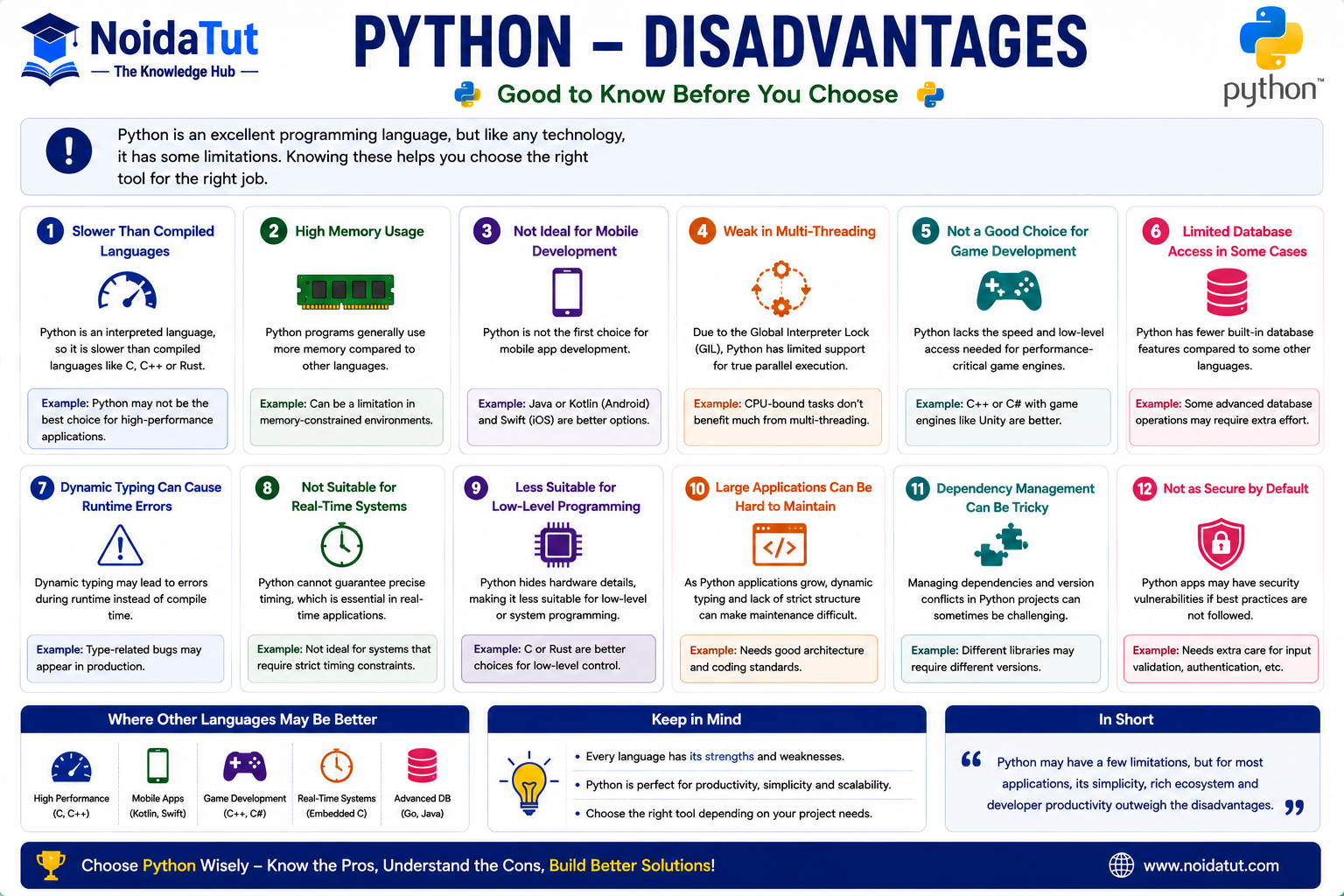
Although Python has many advantages, it also has a few limitations.
| Disadvantage | Explanation |
|---|---|
| Slower Execution | Python is slower than compiled languages like C and C++. |
| Higher Memory Usage | Python consumes more memory than many compiled languages. |
| Runtime Errors | Dynamic typing may produce runtime errors. |
| Mobile Development | Not commonly used for mobile application development. |
Python vs Other Programming Languages
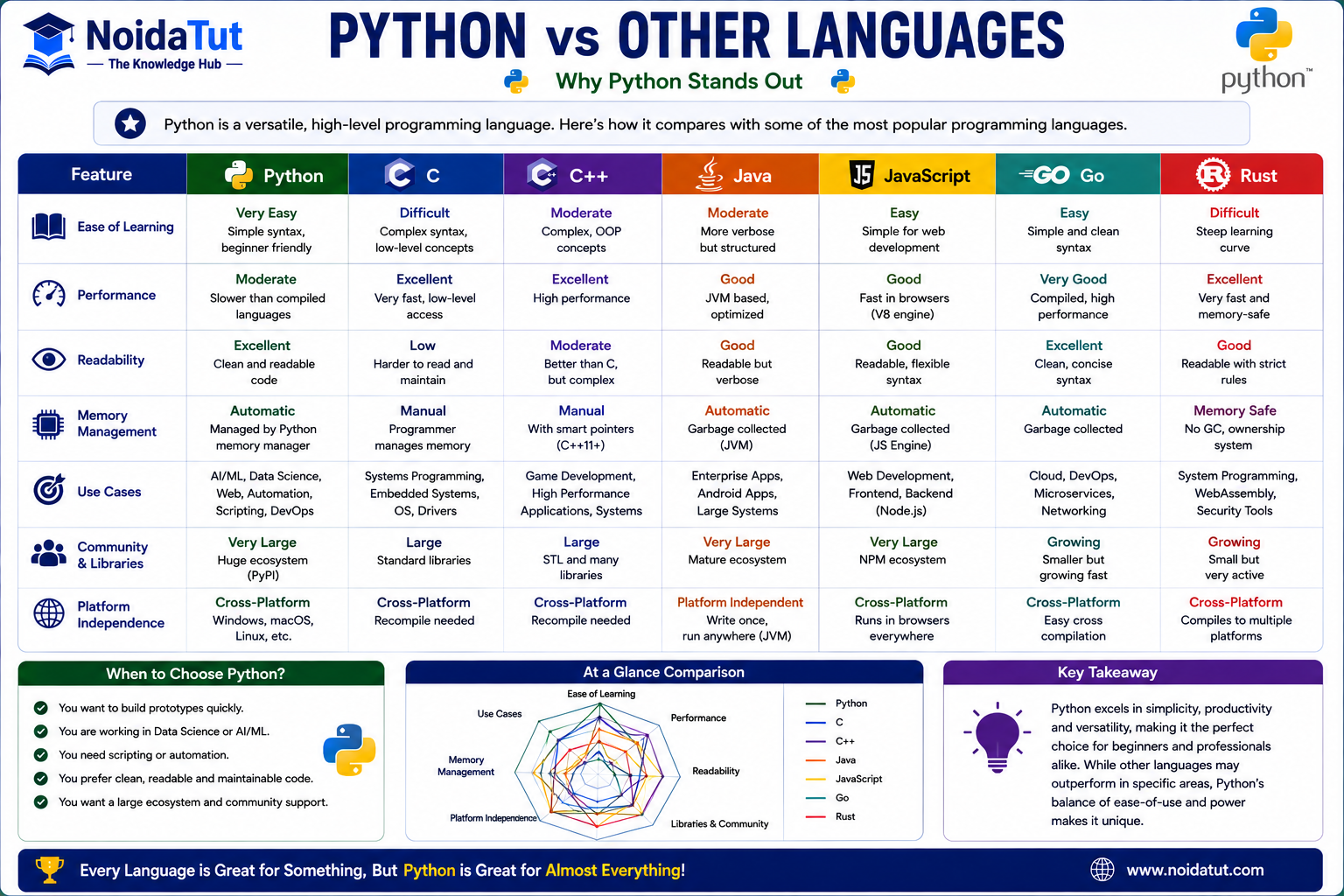
| Feature | Python | C | Java |
|---|---|---|---|
| Learning | Very Easy | Moderate | Moderate |
| Compilation | Interpreted | Compiled | Compiled + JVM |
| Syntax | Simple | Complex | Moderate |
| Typing | Dynamic | Static | Static |
| Development Speed | Very Fast | Medium | Fast |
AKTU Important Questions
Viva Questions
- Why is Python easy to learn?
- What is an interpreted language?
- What is dynamic typing?
- What is portability?
- What is platform independence?
- What is Python's Standard Library?
- Why is Python open source?
- Name two GUI libraries of Python.
- What is Garbage Collection?
- Which programming paradigms are supported by Python?
Multiple Choice Questions (MCQs)
-
Python is a
- (A) Low-Level Language
- (B) High-Level Language ✔
- (C) Assembly Language
- (D) Machine Language
-
Python is
- (A) Compiled Only
- (B) Interpreted ✔
- (C) Hardware Language
- (D) None of These
-
Python is
- (A) Proprietary Software
- (B) Open Source ✔
- (C) Paid Software
- (D) Closed Source
-
Python supports
- (A) Object-Oriented Programming
- (B) Functional Programming
- (C) Procedural Programming
- (D) All of the Above ✔
-
Python is mainly popular because of
- (A) Simple Syntax
- (B) Large Libraries
- (C) Portability
- (D) All of the Above ✔
Interview Questions
- Why should beginners learn Python?
- What makes Python different from C?
- Explain portability with an example.
- What is dynamic typing?
- Why is Python used in AI and Machine Learning?
- Explain the importance of Python libraries.
- What is the role of the Python Interpreter?
- Differentiate compiled and interpreted languages.
Practice Questions
- Explain the features of Python in detail.
- Write a note on Python's Standard Library.
- Differentiate portability and platform independence.
- Explain dynamic typing with examples.
- Compare Python with C and Java.
Summary