Comparison of Sorting Algorithms in Design and Analysis of Algorithms (DAA)
❮ Previous
Next ❯
Sorting is one of the most fundamental operations in computer science.
Different sorting algorithms have been developed to improve efficiency
under different conditions. Every sorting algorithm has its own
advantages, disadvantages, memory requirements, stability, and time
complexity.
Selecting the appropriate sorting algorithm is essential for designing
efficient software systems. The performance of a sorting algorithm
depends upon factors such as input size, available memory, whether the
data is already partially sorted, and the requirement for stability.
This tutorial provides a comprehensive comparison of the most commonly
used sorting algorithms in Design and Analysis of Algorithms (DAA),
including Bubble Sort, Selection Sort, Insertion Sort, Merge Sort,
Quick Sort, Heap Sort, Counting Sort, Radix Sort and Bucket Sort.
Learning Objectives
After completing this tutorial, students will be able to:
- Understand the differences between popular sorting algorithms.
- Compare time and space complexities.
- Identify stable and unstable sorting algorithms.
- Differentiate between in-place and out-of-place sorting.
- Select the most appropriate sorting algorithm for different applications.
- Prepare for AKTU examinations and placement interviews.
Prerequisites
- Bubble Sort
- Selection Sort
- Insertion Sort
- Merge Sort
- Quick Sort
- Heap Sort
- Asymptotic Notations
- Time Complexity Analysis
Why Do We Need Different Sorting Algorithms?
No single sorting algorithm is best for every situation. Some algorithms
are very simple but slow, while others are highly efficient but require
additional memory or have complex implementations.
For example:
- Bubble Sort is easy to understand but inefficient for large datasets.
- Insertion Sort performs very well on nearly sorted data.
- Merge Sort guarantees O(n log n) performance but requires extra memory.
- Quick Sort is generally the fastest comparison-based sorting algorithm in practice.
- Heap Sort guarantees O(n log n) performance with constant extra space.
Classification of Sorting Algorithms
Sorting algorithms can be classified into several categories.
| Classification |
Algorithms |
| Comparison Based |
Bubble, Selection, Insertion, Merge, Quick, Heap |
| Non-Comparison Based |
Counting, Radix, Bucket |
| Internal Sorting |
Sorting performed entirely in main memory |
| External Sorting |
Sorting very large files stored on secondary memory |
| Stable Sorting |
Bubble, Insertion, Merge, Counting, Radix |
| Unstable Sorting |
Selection, Quick, Heap |
| In-place Sorting |
Bubble, Selection, Insertion, Heap, Quick |
| Out-of-place Sorting |
Merge, Counting, Bucket, Radix |
Sorting Algorithms Covered in This Tutorial
| S. No. |
Sorting Algorithm |
| 1 |
Bubble Sort |
| 2 |
Selection Sort |
| 3 |
Insertion Sort |
| 4 |
Merge Sort |
| 5 |
Quick Sort |
| 6 |
Heap Sort |
| 7 |
Counting Sort |
| 8 |
Radix Sort |
| 9 |
Bucket Sort |
Parameters Used for Comparison
To compare different sorting algorithms, the following parameters are
considered.
| Parameter |
Description |
| Best Case |
Minimum execution time |
| Average Case |
Expected execution time |
| Worst Case |
Maximum execution time |
| Space Complexity |
Additional memory required |
| Stable |
Maintains relative order of equal elements |
| Adaptive |
Improves performance for nearly sorted data |
| In-place |
Requires constant extra memory |
| Recursive |
Uses recursion during execution |
Factors Affecting the Choice of Sorting Algorithm
- Input size
- Available memory
- Need for stability
- Nearly sorted input
- Random data
- External storage
- Real-time requirements
- Ease of implementation
Flowchart for Selecting a Sorting Algorithm
The following flowchart helps in selecting an appropriate sorting
algorithm based on different requirements.
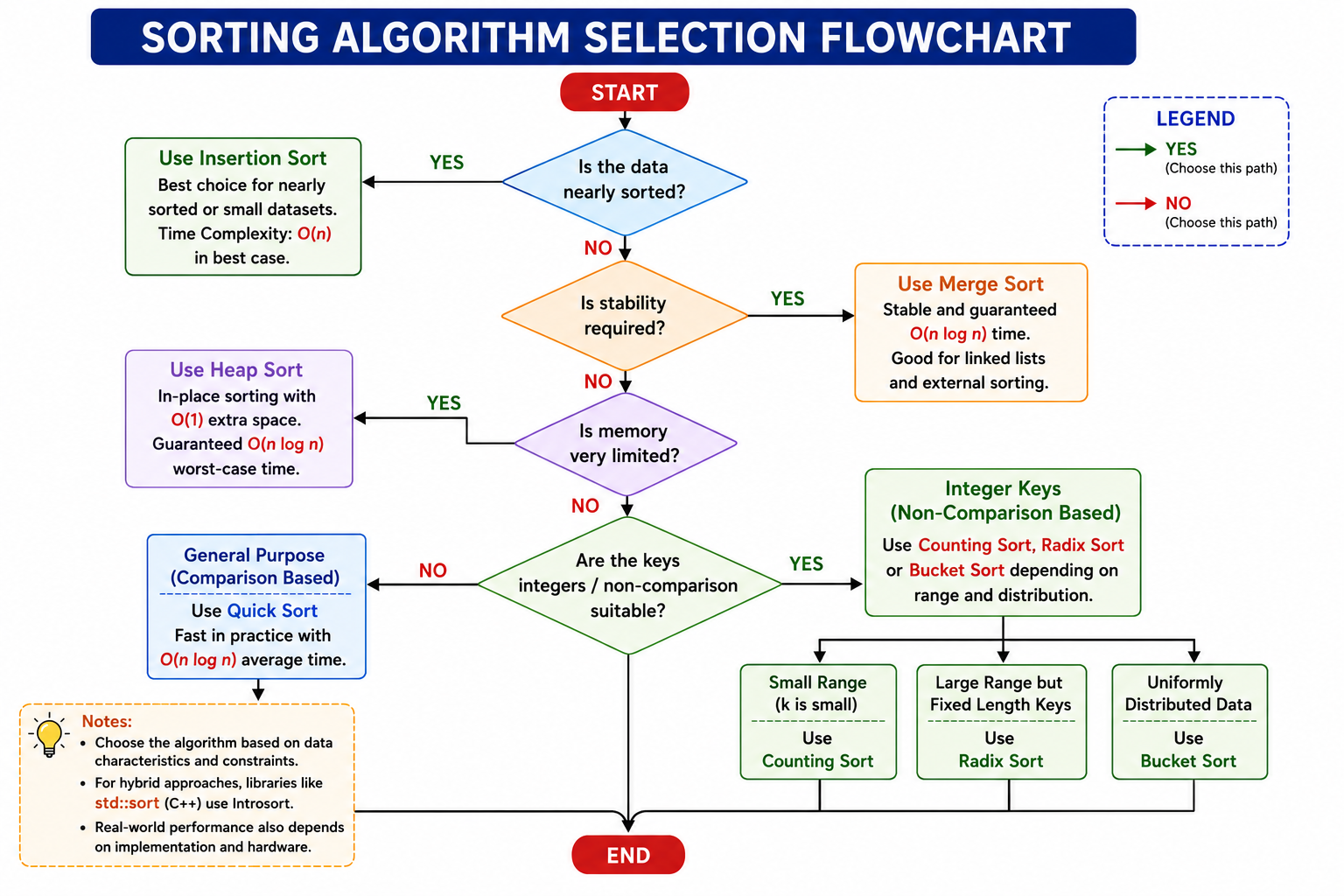
Image Required
- Start
- Is data nearly sorted?
- Yes → Insertion Sort
- No → Is stability required?
- Yes → Merge Sort
- No → Memory available?
- Limited → Heap Sort
- General purpose → Quick Sort
- Integer keys only → Counting/Radix Sort
- Stop
AKTU Examination Tip
Questions asking students to compare sorting algorithms are frequently
asked in AKTU semester examinations. Students should remember the
differences in time complexity, space complexity, stability,
adaptiveness and applications of each algorithm.
Detailed Comparison of Sorting Algorithms
The following table compares the most popular sorting algorithms based
on their time complexity, space complexity, stability, adaptiveness,
memory usage and implementation.
Comparison Based on Time Complexity
| Algorithm |
Best Case |
Average Case |
Worst Case |
| Bubble Sort |
O(n) |
O(n²) |
O(n²) |
| Selection Sort |
O(n²) |
O(n²) |
O(n²) |
| Insertion Sort |
O(n) |
O(n²) |
O(n²) |
| Merge Sort |
O(n log n) |
O(n log n) |
O(n log n) |
| Quick Sort |
O(n log n) |
O(n log n) |
O(n²) |
| Heap Sort |
O(n log n) |
O(n log n) |
O(n log n) |
| Counting Sort |
O(n+k) |
O(n+k) |
O(n+k) |
| Radix Sort |
O(d(n+k)) |
O(d(n+k)) |
O(d(n+k)) |
| Bucket Sort |
O(n+k) |
O(n+k) |
O(n²) |
Comparison Based on Space Complexity
| Algorithm |
Extra Space |
| Bubble Sort |
O(1) |
| Selection Sort |
O(1) |
| Insertion Sort |
O(1) |
| Merge Sort |
O(n) |
| Quick Sort |
O(log n) |
| Heap Sort |
O(1) |
| Counting Sort |
O(k) |
| Radix Sort |
O(n+k) |
| Bucket Sort |
O(n) |
Comparison Based on Stability
| Algorithm |
Stable |
| Bubble Sort |
Yes |
| Selection Sort |
No |
| Insertion Sort |
Yes |
| Merge Sort |
Yes |
| Quick Sort |
No |
| Heap Sort |
No |
| Counting Sort |
Yes |
| Radix Sort |
Yes |
| Bucket Sort |
Depends on implementation |
Comparison Based on Adaptiveness
| Algorithm |
Adaptive |
| Bubble Sort (Optimized) |
Yes |
| Selection Sort |
No |
| Insertion Sort |
Yes |
| Merge Sort |
No |
| Quick Sort |
No |
| Heap Sort |
No |
| Counting Sort |
No |
| Radix Sort |
No |
| Bucket Sort |
Depends on implementation |
Comparison Based on Memory Usage
| Algorithm |
Memory Efficient |
| Bubble Sort |
Yes |
| Selection Sort |
Yes |
| Insertion Sort |
Yes |
| Merge Sort |
No |
| Quick Sort |
Moderate |
| Heap Sort |
Yes |
| Counting Sort |
No |
| Radix Sort |
No |
| Bucket Sort |
No |
Comparison Based on Recursion
| Algorithm |
Recursive Implementation |
| Bubble Sort |
No |
| Selection Sort |
No |
| Insertion Sort |
No |
| Merge Sort |
Yes |
| Quick Sort |
Yes |
| Heap Sort |
No |
| Counting Sort |
No |
| Radix Sort |
No |
| Bucket Sort |
No |
Comparison Based on Ease of Implementation
| Algorithm |
Difficulty Level |
| Bubble Sort |
Very Easy |
| Selection Sort |
Easy |
| Insertion Sort |
Easy |
| Merge Sort |
Moderate |
| Quick Sort |
Moderate |
| Heap Sort |
Difficult |
| Counting Sort |
Moderate |
| Radix Sort |
Moderate |
| Bucket Sort |
Moderate |
Overall Feature Comparison
| Algorithm |
Stable |
Adaptive |
In-place |
Recursive |
Suitable for Large Data |
| Bubble Sort |
Yes |
Yes |
Yes |
No |
No |
| Selection Sort |
No |
No |
Yes |
No |
No |
| Insertion Sort |
Yes |
Yes |
Yes |
No |
Small/Nearly Sorted |
| Merge Sort |
Yes |
No |
No |
Yes |
Yes |
| Quick Sort |
No |
No |
Yes |
Yes |
Yes |
| Heap Sort |
No |
No |
Yes |
No |
Yes |
| Counting Sort |
Yes |
No |
No |
No |
Integer Keys |
| Radix Sort |
Yes |
No |
No |
No |
Integer Keys |
| Bucket Sort |
Depends |
Depends |
No |
No |
Uniform Data |
Comparison Chart
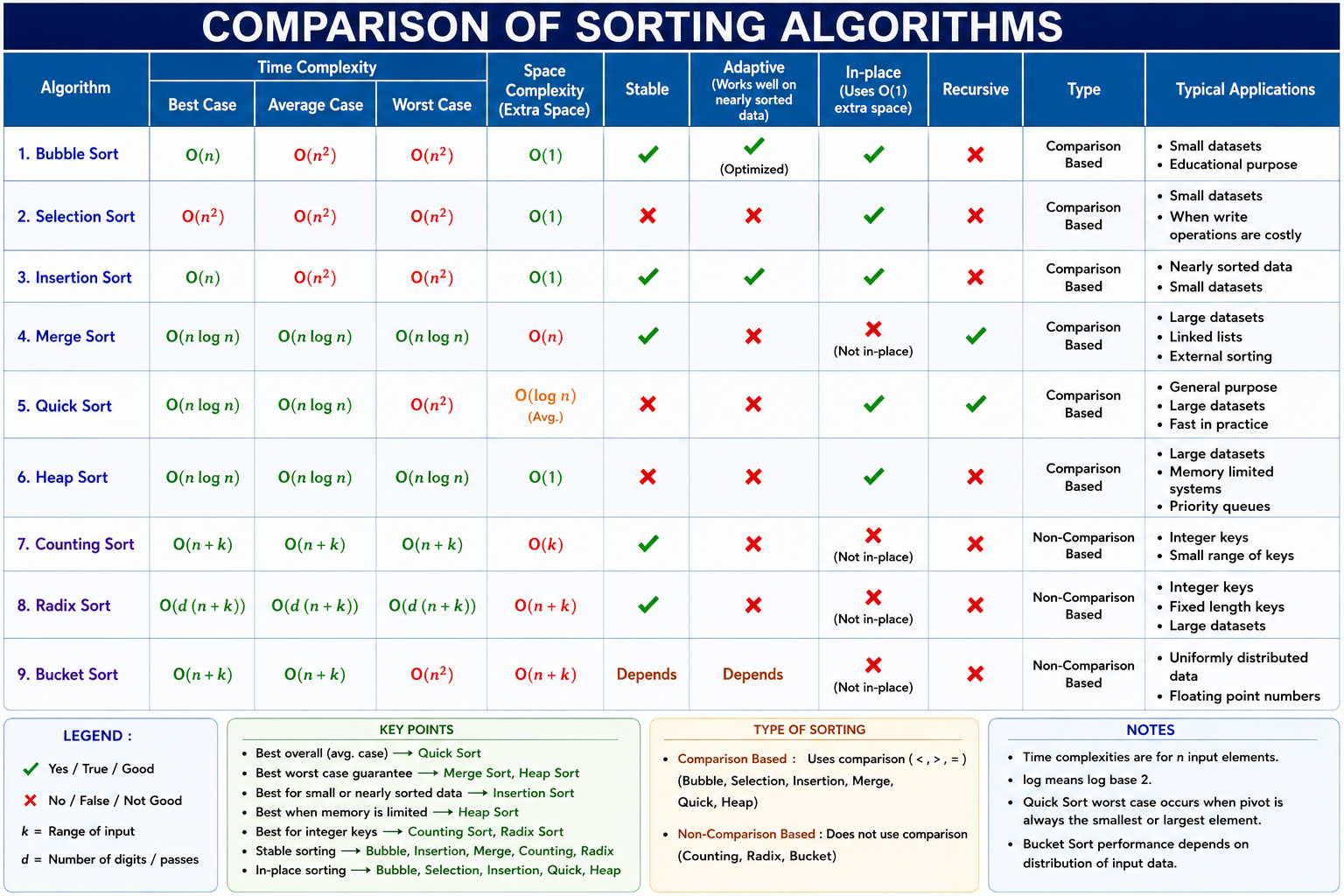
Image Required
- Nine sorting algorithms arranged in rows.
- Columns for Best, Average, Worst, Space, Stable, Adaptive and In-place.
- Green tick marks and red cross marks.
- Color-coded complexity values.
- Professional infographic style.
Important Observation
Merge Sort and Heap Sort guarantee O(n log n) worst-case performance, while Quick Sort offers excellent average-case performance. Insertion Sort is particularly efficient for small or nearly sorted datasets, whereas Counting Sort and Radix Sort achieve linear-time performance under specific assumptions about the input data.
Choosing the Right Sorting Algorithm
Selecting the appropriate sorting algorithm depends on several factors,
including the size of the input data, available memory, data type,
stability requirements, and expected performance.
There is no universal sorting algorithm that is best for every
application. Each algorithm performs well under specific conditions.
Which Sorting Algorithm Should You Choose?
| Situation |
Recommended Algorithm |
Reason |
| Very Small Dataset |
Insertion Sort |
Simple implementation and very low overhead. |
| Nearly Sorted Data |
Insertion Sort |
Runs close to O(n) in the best case. |
| General Purpose Sorting |
Quick Sort |
Excellent average-case performance. |
| Guaranteed O(n log n) |
Merge Sort / Heap Sort |
Consistent worst-case performance. |
| Limited Memory |
Heap Sort |
Requires only O(1) extra space. |
| Stable Sorting Required |
Merge Sort |
Maintains the relative order of equal elements. |
| Large Integer Keys |
Radix Sort |
Linear complexity for suitable inputs. |
| Small Integer Range |
Counting Sort |
Runs in O(n+k). |
| Uniformly Distributed Data |
Bucket Sort |
Very efficient under uniform distribution. |
Real-World Applications of Sorting Algorithms
| Sorting Algorithm |
Applications |
| Bubble Sort |
Educational purposes, small datasets. |
| Selection Sort |
Systems where memory writes are expensive. |
| Insertion Sort |
Online sorting, nearly sorted data, hybrid algorithms. |
| Merge Sort |
External sorting, linked lists, databases. |
| Quick Sort |
Programming libraries, operating systems, compilers. |
| Heap Sort |
Priority queues, scheduling algorithms. |
| Counting Sort |
Exam results, age sorting, integer processing. |
| Radix Sort |
Telephone numbers, IDs, postal codes. |
| Bucket Sort |
Floating-point data, probability distributions. |
Advantages and Limitations
| Algorithm |
Major Advantage |
Major Limitation |
| Bubble Sort |
Very simple |
Very slow for large inputs |
| Selection Sort |
Minimum swaps |
Poor time complexity |
| Insertion Sort |
Excellent for nearly sorted data |
Not suitable for large random datasets |
| Merge Sort |
Guaranteed O(n log n) |
Requires additional memory |
| Quick Sort |
Fastest in practice |
Worst case O(n²) |
| Heap Sort |
Memory efficient |
Cache performance is lower than Quick Sort |
| Counting Sort |
Linear time |
Works only for integers in a limited range |
| Radix Sort |
Very fast for integers |
Requires additional memory |
| Bucket Sort |
Excellent for uniform distribution |
Performance depends on data distribution |
Decision Tree for Selecting a Sorting Algorithm
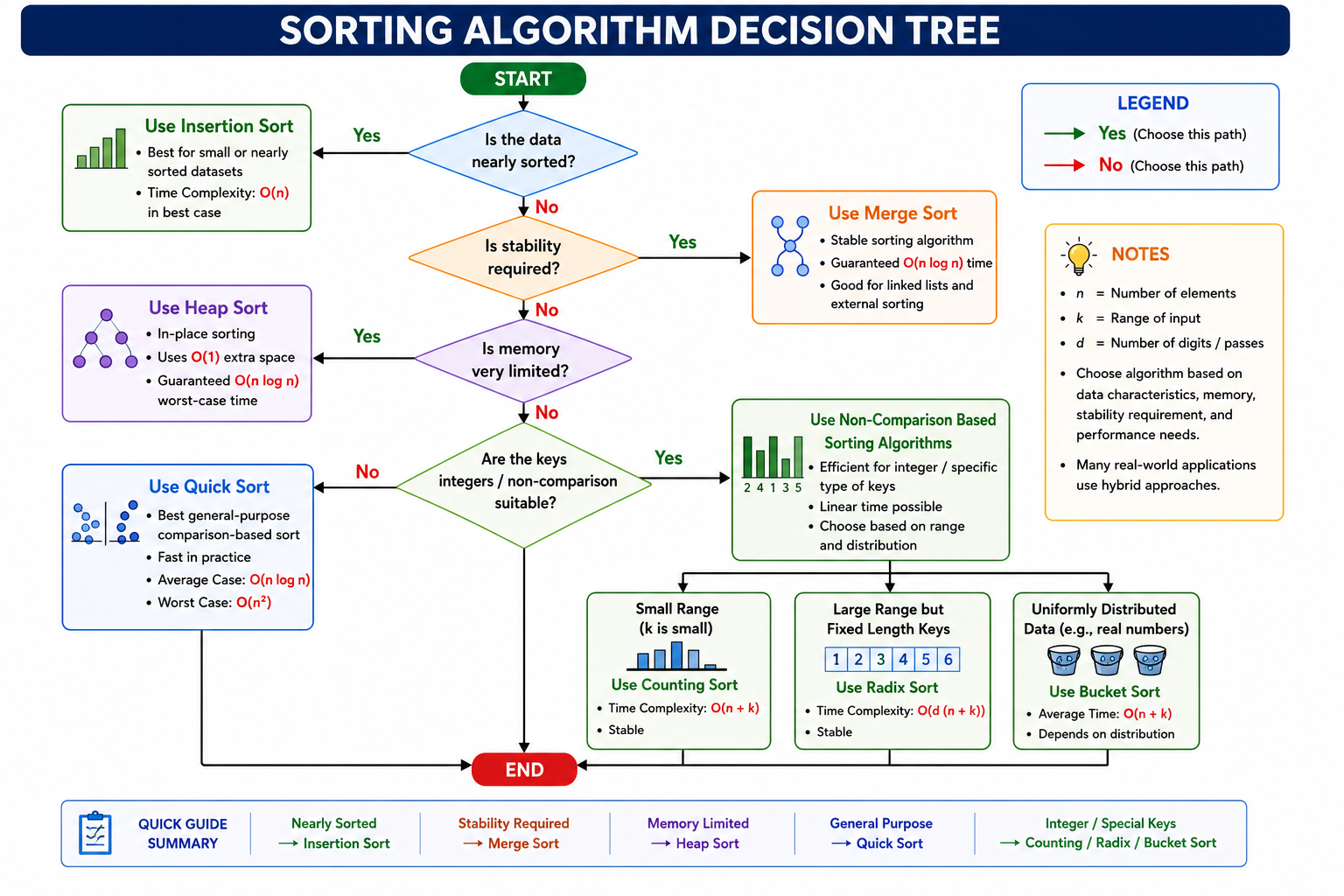
Image Required
- Start
- Is data nearly sorted?
- Yes → Insertion Sort
- No → Is stability required?
- Yes → Merge Sort
- No → Memory limited?
- Yes → Heap Sort
- No → Integer keys only?
- Yes → Counting / Radix Sort
- No → Quick Sort
- End
Comparison Based on Practical Performance
| Algorithm |
Small Data |
Large Data |
Nearly Sorted |
Random Data |
| Bubble Sort |
Good |
Poor |
Average |
Poor |
| Selection Sort |
Average |
Poor |
Poor |
Average |
| Insertion Sort |
Excellent |
Average |
Excellent |
Average |
| Merge Sort |
Good |
Excellent |
Excellent |
Excellent |
| Quick Sort |
Excellent |
Excellent |
Excellent |
Excellent |
| Heap Sort |
Good |
Excellent |
Average |
Excellent |
| Counting Sort |
Excellent |
Excellent |
Excellent |
Only Integer Keys |
| Radix Sort |
Excellent |
Excellent |
Excellent |
Only Integer Keys |
| Bucket Sort |
Good |
Excellent |
Depends |
Uniform Distribution |
Industrial Applications
- Database Management Systems (DBMS)
- Search Engines
- E-commerce Product Listing
- Online Banking Systems
- Student Result Processing
- Operating Systems
- Artificial Intelligence
- Machine Learning Data Preprocessing
- Cloud Computing
- Big Data Analytics
Sorting Algorithms Used in Popular Programming Languages
| Language |
Library Algorithm |
| C++ |
Introsort (Quick Sort + Heap Sort + Insertion Sort) |
| Java |
Dual-Pivot Quick Sort / TimSort |
| Python |
TimSort |
| .NET (C#) |
Introspective Sort |
| JavaScript |
Engine-dependent (typically TimSort or Quick Sort variants) |
Important Interview Tip
One of the most frequently asked interview questions is:
"Which sorting algorithm is the best?"
The correct answer is that there is no single best sorting
algorithm. The choice depends on the characteristics of the input
data, memory constraints, stability requirements, and expected time
complexity.
AKTU Previous Year Questions
The following questions have frequently appeared in AKTU semester examinations and university model papers.
Students should prepare these questions thoroughly for theory examinations.
- Compare Bubble Sort and Selection Sort.
- Differentiate between Merge Sort and Quick Sort.
- Compare all comparison-based sorting algorithms.
- Which sorting algorithm is best for nearly sorted data? Justify your answer.
- Differentiate between stable and unstable sorting algorithms.
- Explain in-place and out-of-place sorting algorithms with examples.
- Why is Merge Sort preferred for linked lists?
- Why is Heap Sort preferred when memory is limited?
- Compare Quick Sort and Heap Sort.
- Which sorting algorithm would you recommend for large datasets? Explain.
Frequently Asked Viva Questions
- What is a sorting algorithm?
- Why is sorting required?
- Which is the simplest sorting algorithm?
- Which sorting algorithm is the fastest in practice?
- Which sorting algorithm has the best worst-case complexity?
- Which sorting algorithm is stable?
- What is adaptive sorting?
- What is in-place sorting?
- Which sorting algorithm uses Divide and Conquer?
- What is the worst-case complexity of Quick Sort?
- Which sorting algorithm requires extra memory?
- What is the complexity of Heap Sort?
- What is Counting Sort?
- Why is Radix Sort called a non-comparison-based sorting algorithm?
- What is the major advantage of Merge Sort?
Placement and Interview Questions
- Which sorting algorithm would you use for sorting 10 million records?
- Why is Quick Sort faster than Merge Sort in practical applications?
- Explain stable sorting with an example.
- What is the difference between internal sorting and external sorting?
- Why is Heap Sort preferred in embedded systems?
- Can Quick Sort degrade to O(n²)? Explain with an example.
- What is TimSort? Which programming languages use it?
- Why is Introsort used in the C++ Standard Library?
- What are hybrid sorting algorithms?
- Which sorting algorithm is most suitable for linked lists and why?
Multiple Choice Questions (MCQs)
| Question |
Answer |
| 1. Which sorting algorithm performs best on average? |
Quick Sort |
| 2. Which sorting algorithm is stable? |
Merge Sort |
| 3. Which sorting algorithm is adaptive? |
Insertion Sort |
| 4. Which sorting algorithm requires O(n) extra memory? |
Merge Sort |
| 5. Which sorting algorithm is non-comparison based? |
Counting Sort |
| 6. Which algorithm guarantees O(n log n) worst-case complexity? |
Heap Sort |
| 7. Which algorithm performs best on nearly sorted data? |
Insertion Sort |
| 8. Which sorting algorithm is based on Divide and Conquer? |
Merge Sort |
| 9. Which algorithm uses a heap data structure? |
Heap Sort |
| 10. Which algorithm is used in Python's sort() function? |
TimSort |
| 11. Which sorting algorithm performs the minimum number of swaps? |
Selection Sort |
| 12. Which sorting algorithm is generally slowest for large datasets? |
Bubble Sort |
| 13. Which sorting algorithm works efficiently only for integer keys? |
Counting Sort |
| 14. Which sorting algorithm is suitable for uniformly distributed data? |
Bucket Sort |
| 15. Which algorithm is commonly used in the C++ STL? |
Introsort |
Practice Exercises
- Compare Bubble Sort and Insertion Sort.
- Differentiate between Merge Sort and Heap Sort.
- Compare Merge Sort and Quick Sort.
- Explain stable and unstable sorting with suitable examples.
- List all in-place sorting algorithms.
- Which sorting algorithms require additional memory?
- Write the best, average and worst-case complexities of all major sorting algorithms.
- Which sorting algorithm is preferred for external sorting? Why?
- Prepare a comparison table of all sorting algorithms.
- Select the best sorting algorithm for an online shopping website and justify your answer.
Sorting Algorithm Cheat Sheet
The following cheat sheet summarizes the most important characteristics of major sorting algorithms.
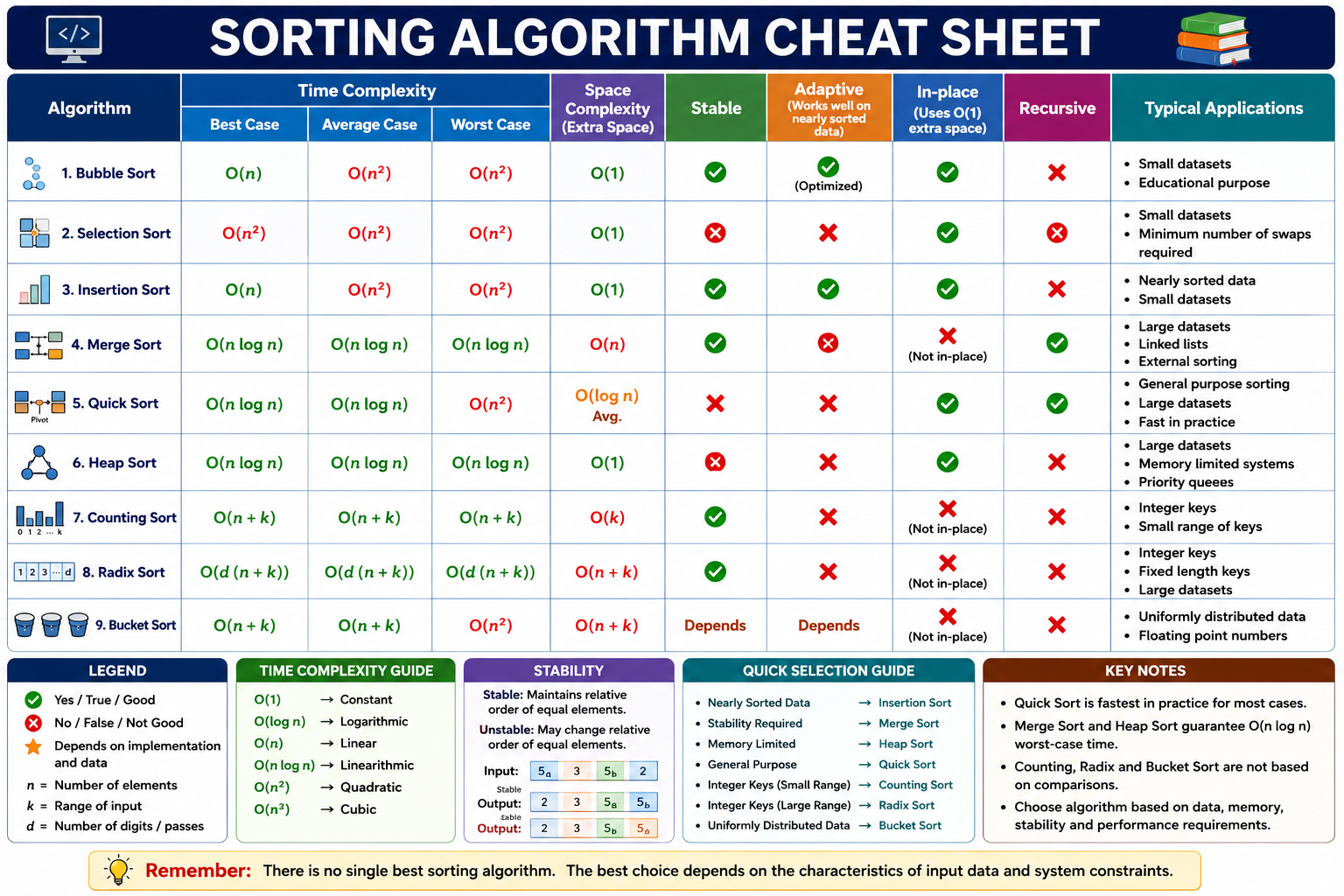
Image Required
- Best, Average and Worst Time Complexities
- Space Complexity
- Stable / Unstable
- Adaptive / Non-Adaptive
- In-place / Out-of-place
- Major Applications
- Easy comparison infographic
Key Takeaways
- No single sorting algorithm is best for every application.
- Quick Sort is generally the fastest comparison-based sorting algorithm in practical applications.
- Merge Sort guarantees O(n log n) performance and provides stable sorting.
- Heap Sort is memory efficient and guarantees O(n log n) worst-case complexity.
- Insertion Sort performs exceptionally well for small and nearly sorted datasets.
- Counting Sort, Radix Sort and Bucket Sort are non-comparison-based algorithms that achieve linear-time performance for specific input types.
- The selection of a sorting algorithm depends on input size, available memory, stability requirements and characteristics of the data.
Summary
Sorting algorithms are among the most fundamental algorithms in computer science and software engineering. Each sorting algorithm possesses its own strengths, weaknesses and ideal application areas. Bubble Sort, Selection Sort and Insertion Sort are simple algorithms suitable for learning and small datasets. Merge Sort and Heap Sort provide guaranteed O(n log n) performance, while Quick Sort is widely preferred because of its excellent average-case efficiency.
Non-comparison-based algorithms such as Counting Sort, Radix Sort and Bucket Sort can outperform comparison-based algorithms when their assumptions are satisfied. Therefore, understanding the characteristics, complexities and practical applications of different sorting algorithms enables software developers and computer science students to select the most suitable algorithm for real-world problems.
❮ Previous
Next ❯