
Performance Measurement in Design and Analysis of Algorithms (DAA)
Objective
After studying this topic, students will be able to:
- Understand the concept of Performance Measurement.
- Analyze algorithm efficiency using theoretical and practical methods.
- Compare different algorithms based on execution time.
- Measure memory utilization of algorithms.
- Understand the importance of scalability.
- Differentiate between theoretical and experimental analysis.
Introduction
Suppose two students write two different programs for sorting 10,000 numbers. Both programs produce the correct output. However,
- Program A finishes in 0.2 seconds.
- Program B finishes in 4.8 seconds.
Although both algorithms solve the same problem, Program A performs significantly better. The process of evaluating such efficiency is known as Performance Measurement.
Definition of Performance Measurement
Performance Measurement is the process of evaluating an algorithm or program by measuring its execution time, memory usage, processor utilization and other computational resources required for solving a problem. It helps determine how efficiently an algorithm behaves for different input sizes.
Performance = f(Time, Space, Input Size, Hardware)
Why is Performance Measurement Important?
| Reason | Description |
|---|---|
| Select Efficient Algorithm | Helps identify the fastest algorithm. |
| Memory Optimization | Determines memory consumption. |
| Scalability | Checks performance for large datasets. |
| Software Optimization | Improves overall application speed. |
| Cost Reduction | Efficient algorithms reduce computing cost. |
| Better User Experience | Fast software improves customer satisfaction. |
Characteristics of a Good Algorithm
- Produces correct output.
- Consumes minimum execution time.
- Requires less memory.
- Scales efficiently for large inputs.
- Simple and easy to maintain.
- Provides reliable performance.
Performance Parameters
The performance of an algorithm depends upon several parameters.
| Parameter | Description |
|---|---|
| Execution Time | Total time taken by the algorithm. |
| Memory Usage | Amount of RAM utilized. |
| CPU Utilization | Processor resources consumed. |
| Disk Access | Input/Output operations performed. |
| Network Usage | Communication overhead in distributed systems. |
Types of Performance Measurement
Performance can be evaluated using two major approaches.
| Method | Description |
|---|---|
| Analytical Measurement | Uses mathematical analysis without executing the program. |
| Experimental Measurement | Measures actual execution by running the program. |
Analytical Performance Measurement
Analytical analysis estimates the performance of an algorithm using mathematical formulas. Instead of executing the program, the number of operations is counted. The analytical approach mainly focuses on:
- Time Complexity
- Space Complexity
- Growth of Functions
- Asymptotic Analysis
Experimental Performance Measurement
Experimental analysis evaluates an algorithm by actually executing the program on a computer system. The execution time is measured using timers or profiling software. This method depends upon:
- Processor Speed
- RAM Size
- Compiler Optimization
- Programming Language
- Operating System
Analytical vs Experimental Performance Measurement
| Analytical Analysis | Experimental Analysis |
|---|---|
| Uses mathematics. | Uses actual execution. |
| Independent of hardware. | Depends upon hardware. |
| No program execution required. | Requires program execution. |
| Suitable during algorithm design. | Suitable after implementation. |
| Predicts scalability. | Measures real execution time. |
Factors Affecting Performance
The performance of an algorithm depends upon several factors.
| Factor | Effect |
|---|---|
| Input Size | Larger inputs increase execution time. |
| Algorithm Design | Efficient algorithms execute faster. |
| Programming Language | Compiled languages are usually faster. |
| Compiler | Optimization improves performance. |
| Processor | Higher clock speed reduces execution time. |
| RAM | More memory improves performance. |
| Operating System | Resource management affects execution. |
Performance Metrics
Performance is commonly evaluated using the following metrics.
| Metric | Description |
|---|---|
| Execution Time | Total CPU time required. |
| Response Time | Time taken to respond to a request. |
| Throughput | Number of tasks completed per unit time. |
| Memory Usage | Amount of memory consumed. |
| CPU Utilization | Percentage of processor usage. |
| Scalability | Ability to handle increasing workload. |
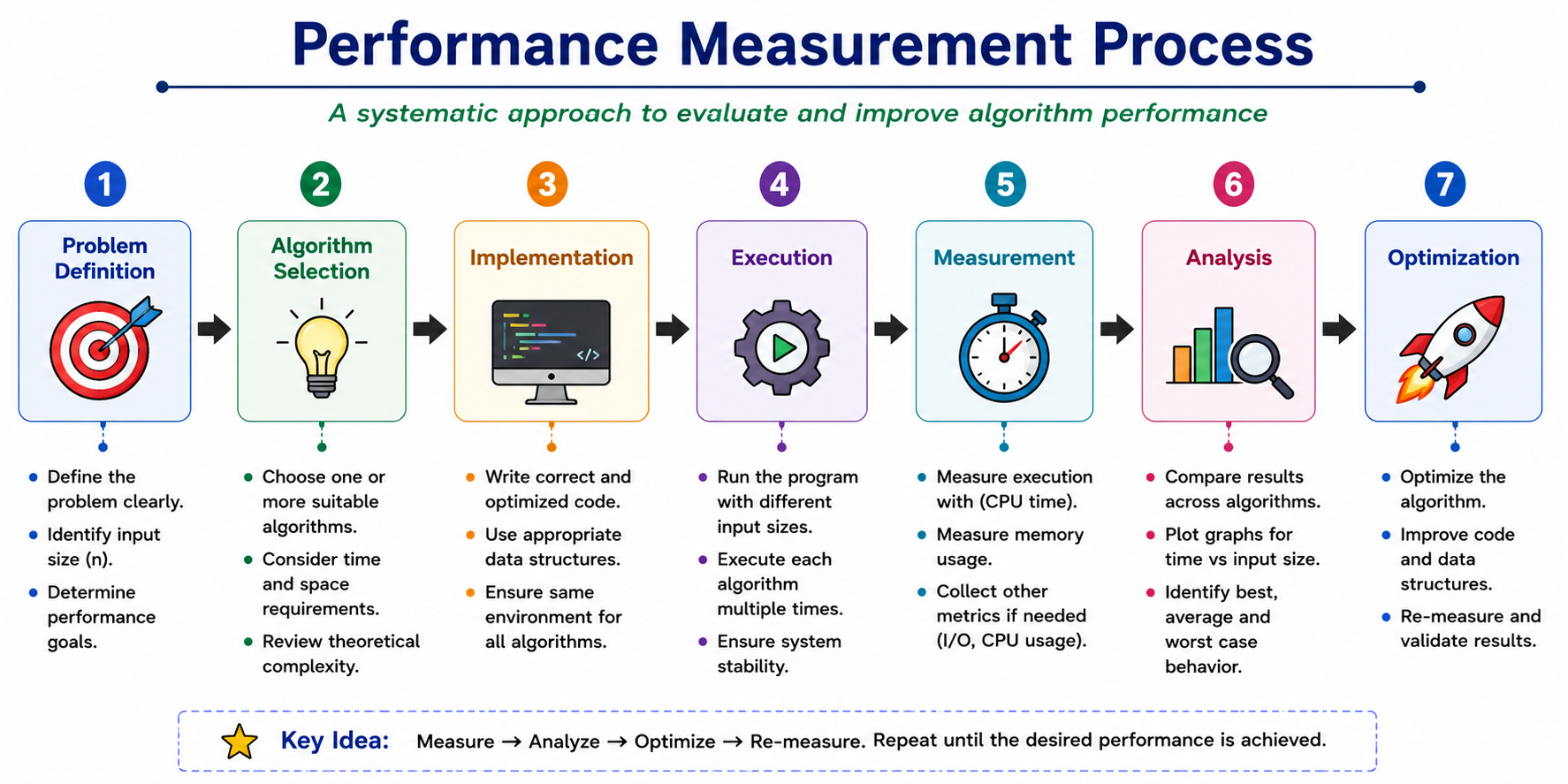
Performance Measurement Process
Relationship Between Input Size and Performance
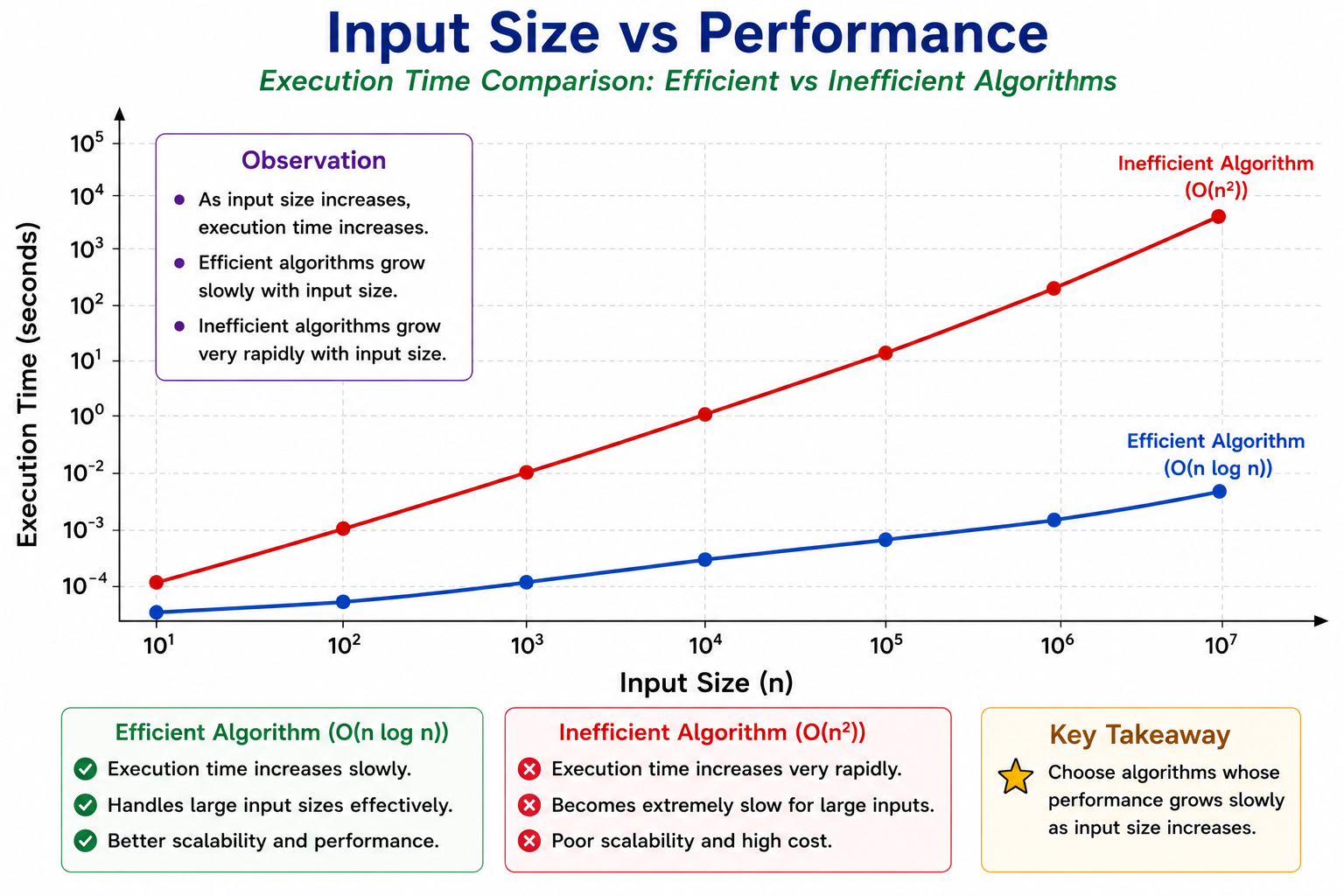
As the input size increases, execution time and memory usage generally increase. An efficient algorithm exhibits slower growth compared to an inefficient algorithm.
Time Complexity Measurement
Time Complexity measures the amount of time required by an algorithm to complete its execution as the input size (n) increases. Instead of measuring the actual execution time in seconds, we count the number of elementary operations performed by the algorithm.
Time Complexity = Number of Operations Executed
Example
Consider Linear Search on an array containing n elements.
for(i=0;i<n;i++)
{
    if(arr[i]==key)
        break;
}
In the worst case, every element must be examined. Therefore,
T(n)=O(n)
Space Complexity Measurement
Space Complexity refers to the amount of memory required by an algorithm during its execution. It includes memory required for:
- Variables
- Arrays
- Recursive function calls
- Dynamic memory allocation
Space Complexity = Fixed Space + Variable Space
| Memory Type | Description |
|---|---|
| Fixed Space | Program instructions, constants and fixed variables. |
| Variable Space | Arrays, recursion stack and dynamically allocated memory. |
Performance Analysis Based on Cases
The running time of an algorithm may vary depending upon the input data. Therefore, algorithms are analyzed using three different cases.
Best Case Analysis
The Best Case represents the minimum execution time required by an algorithm. This situation occurs when the desired result is found immediately.
Example
Searching the first element using Linear Search.
Best Case Complexity = O(1)
Average Case Analysis
Average Case Analysis measures the expected running time over all possible inputs. It represents the average performance of an algorithm.
Example
Linear Search usually finds an element near the middle of the array.
Average Case Complexity = O(n)
Worst Case Analysis
Worst Case Analysis determines the maximum execution time required by an algorithm. This case is the most important because it guarantees an upper bound on running time.
Example
Searching the last element or searching an element that is not present in the array.
Worst Case Complexity = O(n)
Comparison of Best, Average and Worst Cases
| Case | Description | Linear Search |
|---|---|---|
| Best Case | Minimum operations | O(1) |
| Average Case | Expected operations | O(n) |
| Worst Case | Maximum operations | O(n) |
Importance of Input Size
The performance of an algorithm depends primarily upon the size of the input. As the input size increases, the running time generally increases.
| Problem | Input Size |
|---|---|
| Sorting | Number of Elements |
| Searching | Total Records |
| Graph Algorithms | Vertices and Edges |
| String Matching | Length of String |
| Matrix Algorithms | Order of Matrix |
Experimental Time Measurement
Actual execution time can be measured using timers provided by the operating system or programming language.
| Programming Language | Timing Function |
|---|---|
| C | clock() |
| C++ | chrono library |
| Java | System.nanoTime() |
| Python | time module |
Performance Comparison of Searching Algorithms
| Algorithm | Best | Average | Worst |
|---|---|---|---|
| Linear Search | O(1) | O(n) | O(n) |
| Binary Search | O(1) | O(log n) | O(log n) |
Performance Comparison of Sorting Algorithms
| Sorting Algorithm | Best | Average | Worst |
|---|---|---|---|
| Bubble Sort | O(n) | O(n²) | O(n²) |
| Selection Sort | O(n²) | O(n²) | O(n²) |
| Insertion Sort | O(n) | O(n²) | O(n²) |
| Merge Sort | O(n log n) | O(n log n) | O(n log n) |
| Quick Sort | O(n log n) | O(n log n) | O(n²) |
| Heap Sort | O(n log n) | O(n log n) | O(n log n) |
Real-Life Examples of Performance Measurement
| Application | Importance |
|---|---|
| Google Search | Returns search results within milliseconds. |
| Online Banking | Processes transactions quickly and securely. |
| Navigation Systems | Finds shortest routes efficiently. |
| E-commerce Websites | Displays products rapidly during high traffic. |
| Social Media | Loads feeds and notifications quickly. |
| Artificial Intelligence | Processes large datasets efficiently. |
Example of Performance Measurement
Suppose two sorting algorithms are tested on the same computer.
| Input Size | Bubble Sort | Merge Sort |
|---|---|---|
| 100 | 0.01 sec | 0.003 sec |
| 1,000 | 0.45 sec | 0.02 sec |
| 10,000 | 42 sec | 0.28 sec |
The table clearly shows that Merge Sort performs much better than Bubble Sort as the input size increases.
Performance Measurement Workflow

Important Observations
- Lower execution time indicates better performance.
- Lower memory consumption improves scalability.
- Algorithms with lower complexity perform better for large datasets.
- Actual running time depends upon hardware configuration.
- Analytical analysis remains independent of programming language.
- Experimental analysis validates theoretical analysis.
Advantages of Performance Measurement
- Helps in selecting the most efficient algorithm.
- Improves software execution speed.
- Reduces memory consumption.
- Supports scalability for large datasets.
- Enhances user experience.
- Provides a basis for algorithm optimization.
- Reduces computational cost.
- Helps compare multiple algorithms objectively.
Limitations of Performance Measurement
- Actual execution time depends upon hardware configuration.
- Compiler optimization may affect measured results.
- Operating system scheduling influences execution time.
- Small input datasets may not reflect actual scalability.
- Experimental analysis requires implementation of the algorithm.
- Performance may vary on different computing platforms.
Applications of Performance Measurement
- Operating Systems
- Database Management Systems
- Artificial Intelligence
- Machine Learning
- Computer Networks
- Cloud Computing
- Compiler Design
- Computer Graphics
- Big Data Processing
- Cyber Security
- Scientific Computing
- Mobile Application Development
Difference Between Performance Measurement and Performance Analysis
| Performance Measurement | Performance Analysis |
|---|---|
| Measures actual execution. | Studies theoretical efficiency. |
| Requires program execution. | Can be performed before implementation. |
| Depends upon hardware. | Independent of hardware. |
| Uses timers and profilers. | Uses mathematical formulas. |
| Provides practical results. | Provides theoretical estimation. |
Solved Numerical Example 1
Suppose Algorithm A executes 5n operations and Algorithm B executes n² operations. Determine the better algorithm for large input sizes.
Solution:
- Algorithm A = O(n)
- Algorithm B = O(n²)
Since linear growth increases much slower than quadratic growth, Algorithm A performs significantly better for large values of n.
Solved Numerical Example 2
An algorithm requires
T(n)=8n log n + 25n + 100
Find the order of growth.
Solution:
The dominant term is n log n. Therefore,
O(n log n)
Performance Measurement Tools
| Tool | Purpose |
|---|---|
| Profiler | Measures execution time of functions. |
| Benchmark Software | Compares algorithm performance. |
| Memory Analyzer | Detects memory usage and leaks. |
| CPU Monitor | Measures processor utilization. |
| Performance Counters | Collect runtime statistics. |
Best Practices for Improving Performance
- Select efficient algorithms.
- Choose appropriate data structures.
- Avoid unnecessary loops.
- Reduce recursive calls where possible.
- Reuse previously computed results.
- Optimize memory allocation.
- Use compiler optimization techniques.
- Minimize disk access operations.
AKTU Previous Year Examination Questions
- Define Performance Measurement.
- Differentiate analytical and experimental analysis.
- Explain the importance of Performance Measurement.
- What factors affect algorithm performance?
- Explain best, average and worst case analysis.
- Discuss the role of input size in algorithm analysis.
- Differentiate Performance Measurement and Performance Analysis.
Frequently Asked Viva Questions
- What is Performance Measurement?
- Why is algorithm analysis required?
- What is execution time?
- What is memory utilization?
- Which complexity is preferred for large datasets?
- Define scalability.
- What is the best case of an algorithm?
- What is the worst case?
- Why is experimental analysis hardware dependent?
- Name two performance measurement tools.
Frequently Asked Interview Questions
- How do you compare two algorithms?
- What factors influence execution time?
- Explain analytical vs experimental performance measurement.
- Why is Big-O notation important in performance analysis?
- Which sorting algorithm performs better for large datasets?
- How can memory usage be optimized?
- How does compiler optimization affect performance?
- What is profiling?
Practice Questions
- Explain Performance Measurement with a suitable example.
- Differentiate analytical and experimental methods.
- Explain the importance of input size.
- Compare execution time and memory utilization.
- Explain the characteristics of a good algorithm.
- Describe best, average and worst case analysis.
- Discuss factors affecting algorithm performance.
- Write short notes on scalability.
Multiple Choice Questions (MCQs)
-
Performance Measurement primarily evaluates
A. Syntax Errors
B. Execution Efficiency
C. Variable Names
D. Compiler Version
Answer: B -
Which method requires actual execution of the program?
A. Analytical Analysis
B. Experimental Analysis
C. Mathematical Analysis
D. Growth Analysis
Answer: B -
Which factor is hardware independent?
A. Experimental Analysis
B. Benchmark Testing
C. Analytical Analysis
D. CPU Timing
Answer: C -
Which metric measures RAM consumption?
A. Throughput
B. CPU Utilization
C. Space Complexity
D. Response Time
Answer: C -
The most important factor affecting algorithm performance is
A. Variable Names
B. Input Size
C. Monitor Resolution
D. Keyboard Type
Answer: B
Key Takeaways
- Performance Measurement evaluates execution time and memory usage.
- Analytical analysis is hardware independent.
- Experimental analysis measures actual execution.
- Efficient algorithms improve scalability and reduce resource consumption.
- Input size is the most important factor affecting algorithm performance.
- Performance optimization is essential for modern software systems.
- Performance Measurement helps software engineers select the most suitable algorithm.
Summary
Performance Measurement is a fundamental concept in Design and Analysis of Algorithms that evaluates the efficiency of an algorithm based on execution time, memory usage, processor utilization and scalability. Both analytical and experimental approaches are used to compare algorithms and determine the most efficient solution for a given problem. Understanding performance measurement enables software engineers to develop faster, scalable and resource-efficient applications, making it one of the most important topics in the AKTU DAA syllabus.