
Master Theorem in Design and Analysis of Algorithms (DAA)
Learning Objectives
After completing this tutorial, students will be able to:
- Understand the concept of Master Theorem.
- Solve recurrence relations using Master Theorem.
- Identify values of a, b and f(n).
- Apply Case 1, Case 2 and Case 3 correctly.
- Analyze Divide and Conquer algorithms efficiently.
- Determine the time complexity without lengthy calculations.
- Prepare for AKTU examinations and placement interviews.
Prerequisites
Before studying Master Theorem, students should be familiar with the following topics:
- Recurrence Relations
- Asymptotic Notations
- Big-O, Big-Ω and Big-Θ
- Divide and Conquer Strategy
- Logarithms
- Exponent Rules
What is Master Theorem?
The Master Theorem is a mathematical formula used to determine the asymptotic running time of recurrence relations having the following standard form:
T(n)=aT(n/b)+f(n)
where
- a = Number of recursive subproblems
- b = Factor by which the problem size is divided
- f(n) = Cost of work performed outside recursive calls
If a recurrence relation satisfies this form, the Master Theorem can be applied directly to obtain the time complexity.
Need of Master Theorem
Without Master Theorem, solving recurrence relations often requires substitution, recursion tree or iteration methods, which can be lengthy and time-consuming. Master Theorem provides a shortcut to determine the time complexity in just a few steps.
- Reduces lengthy mathematical calculations.
- Provides direct asymptotic complexity.
- Useful for Divide and Conquer algorithms.
- Frequently used in algorithm analysis.
- Saves time during examinations.
General Form of Master Theorem
The recurrence relation must be written in the following standard form:
T(n)=aT(n/b)+f(n)
| Symbol | Meaning |
|---|---|
| a | Number of recursive calls |
| b | Division factor (b > 1) |
| n | Input size |
| f(n) | Work performed outside recursive calls |
Conditions for Applying Master Theorem
Master Theorem can only be applied when the recurrence satisfies the following conditions.
- The recurrence must be of the form T(n)=aT(n/b)+f(n).
- a ≥ 1
- b > 1
- Subproblems must be of equal size.
- The problem should follow Divide and Conquer.
- f(n) should be asymptotically positive.
Applications of Master Theorem
Master Theorem is used to analyze the time complexity of many popular Divide and Conquer algorithms.
- Merge Sort
- Binary Search
- Strassen Matrix Multiplication
- Karatsuba Multiplication
- Closest Pair of Points
- Many Divide and Conquer Algorithms
Three Cases of Master Theorem
Master Theorem consists of three different cases depending upon the relationship between f(n) and nlogba.
| Case | Condition | Result |
|---|---|---|
| Case 1 | f(n) is smaller | Recursive work dominates |
| Case 2 | Both are equal | Balanced work |
| Case 3 | f(n) is larger | Outside work dominates |
Workflow for Solving Master Theorem Problems
- Write the recurrence in standard form.
- Identify the values of a, b and f(n).
- Calculate nlogba.
- Compare f(n) with nlogba.
- Select the correct case.
- Write the final asymptotic complexity.
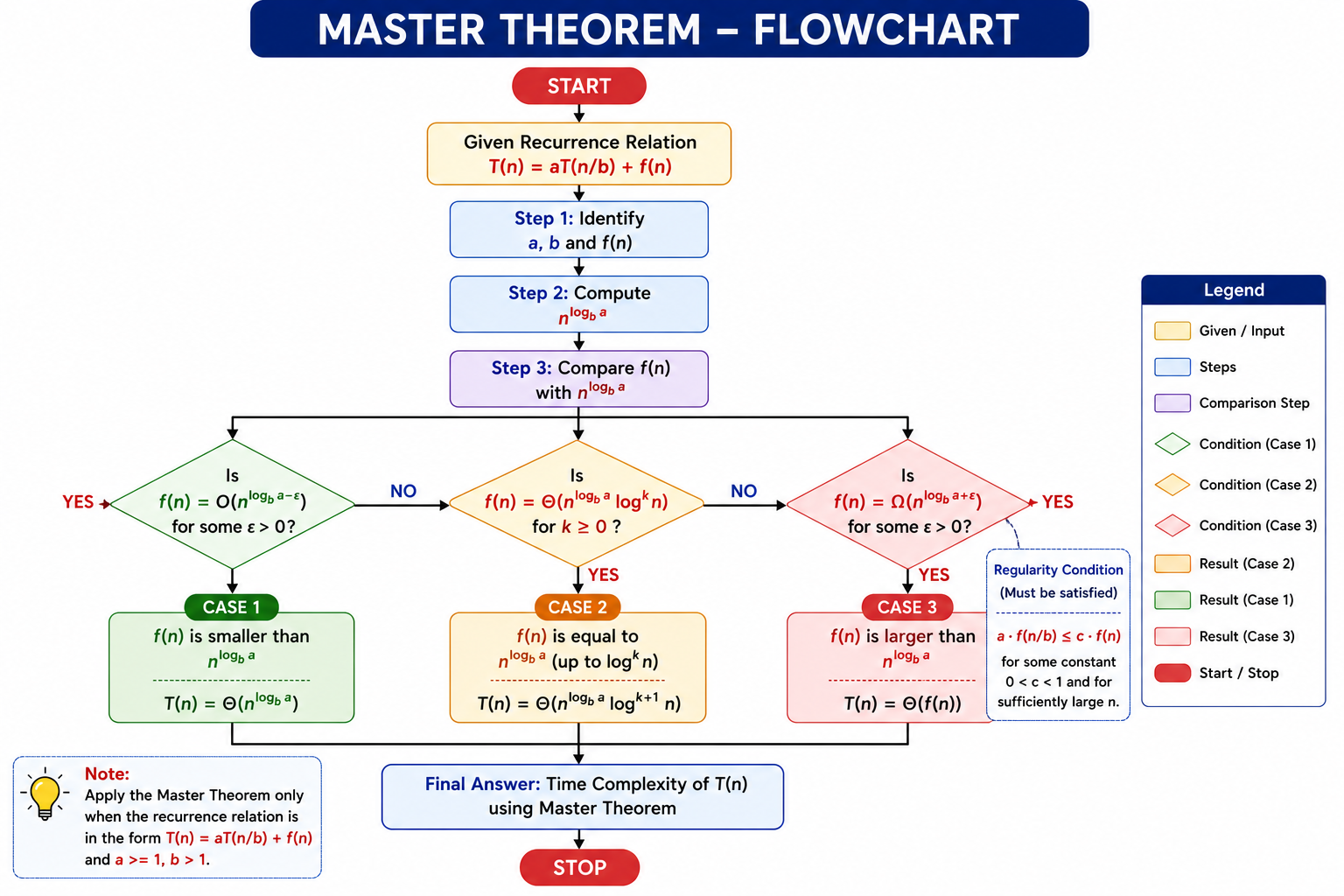
Flowchart of Applying Master Theorem
The following flowchart illustrates the step-by-step procedure for solving recurrence relations using Master Theorem.
Case 1 of Master Theorem
Case 1 applies when the work performed outside the recursive calls is asymptotically smaller than the total work performed by the recursive calls.
If
f(n) = O(nlogba - ε)
where ε > 0
then
T(n) = Θ(nlogba)
Example 1
Solve the recurrence relation
T(n)=2T(n/2)+1
Step 1
Identify the values.
| Parameter | Value |
|---|---|
| a | 2 |
| b | 2 |
| f(n) | 1 |
Step 2
Calculate
nlog22=n
Step 3
Since
1 = O(n1-ε)
Case 1 is applicable.
Answer
T(n)=Θ(n)
Case 2 of Master Theorem
Case 2 applies when the work outside recursion and recursive work are asymptotically equal.
If
f(n)=Θ(nlogba logkn)
where k ≥ 0
then
T(n)=Θ(nlogba logk+1n)
Example 2
Solve
T(n)=2T(n/2)+n
Step 1
| Parameter | Value |
|---|---|
| a | 2 |
| b | 2 |
| f(n) | n |
Step 2
Compute
nlog22=n
Step 3
Since
f(n)=Θ(n)
Both expressions are equal. Therefore, Case 2 is applicable.
Answer
T(n)=Θ(n log n)
Case 3 of Master Theorem
Case 3 applies when the work outside recursion dominates the recursive work.
If
f(n)=Ω(nlogba+ε)
where ε > 0 and the regularity condition is satisfied,
then
T(n)=Θ(f(n))
Example 3
Solve
T(n)=2T(n/2)+n²
Step 1
| Parameter | Value |
|---|---|
| a | 2 |
| b | 2 |
| f(n) | n² |
Step 2
Calculate
nlog22=n
Step 3
Since
n² = Ω(n1+ε)
Case 3 is applicable.
Answer
T(n)=Θ(n²)
Quick Comparison of All Three Cases
| Case | Condition | Result |
|---|---|---|
| Case 1 | f(n) is smaller than nlogba | Θ(nlogba) |
| Case 2 | f(n) equals nlogba | Θ(nlogba log n) |
| Case 3 | f(n) is larger than nlogba | Θ(f(n)) |
Decision Making Steps
- Write the recurrence in standard form.
- Identify a, b and f(n).
- Compute nlogba.
- Compare f(n) with nlogba.
- Select Case 1, Case 2 or Case 3.
- Write the final Θ() complexity.
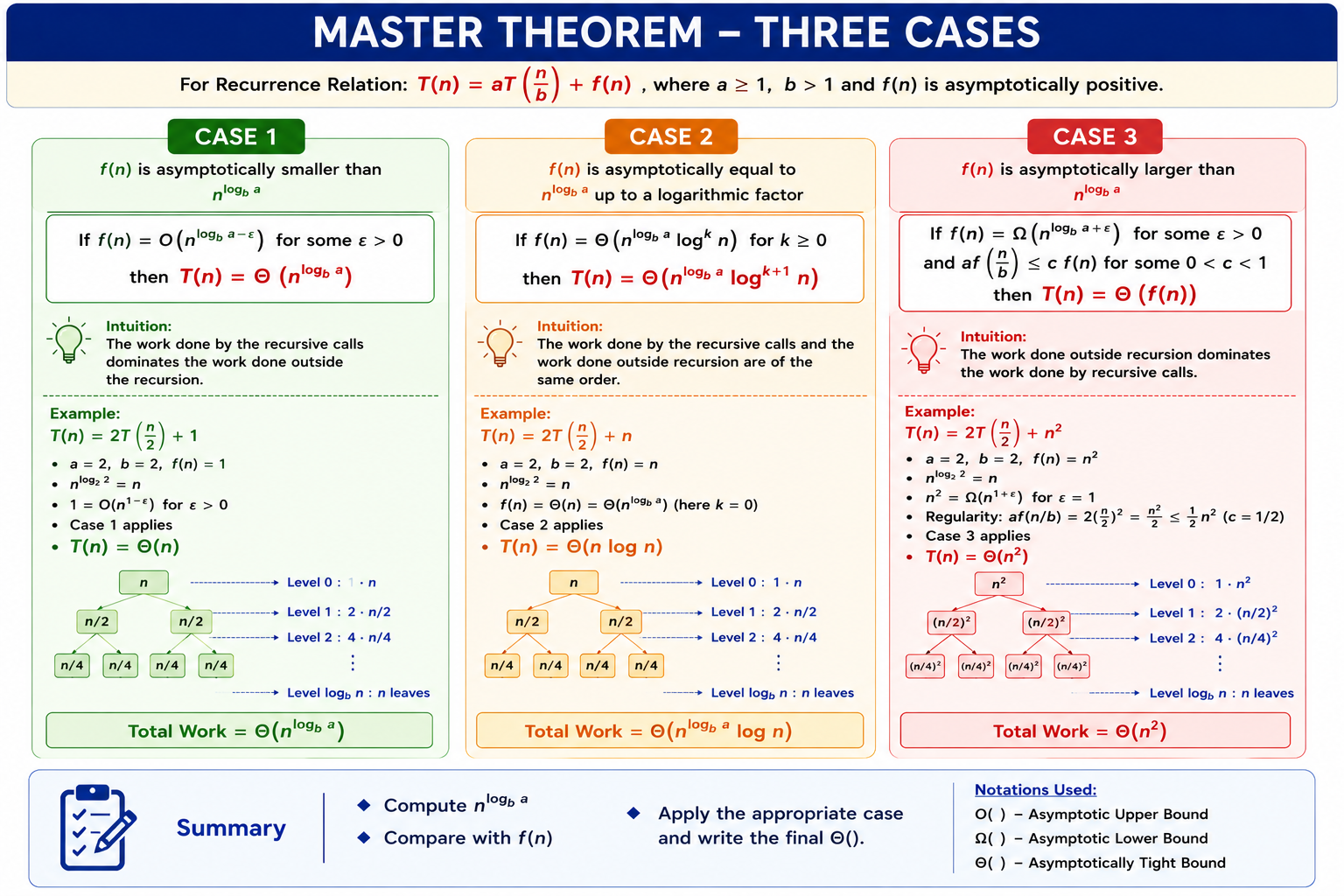
Flow of Solving Master Theorem
Regularity Condition
Before applying Case 3 of the Master Theorem, the following regularity condition must also be satisfied.
af(n/b) ≤ cf(n)
where
- 0 < c < 1
- n is sufficiently large.
This condition ensures that the work performed outside recursion grows significantly faster than the recursive work.
When Master Theorem Cannot Be Applied
Master Theorem is not applicable in the following situations.
- Recursive subproblems are of unequal sizes.
- Recurrence relation is not in the standard form.
- Problem does not follow Divide and Conquer.
- f(n) is not asymptotically positive.
- Regularity condition fails in Case 3.
Common Mistakes While Applying Master Theorem
- Incorrectly identifying the values of a and b.
- Comparing f(n) incorrectly with nlogba.
- Ignoring logarithmic terms.
- Applying the theorem to non-standard recurrence relations.
- Ignoring the regularity condition in Case 3.
- Writing the final answer without showing intermediate steps.
Applying Master Theorem to Divide and Conquer Algorithms
Many Divide and Conquer algorithms generate recurrence relations of the form
T(n)=aT(n/b)+f(n)
The Master Theorem can be directly applied to determine their time complexity.
1. Binary Search
Recurrence Relation
T(n)=T(n/2)+1
| Parameter | Value |
|---|---|
| a | 1 |
| b | 2 |
| f(n) | 1 |
| nlogba | 1 |
| Case | Case 2 |
| Time Complexity | Θ(log n) |
2. Merge Sort
Recurrence Relation
T(n)=2T(n/2)+n
| Parameter | Value |
|---|---|
| a | 2 |
| b | 2 |
| f(n) | n |
| nlogba | n |
| Case | Case 2 |
| Time Complexity | Θ(n log n) |
3. Strassen Matrix Multiplication
Recurrence Relation
T(n)=7T(n/2)+n²
| Parameter | Value |
|---|---|
| a | 7 |
| b | 2 |
| f(n) | n² |
| nlog27 | n2.807 |
| Case | Case 1 |
| Time Complexity | Θ(n2.807) |
4. Karatsuba Multiplication
Recurrence Relation
T(n)=3T(n/2)+n
| Parameter | Value |
|---|---|
| a | 3 |
| b | 2 |
| f(n) | n |
| nlog23 | n1.585 |
| Case | Case 1 |
| Time Complexity | Θ(n1.585) |
5. Closest Pair of Points
Recurrence Relation
T(n)=2T(n/2)+n
| Parameter | Value |
|---|---|
| a | 2 |
| b | 2 |
| Case | Case 2 |
| Time Complexity | Θ(n log n) |
6. Convex Hull (Divide and Conquer)
T(n)=2T(n/2)+n
Using Case 2,
Θ(n log n)
7. Maximum Subarray (Divide and Conquer)
T(n)=2T(n/2)+n
Applying Case 2,
Θ(n log n)
Summary of Divide and Conquer Algorithms
| Algorithm | Recurrence Relation | Master Theorem Case | Time Complexity |
|---|---|---|---|
| Binary Search | T(n)=T(n/2)+1 | Case 2 | Θ(log n) |
| Merge Sort | T(n)=2T(n/2)+n | Case 2 | Θ(n log n) |
| Strassen Matrix Multiplication | T(n)=7T(n/2)+n² | Case 1 | Θ(n²·⁸⁰⁷) |
| Karatsuba Multiplication | T(n)=3T(n/2)+n | Case 1 | Θ(n¹·⁵⁸⁵) |
| Closest Pair | T(n)=2T(n/2)+n | Case 2 | Θ(n log n) |
| Convex Hull | T(n)=2T(n/2)+n | Case 2 | Θ(n log n) |
| Maximum Subarray | T(n)=2T(n/2)+n | Case 2 | Θ(n log n) |
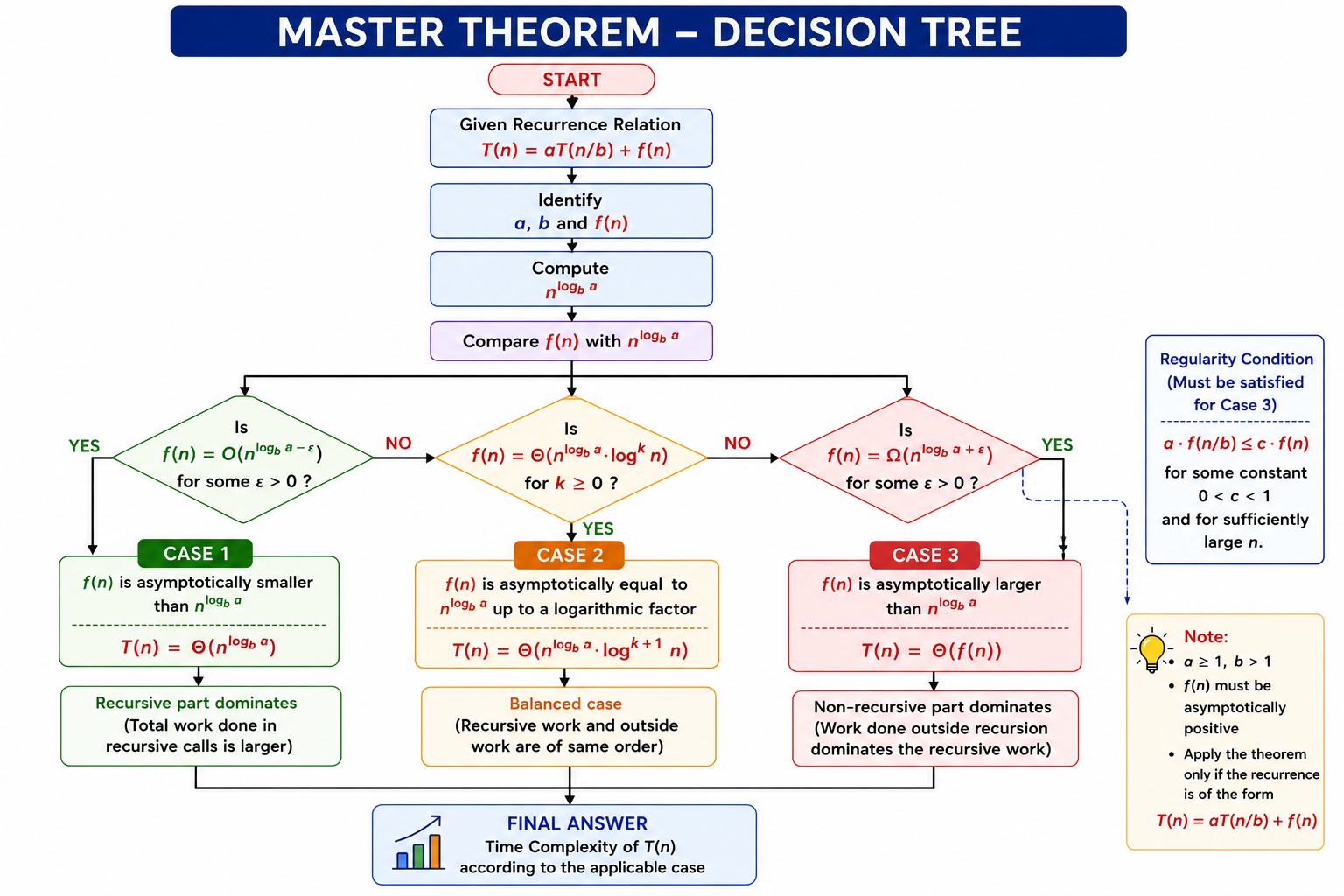
Decision Tree for Applying Master Theorem
Solved Examples Using Master Theorem
Example 1
Solve
T(n)=4T(n/2)+n
| Step | Solution |
|---|---|
| a | 4 |
| b | 2 |
| f(n) | n |
| nlog₂4 | n² |
| Applicable Case | Case 1 |
| Time Complexity | Θ(n²) |
Example 2
Solve
T(n)=8T(n/2)+n³
| Step | Solution |
|---|---|
| a | 8 |
| b | 2 |
| f(n) | n³ |
| nlog₂8 | n³ |
| Applicable Case | Case 2 |
| Time Complexity | Θ(n³ log n) |
Example 3
Solve
T(n)=9T(n/3)+n³
| Step | Solution |
|---|---|
| a | 9 |
| b | 3 |
| f(n) | n³ |
| nlog₃9 | n² |
| Applicable Case | Case 3 |
| Time Complexity | Θ(n³) |
Master Theorem Cheat Sheet
| Comparison | Case | Result |
|---|---|---|
| f(n) is Smaller | Case 1 | Θ(nlogba) |
| Equal | Case 2 | Θ(nlogba log n) |
| Greater | Case 3 | Θ(f(n)) |
Quick Steps to Solve Any Problem
- Write the recurrence in standard form.
- Identify a, b and f(n).
- Calculate nlogba.
- Compare f(n) with nlogba.
- Select the appropriate case.
- Write the Θ() complexity.
AKTU Previous Year Questions
- State and explain the Master Theorem.
- Explain all three cases of the Master Theorem with suitable examples.
- Solve T(n)=2T(n/2)+n using Master Theorem.
- Solve T(n)=4T(n/2)+n² using Master Theorem.
- Solve T(n)=3T(n/2)+n using Master Theorem.
- Find the time complexity of Merge Sort using Master Theorem.
- Find the time complexity of Binary Search using Master Theorem.
- Write the limitations of the Master Theorem.
- Explain the regularity condition in Case 3.
- Differentiate between Recurrence Relation and Master Theorem.
Viva Questions
- What is the Master Theorem?
- Why is the Master Theorem used?
- What is Divide and Conquer?
- What is a recurrence relation?
- What do the symbols a and b represent?
- What does f(n) represent?
- How many cases are there in the Master Theorem?
- When is Case 1 applicable?
- When is Case 2 applicable?
- When is Case 3 applicable?
- What is the regularity condition?
- Can Master Theorem solve every recurrence relation?
- Why can't it solve unequal subproblems?
- Which algorithms commonly use Master Theorem?
- What is the complexity of Merge Sort?
Interview Questions
- Explain the Master Theorem with examples.
- How do you determine which case is applicable?
- What are the limitations of the Master Theorem?
- Explain the recurrence relation of Merge Sort.
- Explain Binary Search using Master Theorem.
- Why does Merge Sort belong to Case 2?
- Why does Strassen Matrix Multiplication belong to Case 1?
- Explain the regularity condition with an example.
- When should Recursion Tree Method be preferred over Master Theorem?
- Can Quick Sort always be solved using Master Theorem?
Multiple Choice Questions (MCQs)
| Question | Answer |
|---|---|
| 1. Master Theorem is mainly used to solve ______. | Recurrence Relations |
| 2. Master Theorem is applicable to which paradigm? | Divide and Conquer |
| 3. T(n)=2T(n/2)+n belongs to ______. | Case 2 |
| 4. Binary Search has complexity ______. | Θ(log n) |
| 5. Merge Sort has complexity ______. | Θ(n log n) |
| 6. Strassen Matrix Multiplication belongs to ______. | Case 1 |
| 7. Case 3 requires ______. | Regularity Condition |
| 8. Karatsuba Algorithm complexity is ______. | Θ(n1.585) |
| 9. Number of cases in Master Theorem is ______. | 3 |
| 10. Master Theorem provides ______ complexity. | Asymptotic |
Practice Problems
- Solve T(n)=4T(n/2)+n.
- Solve T(n)=2T(n/2)+n².
- Solve T(n)=9T(n/3)+n.
- Solve T(n)=8T(n/2)+n³.
- Solve T(n)=3T(n/3)+n.
- Find the complexity of Strassen Matrix Multiplication.
- Find the complexity of Karatsuba Multiplication.
- Explain why Binary Search belongs to Case 2.
- Compare the three cases of Master Theorem.
- Write an algorithm for solving recurrence relations using Master Theorem.
Key Takeaways
- Master Theorem is the fastest technique for solving Divide and Conquer recurrence relations.
- Always identify a, b and f(n) first.
- Compute nlogba before selecting a case.
- There are only three cases in the Master Theorem.
- Binary Search, Merge Sort, Strassen Matrix Multiplication, Karatsuba Multiplication, Closest Pair, Convex Hull and Maximum Subarray can all be analyzed using the Master Theorem.
- Do not apply the theorem to recurrence relations that do not satisfy its standard form.
- Remember the regularity condition while applying Case 3.
Summary
The Master Theorem is one of the most powerful techniques in Design and Analysis of Algorithms for solving recurrence relations generated by Divide and Conquer algorithms. It provides a direct method to determine asymptotic time complexity without expanding the recurrence relation manually. By identifying the values of a, b and f(n), computing nlogba, and comparing the results, students can easily determine whether Case 1, Case 2 or Case 3 is applicable. Master Theorem is extensively used to analyze algorithms such as Binary Search, Merge Sort, Strassen Matrix Multiplication, Karatsuba Multiplication, Closest Pair of Points, Convex Hull and Maximum Subarray. A strong understanding of this theorem is essential for AKTU semester examinations, GATE, placement interviews and competitive programming.