Question Bank 1
Basic Questions for Practise : Part 1 :
-
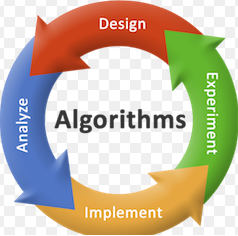
What is an algorithm?
→ Define what an algorithm is and its basic characteristics. -
What are the different types of algorithm design techniques?
→ Examples: Divide and Conquer, Dynamic Programming, Greedy Method, Backtracking, etc. -
What is time complexity?
→ Explain how the running time of an algorithm is measured. -
What is space complexity?
→ Define how much memory an algorithm uses during execution. -
What is Big O notation?
→ Explain its use in representing the upper bound of an algorithm’s growth rate. -
What is the difference between best case, worst case, and average case complexity?
→ Describe with examples (like linear search or binary search). -
What is Divide and Conquer technique? Give an example.
→ Example: Merge Sort, Quick Sort, Binary Search. -
What is a greedy algorithm? Give an example.
→ Example: Kruskal’s or Prim’s algorithm for Minimum Spanning Tree. -
What is Dynamic Programming?
→ Explain with an example such as Fibonacci series or shortest path (Floyd-Warshall).
Part 2:
- Define Algorithms and its Design Strategies.
- What is the recurrence relation of Merge Sort? Derive its time complexity for best and worst case.
- List the properties of Binomial Tree.
- Define Greedy Method.
- Sort the following array by counting sort. A= {2,5,3,0,2,3,0,3}
- What is the stable sorting algorithm? Which of the sorting algorithms(in our syllabus) are stable and which are unstable?
- Explain B-trees and its properties. Also write the algorithm for deletion cases with example.
- Insert the following elements using RB tree. {61,58,51,32,39,29}
- Write a pseudocode for Dijkstra’s algorithm for single source shortest path with the help of an example.
- Write the Pseudocode of partitioning algorithm of Quick Sort. Use Quick Sort to sort {4,3,1,2,5,9,7,1,6}
- Describe the Master’s theorem. Solve the following recurrence relations by using Master’s theorem.
a)T(n)=4T(n/2)+n
b)T(n)=2T(n/2)+nlogn
- What is Skip List? Explain the Search operations in Skip List with the help of an example.
- Explain the different conditions of getting union of two existing Binomial Heaps. Also write algorithm for union of two Binomial Heaps. What is its complexity?
- Discuss about fractional knapsack problem. Consider the following instance of knapsack problem:
n=3 and m=20, Profits: (p1,p2,p3)=(25,24,15)Weights: (w1,w2,w3)=(18,15,10)
- Obtain the optimal solution using greedy approach.
- Prove that if the weights on the edge of the connected undirected graph are distinct, then there is a unique Minimum Spanning Tree. Give an example in this regard. Also discuss Prim’s Minimum Spanning Tree Algorithm in detail.
- Write algorithm for Bubble sort .
- Explain the logic for insertion and merge sort .