Tree Traversal Algorithms: Inorder, Preorder and Postorder
Tree traversal is the process of visiting exactly once every node in a tree data structure. It defines the specific order in which nodes are accessed, typically to update, delete, or display the data they contain.
Theory & Explanation
Tree Traversal Algorithms: Inorder, Preorder, and Postorder
1. Definition and Overview
Tree Traversal is the process of visiting (checking and/or updating) each node in a tree data structure, exactly once. Unlike linear data structures (arrays, linked lists) which have a canonical linear ordering, trees can be traversed in multiple ways.
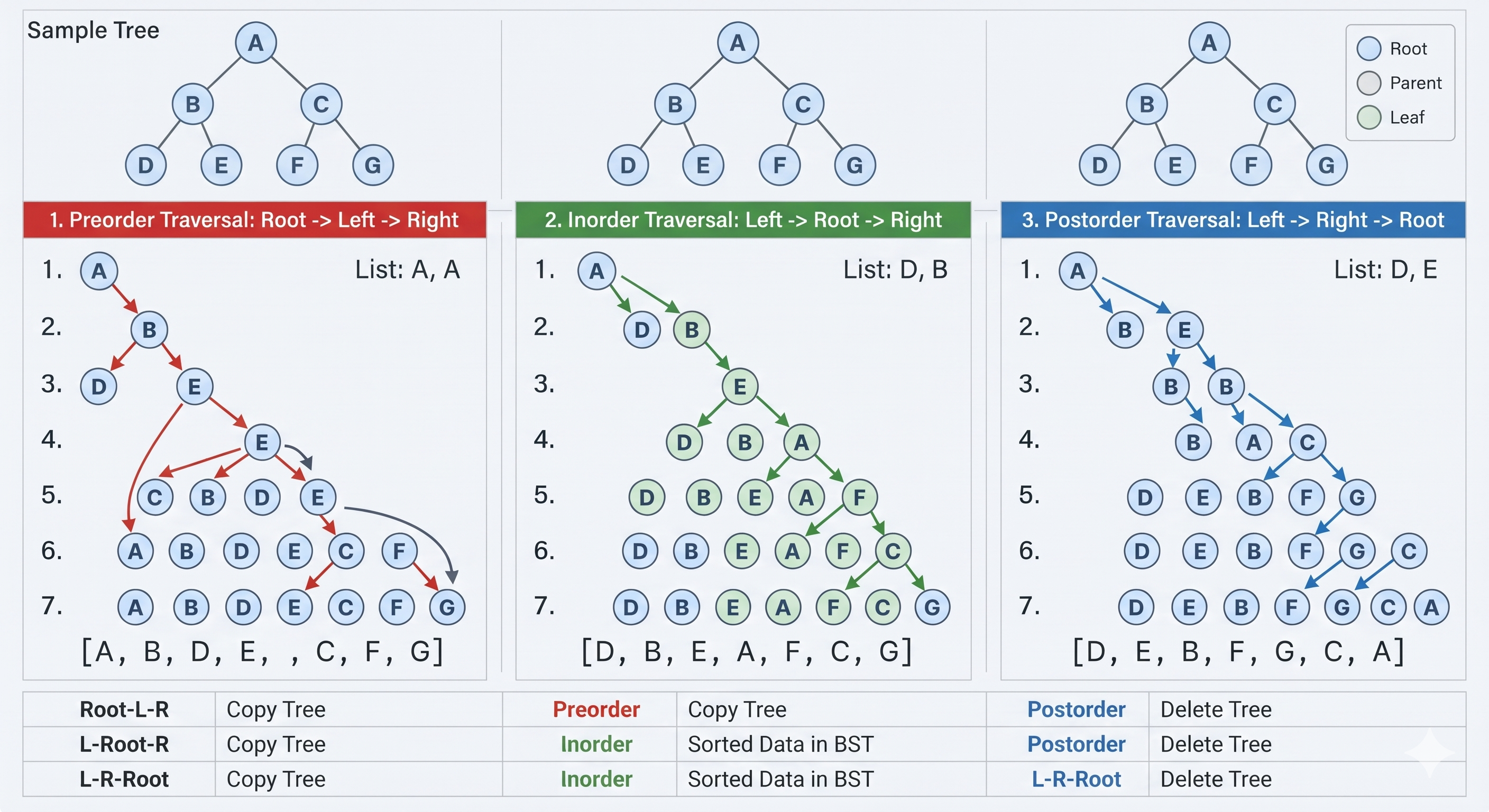
The three most common Depth-First Search (DFS) traversal algorithms for binary trees are defined by the position of the parent node (Root) relative to visiting its Left and Right subtrees:
- Preorder: Root → Left → Right
- Inorder: Left → Root → Right
- Postorder: Left → Right → Root
2. Graphical Representation of the Sample Tree
We will use the following binary tree for our examples and traversal traces.
Sample Binary Tree Structure
3. Traversal Algorithms: Step-by-Step Trace and Example
Using the tree above, we recursively trace each algorithm.
A. Preorder Traversal (Root → Left → Right)
The root is visited first, followed by the recursive preorder traversal of the left subtree, then the recursive preorder traversal of the right subtree.
- 1. Visit Root: 1
- 2. Traverse Left Subtree of 1:
- 2a. Visit Root: 2
- 2b. Traverse Left Subtree of 2: Visit 4
- 2c. Traverse Right Subtree of 2: Visit 5
- 3. Traverse Right Subtree of 1: Visit 3
Preorder Output: [1, 2, 4, 5, 3]
B. Inorder Traversal (Left → Root → Right)
The left subtree is visited first (recursively), then the root node, and finally the right subtree (recursively). For a Binary Search Tree (BST), this visits nodes in non-decreasing order.
- 1. Traverse Left Subtree of 1:
- 1a. Traverse Left Subtree of 2: Visit 4
- 1b. Visit Root: 2
- 1c. Traverse Right Subtree of 2: Visit 5
- 2. Visit Root: 1
- 3. Traverse Right Subtree of 1: Visit 3
Inorder Output: [4, 2, 5, 1, 3]
C. Postorder Traversal (Left → Right → Root)
Both the left and right subtrees are visited (recursively) before the root node. This is commonly used to delete a tree or evaluate postfix expressions.
- 1. Traverse Left Subtree of 1:
- 1a. Traverse Left Subtree of 2: Visit 4
- 1b. Traverse Right Subtree of 2: Visit 5
- 1c. Visit Root: 2
- 2. Traverse Right Subtree of 1: Visit 3
- 3. Visit Root: 1
Postorder Output: [4, 5, 2, 3, 1]
4. C Implementation of Tree Traversals
#include <stdio.h>
#include <stdlib.h>

// Definition of a Tree Node
struct Node {
    int data;
    struct Node left;
    struct Node right;
};

// Helper function to create a new node
struct Node createNode(int data) {
    struct Node newNode = (struct Node)malloc(sizeof(struct Node));
    newNode->data = data;
    newNode->left = NULL;
    newNode->right = NULL;
    return newNode;
}

// 1. Preorder Traversal (Root, Left, Right)
void preorderTraversal(struct Node root) {
    if (root == NULL) return;
    printf("%d ", root->data);      // Visit Root
    preorderTraversal(root->left);   // Traverse Left
    preorderTraversal(root->right);  // Traverse Right
}

// 2. Inorder Traversal (Left, Root, Right)
void inorderTraversal(struct Node root) {
    if (root == NULL) return;
    inorderTraversal(root->left);    // Traverse Left
    printf("%d ", root->data);      // Visit Root
    inorderTraversal(root->right);   // Traverse Right
}

// 3. Postorder Traversal (Left, Right, Root)
void postorderTraversal(struct Node root) {
    if (root == NULL) return;
    postorderTraversal(root->left);   // Traverse Left
    postorderTraversal(root->right);  // Traverse Right
    printf("%d ", root->data);      // Visit Root
}

int main() {
    // Constructing the sample tree
    struct Node* root = createNode(1);
    root->left = createNode(2);
    root->right = createNode(3);
    root->left->left = createNode(4);
    root->left->right = createNode(5);

    printf("Preorder Traversal:  ");
    preorderTraversal(root);
    printf("\n");

    printf("Inorder Traversal:   ");
    inorderTraversal(root);
    printf("\n");

    printf("Postorder Traversal: ");
    postorderTraversal(root);
    printf("\n");

    return 0;
}
Expected Output (C):
Preorder Traversal:  1 2 4 5 3
Inorder Traversal:   4 2 5 1 3
Postorder Traversal: 4 5 2 3 1
5. Python Implementation of Tree Traversals
class Node:
    def __init__(self, data):
        self.data = data
        self.left = None
        self.right = None

# 1. Preorder Traversal (Root, Left, Right)
def preorder_traversal(root, result=[]):
    if not root:
        return result
    result.append(root.data)        # Visit Root
    preorder_traversal(root.left, result)  # Traverse Left
    preorder_traversal(root.right, result) # Traverse Right
    return result

# 2. Inorder Traversal (Left, Root, Right)
def inorder_traversal(root, result=[]):
    if not root:
        return result
    inorder_traversal(root.left, result)   # Traverse Left
    result.append(root.data)         # Visit Root
    inorder_traversal(root.right, result)  # Traverse Right
    return result

# 3. Postorder Traversal (Left, Right, Root)
def postorder_traversal(root, result=[]):
    if not root:
        return result
    postorder_traversal(root.left, result)  # Traverse Left
    postorder_traversal(root.right, result) # Traverse Right
    result.append(root.data)        # Visit Root
    return result

if __name__ == "__main__":
    # Constructing the sample tree
    root = Node(1)
    root.left = Node(2)
    root.right = Node(3)
    root.left.left = Node(4)
    root.left.right = Node(5)

    # Note: We pass a fresh list for each call because Python
    # default arguments persist between calls.
    print("Preorder Traversal: ", preorder_traversal(root, []))
    print("Inorder Traversal:  ", inorder_traversal(root, []))
    print("Postorder Traversal:", postorder_traversal(root, []))
Expected Output (Python):
Preorder Traversal:  [1, 2, 4, 5, 3]
Inorder Traversal:   [4, 2, 5, 1, 3]
Postorder Traversal: [4, 5, 2, 3, 1]
Diagrams
tree-traversal-algorithms-inorder-preorder-and-postorder - Diagram