Application of stack: Prefix and Postfix Expressions, Evaluation of postfix expression
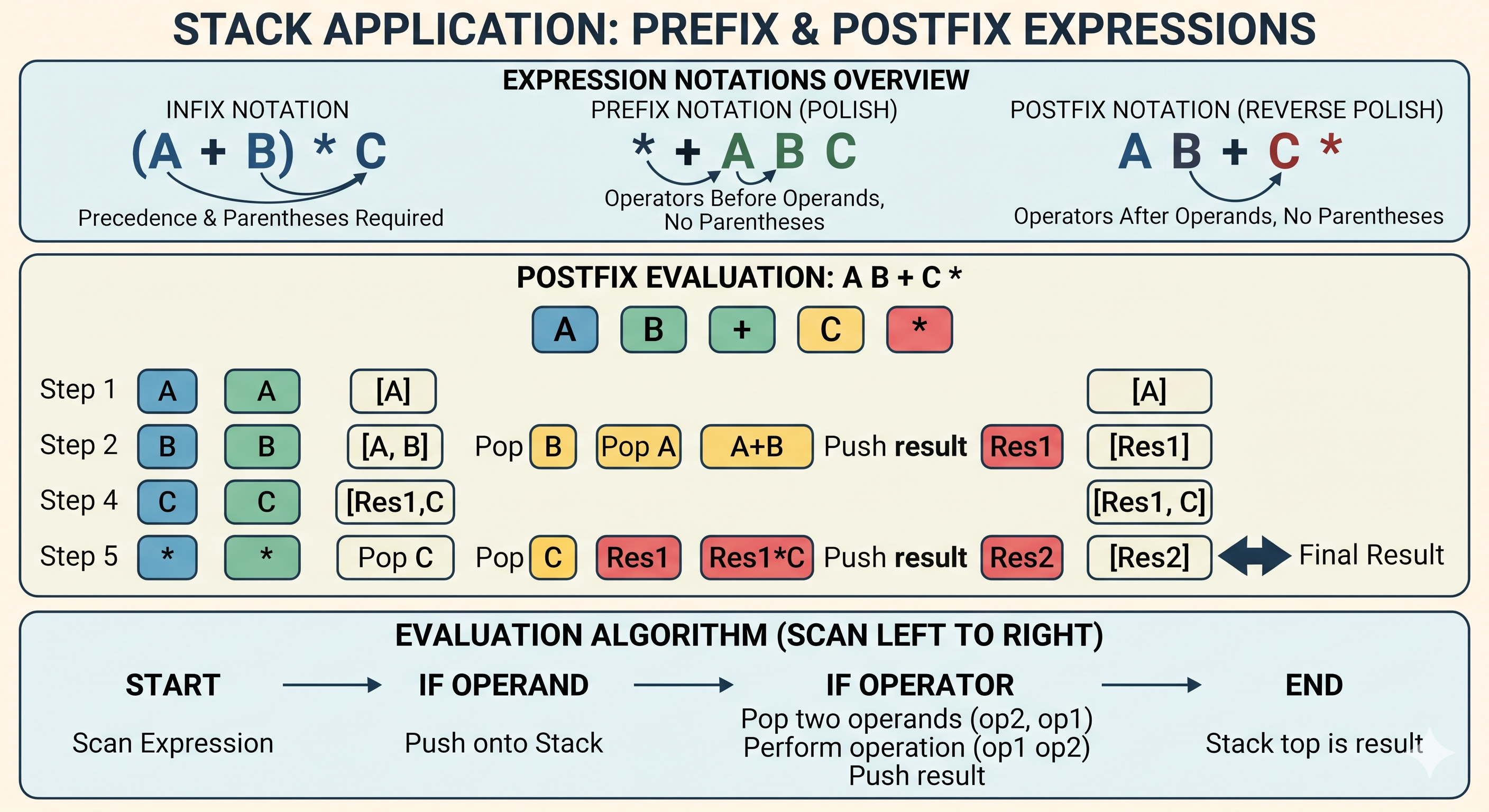
Stacks efficiently handle Prefix and Postfix notations, eliminating parentheses and precedence rules. To evaluate a postfix expression, scan left to right: push operands, pop top two for operators, apply the operator, and push the result back.
Theory & Explanation
Applications of Stack: Infix, Prefix & Postfix Expressions and Postfix Evaluation
1. Why Use Stacks for Expressions?
A stack (LIFO: Last-In, First-Out) is widely used by compilers and calculators to parse and evaluate arithmetic expressions. Standard human-readable expressions require rules for operator precedence (such as and / before + and -), associativity (left-to-right or right-to-left), and parentheses () to override precedence.
Prefix and Postfix notations remove the need for parentheses and precedence rules during evaluation, making expression evaluation clean and unambiguous using a stack.
2. Definitions & Examples of Notations
-
Infix Notation: The operator is placed between its two operands. Example:
(A + B) Cor5 + 3 2. Easy for humans to read, but needs precedence and parentheses rules for evaluation. -
Prefix Notation (Polish Notation): The operator is placed before its operands. Example: Infix
(A + B) Cbecomes+ A B C. -
Postfix Notation (Reverse Polish Notation / RPN): The operator is placed after its operands. Example: Infix
(A + B) CbecomesA B + C.
| Infix Expression | Prefix Expression | Postfix Expression |
|---|---|---|
A + B |
+ A B |
A B + |
(A + B) C |
+ A B C |
A B + C |
A + B C |
+ A B C |
A B C + |
(A - B) / (C + D) |
/ - A B + C D |
A B - C D + / |
3. Operator Precedence & Associativity (Exam Quick Reference)
- Highest Precedence: Exponentiation (
^or$) — typically Right-to-Left associative. - Medium Precedence: Multiplication (
) and Division (/) — Left-to-Right associative. - Lowest Precedence: Addition (
+) and Subtraction (-) — Left-to-Right associative. - Parentheses
(and): Group sub-expressions and override default precedence.
4. Expression Conversions (Algorithms & Examples)
A. Infix to Postfix Conversion (Using Stack)
- Scan the infix expression from left to right.
- If the token is an operand (variable/number), append it directly to the postfix output.
- If the token is
(, push it onto the stack. - If the token is
), pop and output operators until(is encountered; discard both(and). - If the token is an operator, while the stack is non-empty and top of stack has higher or equal precedence (respecting right-associativity for
^), pop to output; then push the current operator. - After scanning all tokens, pop and output any remaining operators from the stack.
Example Trace — Convert Infix A + B C to Postfix:
- Read
A(operand) → Output:A, Stack:[] - Read
+(operator) → Stack empty → Output:A, Stack:[+] - Read
B(operand) → Output:A B, Stack:[+] - Read
(operator) →has higher precedence than+→ Output:A B, Stack:[+, ] - Read
C(operand) → Output:A B C, Stack:[+, ] - End of string → Pop remaining:
then+→ Final Postfix:A B C +.
B. Infix to Prefix Conversion (Reverse-Postfix-Reverse Method)
- Reverse the infix expression and swap
(with)and)with(. - Convert the modified expression to postfix (adjusting operator popping condition so equal precedence is handled cleanly for right-to-left scan).
- Reverse the resulting postfix string to get the prefix expression.
Example Trace — Convert Infix (A + B) C to Prefix:
- Step 1 (Reverse & swap brackets):
(A + B) C→ reversed:C ) B + A (→ swapped:C ( B + A ). - Step 2 (Postfix of
C ( B + A )):C B A +. - Step 3 (Reverse result):
+ A B C(Prefix).
C. Postfix to Infix Conversion (Using Stack)
- Scan postfix from left to right.
- If operand, push it onto the stack.
- If operator, pop top two operands:
op2 = pop()(right operand) andop1 = pop()(left operand). Form"(op1 operator op2)"and push it back.
Example: Postfix A B + C → A pushed, B pushed, + pops B, A → pushes (A + B); C pushed, pops C, (A + B) → pushes ((A + B) C).
D. Prefix to Infix Conversion (Using Stack)
- Scan prefix from right to left.
- If operand, push it onto the stack.
- If operator, pop top two operands:
op1 = pop()(left operand) andop2 = pop()(right operand). Form"(op1 operator op2)"and push it back.
Example: Prefix + A B C (scan right-to-left) → push C, B, A; see + → pop A, B → push (A + B); see → pop (A + B), C → push ((A + B) C).
E. Postfix to Prefix & Prefix to Postfix
- Postfix to Prefix: Scan left-to-right; on operand, push; on operator, pop
op2thenop1, pushoperator + op1 + op2. Example:A B +→+ A B. - Prefix to Postfix: Scan right-to-left; on operand, push; on operator, pop
op1thenop2, pushop1 + op2 + operator. Example:+ A B→A B +.
5. Evaluation of a Postfix Expression
To evaluate a postfix expression, scan from left to right using a stack:
- If the scanned token is an operand, push its numeric value onto the stack.
- If the scanned token is an operator, pop the top two elements: first
operand2(right operand), thenoperand1(left operand). - Compute
result = operand1 (operator) operand2(note order for subtractionop1 - op2and divisionop1 / op2). - Push
resultback onto the stack. - After scanning the entire expression, the single value remaining on top of the stack is the final answer.
Numerical Example Trace — Evaluate Postfix 2 3 1 + 9 -:
| Token | Action | Stack (Bottom → Top) |
|---|---|---|
2 |
Operand → Push 2 |
[2] |
3 |
Operand → Push 3 |
[2, 3] |
1 |
Operand → Push 1 |
[2, 3, 1] |
|
Operator → Pop 1 (op2), Pop 3 (op1); 3 * 1 = 3; Push 3 |
[2, 3] |
+ |
Operator → Pop 3 (op2), Pop 2 (op1); 2 + 3 = 5; Push 5 |
[5] |
9 |
Operand → Push 9 |
[5, 9] |
- |
Operator → Pop 9 (op2), Pop 5 (op1); 5 - 9 = -4; Push -4 |
[-4] |
Final Result: -4 (Time Complexity: O(n), Space Complexity: O(n) where n is the number of tokens).
Diagrams
application-of-stack-prefix-and-postfix-expressions-evaluation-of-postfix-expression - Diagram