
Power Set of a Set using C, C++, Java and Python
Objective
To write a program in C, C++, Java and Python to create a set and perform the Power Set operation on the set.
Theory
The Power Set of a set A is represented by:
P(A)
It is the set containing all possible subsets of Set A.
If a set contains n elements, then its Power Set contains:
2ⁿ subsets
Example
Consider the set:
A = {1, 2, 3}
The Power Set contains all possible subsets of A:
P(A) = { ∅, {1}, {2}, {3}, {1,2}, {1,3}, {2,3}, {1,2,3} }
Since Set A contains 3 elements:
2³ = 8
Therefore, the Power Set contains 8 subsets.
Important Points
- The Power Set contains the empty set.
- The Power Set contains the original set.
- If A contains n elements, P(A) contains 2ⁿ subsets.
- The Power Set is itself a set.
- The number of subsets grows exponentially with the number of elements.
Bitmask Concept
One efficient way to generate a Power Set is by using the bitmask technique. For a set containing n elements, we need to generate numbers from:
0 to 2ⁿ − 1
Each binary number represents one possible subset. For example, consider:
A = {1, 2, 3}
| Binary | Selected Elements | Subset |
|---|---|---|
| 000 | None | ∅ |
| 001 | 1 | {1} |
| 010 | 2 | {2} |
| 011 | 1, 2 | {1,2} |
| 100 | 3 | {3} |
| 101 | 1, 3 | {1,3} |
| 110 | 2, 3 | {2,3} |
| 111 | 1, 2, 3 | {1,2,3} |
Algorithm
- Start.
- Read the number of elements n.
- Read the elements of the set.
- Calculate 2ⁿ.
- Generate numbers from 0 to 2ⁿ − 1.
- For each number, examine its binary representation.
- If a particular bit is 1, include the corresponding element in the subset.
- Display the generated subset.
- Repeat until all 2ⁿ subsets have been generated.
- Stop.
Flowchart
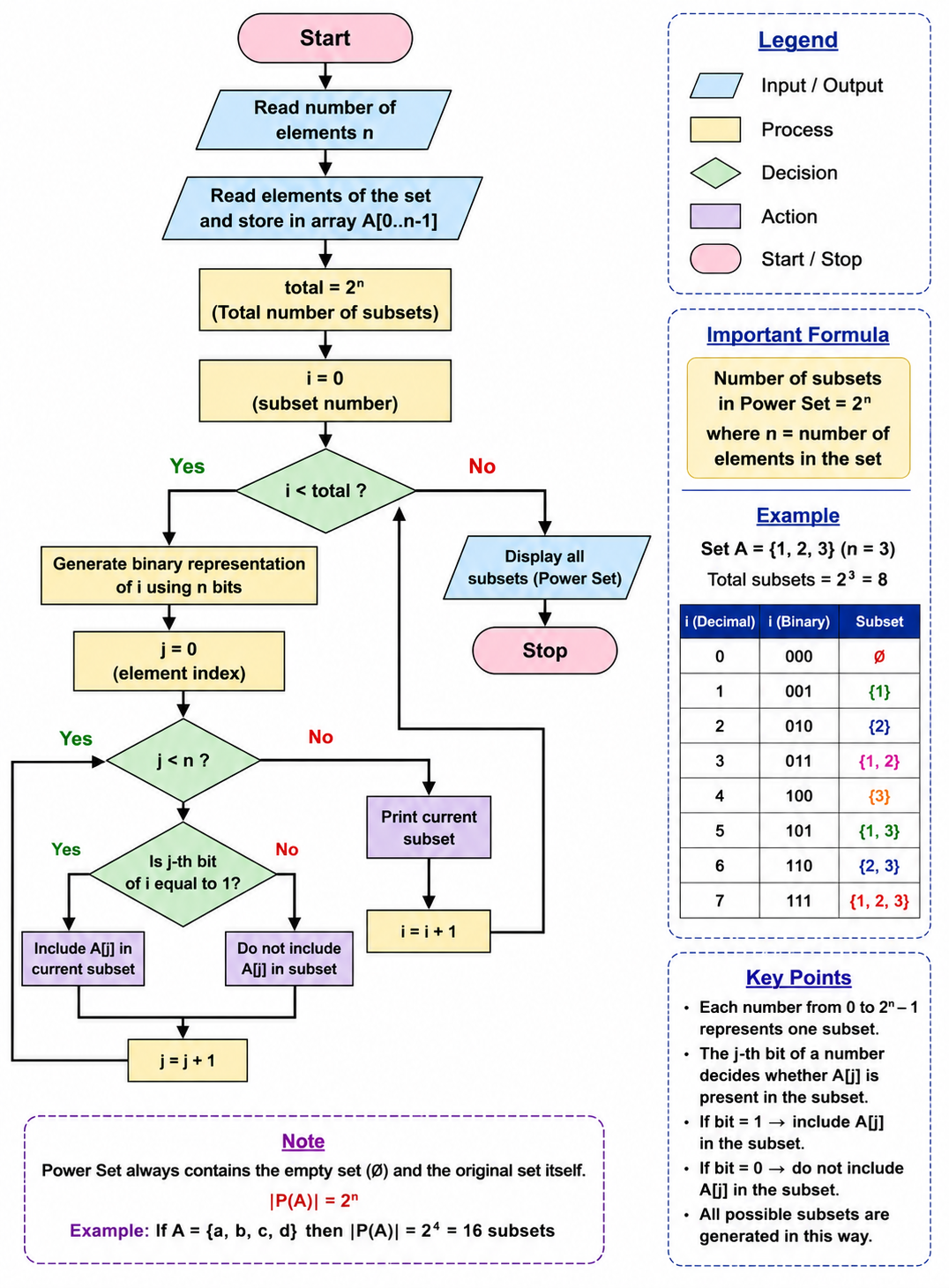
Example
| Number of Elements | Number of Subsets |
|---|---|
| 1 | 2¹ = 2 |
| 2 | 2² = 4 |
| 3 | 2³ = 8 |
| 4 | 2⁴ = 16 |
| 5 | 2⁵ = 32 |
C Program
The following C program generates the Power Set using the bitmask technique.
/* C Program to Generate Power Set */

#include <stdio.h>

int main()
{
    int set[20];
    int n;
    int i, j;
    int total;

    printf("Enter number of elements in the set: ");
    scanf("%d", &n);

    printf("Enter elements of the set:\n");

    for(i = 0; i < n; i++)
    {
        scanf("%d", &set[i]);
    }

    total = 1 << n;

    printf("\nPower Set:\n");

    for(i = 0; i < total; i++)
    {
        printf("{ ");

        for(j = 0; j < n; j++)
        {
            if(i & (1 << j))
            {
                printf("%d ", set[j]);
            }
        }

        printf("}\n");
    }

    return 0;
}
Sample Output (C)
Enter number of elements in the set: 3

Enter elements of the set:
1 2 3

Power Set:
{ }
{ 1 }
{ 2 }
{ 1 2 }
{ 3 }
{ 1 3 }
{ 2 3 }
{ 1 2 3 }
How the C Program Works
- The elements of the set are stored in an array.
- The program calculates 2ⁿ using the left-shift operation.
- Each number from 0 to 2ⁿ − 1 represents one subset.
- Each bit is checked using the bitwise AND operator.
- If a bit is 1, the corresponding element is included.
- If a bit is 0, the corresponding element is excluded.
- All possible subsets are therefore generated.
Understanding the Bitwise Operation
The expression:
i & (1 << j)
checks whether the j-th bit of i is set to 1. If the result is non-zero, the corresponding element is included in the subset.
C++ Program
/* C++ Program to Generate Power Set */

#include <iostream>
#include <vector>

using namespace std;

int main()
{
    int n;

    cout << "Enter number of elements in the set: ";
    cin >> n;

    vector<int> set(n);

    cout << "Enter elements of the set:\n";

    for(int i = 0; i < n; i++)
    {
        cin >> set[i];
    }

    int total = 1 << n;

    cout << "\nPower Set:\n";

    for(int i = 0; i < total; i++)
    {
        cout << "{ ";

        for(int j = 0; j < n; j++)
        {
            if(i & (1 << j))
            {
                cout << set[j] << " ";
            }
        }

        cout << "}\n";
    }

    return 0;
}
Sample Output (C++)
Enter number of elements in the set: 3

Enter elements of the set:
1 2 3

Power Set:
{ }
{ 1 }
{ 2 }
{ 1 2 }
{ 3 }
{ 1 3 }
{ 2 3 }
{ 1 2 3 }
Java Program
The following Java program generates all subsets using the bitmask technique.
/* Java Program to Generate Power Set */

import java.util.Scanner;

public class PowerSet
{
    public static void main(String[] args)
    {
        Scanner sc = new Scanner(System.in);

        System.out.print("Enter number of elements in the set: ");
        int n = sc.nextInt();

        int[] set = new int[n];

        System.out.println("Enter elements of the set:");

        for(int i = 0; i < n; i++)
        {
            set[i] = sc.nextInt();
        }

        int total = 1 << n;

        System.out.println("\nPower Set:");

        for(int i = 0; i < total; i++)
        {
            System.out.print("{ ");

            for(int j = 0; j < n; j++)
            {
                if((i & (1 << j)) != 0)
                {
                    System.out.print(set[j] + " ");
                }
            }

            System.out.println("}");
        }

        sc.close();
    }
}
Sample Output (Java)
Enter number of elements in the set: 3

Enter elements of the set:
1 2 3

Power Set:
{ }
{ 1 }
{ 2 }
{ 1 2 }
{ 3 }
{ 1 3 }
{ 2 3 }
{ 1 2 3 }
Python Program
Python can generate the Power Set using the same bitmask concept.
# Python Program to Generate Power Set

n = int(input("Enter number of elements in the set: "))

elements = []

print("Enter elements of the set:")

for i in range(n):

    elements.append(int(input()))

total = 1 << n

print("\nPower Set:")

for i in range(total):

    subset = []

    for j in range(n):

        if i & (1 << j):

            subset.append(elements[j])

    print(subset)
Sample Output (Python)
Enter number of elements in the set: 3

Enter elements of the set:
1
2
3

Power Set:
[]
[1]
[2]
[1, 2]
[3]
[1, 3]
[2, 3]
[1, 2, 3]
Python Using itertools
Python also provides a convenient way to generate combinations using the itertools module.
# Python Program to Generate Power Set using itertools

from itertools import combinations

A = {1, 2, 3}

power_set = []

for r in range(len(A) + 1):

    for subset in combinations(A, r):

        power_set.append(set(subset))

print("Set A =", A)

print("Power Set:")

for subset in power_set:

    print(subset)
Python Using a Simple Iterative Method
The Power Set can also be generated by starting with the empty set and repeatedly adding each element to all existing subsets.
# Python Program to Generate Power Set

A = [1, 2, 3]

power_set = [[]]

for element in A:

    new_subsets = []

    for subset in power_set:

        new_subsets.append(subset + [element])

    power_set = power_set + new_subsets

print("Set A =", A)

print("Power Set:")

for subset in power_set:

    print(subset)
Number of Subsets
For a set containing n elements, the number of subsets is:
2ⁿ
For example, for 4 elements:
2⁴ = 16
Therefore, a set containing four elements has exactly 16 subsets.
Dry Run
Consider the set:
A = {1, 2, 3}
Since the set contains three elements:
2³ = 8
Therefore, eight subsets will be generated.
| Decimal | Binary | Selected Elements | Subset |
|---|---|---|---|
| 0 | 000 | None | ∅ |
| 1 | 001 | 1 | {1} |
| 2 | 010 | 2 | {2} |
| 3 | 011 | 1, 2 | {1,2} |
| 4 | 100 | 3 | {3} |
| 5 | 101 | 1, 3 | {1,3} |
| 6 | 110 | 2, 3 | {2,3} |
| 7 | 111 | 1, 2, 3 | {1,2,3} |
Understanding the Bitmask
Suppose:
A = {1, 2, 3}
For the binary number 101:
- The first bit is 1 → include 1.
- The second bit is 0 → exclude 2.
- The third bit is 1 → include 3.
Therefore:
101 → {1,3}
This is the basic idea behind the bitmask algorithm.
Time Complexity
| Operation | Complexity |
|---|---|
| Generate all subsets | O(n × 2ⁿ) |
There are 2ⁿ subsets, and each subset may require checking up to n elements. Therefore, the overall time complexity is:
O(n × 2ⁿ)
Space Complexity
If the generated Power Set is stored, the space requirement can be considered:
O(n × 2ⁿ)
This is because there are 2ⁿ subsets and each subset can contain up to n elements.
Applications
- Combinatorial Problems
- Subset Sum Problems
- Dynamic Programming
- Backtracking
- Optimization Problems
- Combinatorial Search
- Feature Selection
- Machine Learning
- Database Query Processing
- Artificial Intelligence
Advantages
- Simple and systematic method for generating all subsets.
- Bitmask technique is easy to implement.
- Works efficiently for small sets.
- Useful in many combinatorial algorithms.
- Can be implemented in C, C++, Java and Python.
Disadvantages
- The number of subsets increases exponentially.
- Large sets require significant memory.
- Time complexity becomes very high for large values of n.
- Power Set generation is generally impractical for very large sets.
Important Properties of Power Set
- If A contains n elements, P(A) contains 2ⁿ elements.
- The empty set ∅ always belongs to P(A).
- The original set A always belongs to P(A).
- Every subset of A belongs to P(A).
- P(A) itself is a set.
Viva Questions
- What is a Power Set?
- How is Power Set represented?
- How many subsets does a set containing n elements have?
- What is the Power Set of {1,2}?
- Does the Power Set contain the empty set?
- Does the Power Set contain the original set?
- What is the time complexity of generating a Power Set?
- What is the bitmask technique?
- Why are numbers from 0 to 2ⁿ − 1 used?
- What does a bit value of 1 represent?
Frequently Asked Interview Questions
-
What is a Power Set?
A Power Set is the set containing all possible subsets of a given set. -
How many elements are present in the Power Set of a set containing n
elements?
The Power Set contains 2ⁿ elements. -
What is the Power Set of {a,b}?
P(A) = {∅, {a}, {b}, {a,b}} -
Why does the Power Set contain 2ⁿ subsets?
Each element has two possibilities: it can either be included in a subset or excluded from it. Therefore, for n elements there are 2 × 2 × ... × 2 = 2ⁿ possible subsets. -
What is the time complexity of Power Set generation?
The standard bitmask implementation takes O(n × 2ⁿ) time. -
Why is Power Set generation considered exponential?
Because the number of subsets doubles whenever one additional element is added to the original set.
Practice Questions
- Write a C program to generate the Power Set of a set.
- Write a C++ program to generate the Power Set.
- Write a Java program to generate the Power Set.
- Write a Python program to generate the Power Set.
- Find the Power Set of {1,2}.
- Find the Power Set of {a,b,c}.
- How many subsets are present in the Power Set of a 5-element set?
- Generate the Power Set without using built-in functions.
- Explain the bitmask technique used for Power Set generation.
- Determine the time and space complexity of Power Set generation.
Key Takeaways
- Power Set contains all possible subsets of a set.
- The Power Set is represented by P(A).
- A set containing n elements has 2ⁿ subsets.
- The empty set is always part of the Power Set.
- The original set is always part of its Power Set.
- Bitmasking provides a systematic way to generate subsets.
- Power Set generation has exponential complexity.
- The standard implementation takes O(n × 2ⁿ) time.
- Power Set generation is useful in combinatorial algorithms.
Summary
The Power Set of a set is the set containing all possible subsets of that set. If a set contains n elements, its Power Set contains 2ⁿ subsets. For example, the Power Set of {1,2,3} contains eight subsets. In this experiment, the Power Set operation has been implemented using C, C++, Java and Python. The bitmask technique is used to systematically generate every possible subset. Since the number of subsets grows exponentially, the standard algorithm has a time complexity of O(n × 2ⁿ).